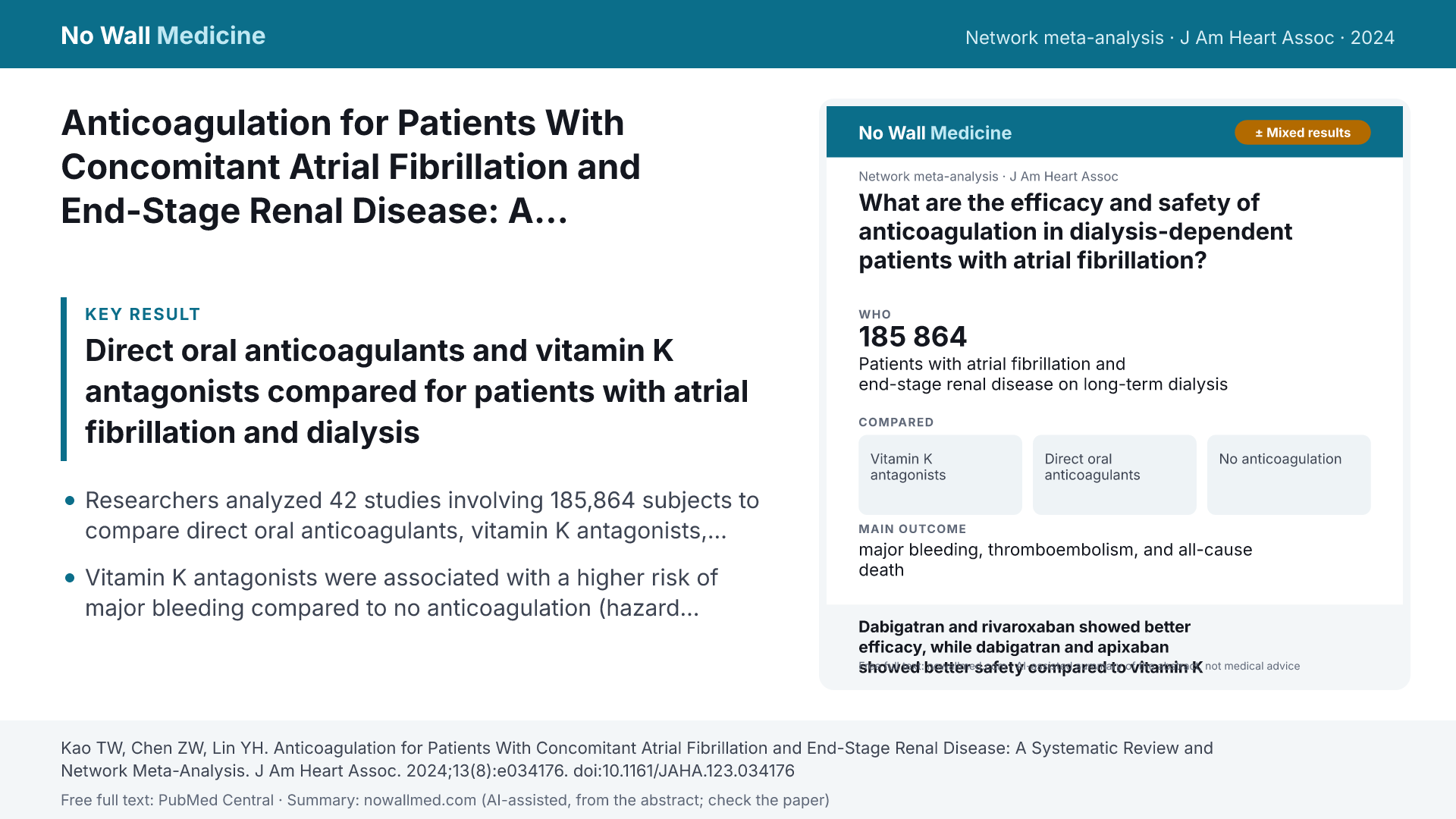
Direct oral anticoagulants and vitamin K antagonists compared for patients with atrial fibrillation and dialysis
Anticoagulation for Patients With Concomitant Atrial Fibrillation and End-Stage Renal Disease: A Systematic Review and Network Meta-Analysis
Network meta-analysisMixed results
What are the efficacy and safety of anticoagulation in dialysis-dependent patients with atrial fibrillation?
Who
185 864
Patients with atrial fibrillation and end-stage renal disease on long-term dialysis · MEDLINE, EMBASE, and the Cochrane Library
Compared
Vitamin K antagonists
Direct oral anticoagulants
No anticoagulation
Main outcome
major bleeding, thromboembolism, and all-cause death
Result: hazard ratio 0.74 (95% CI 0.64-0.84) for DOACs versus VKAs for major bleeding
Bottom line: Dabigatran and rivaroxaban showed better efficacy, while dabigatran and apixaban showed better safety compared to vitamin K antagonists.
J Am Heart Assoc · 2024-04-12Download image
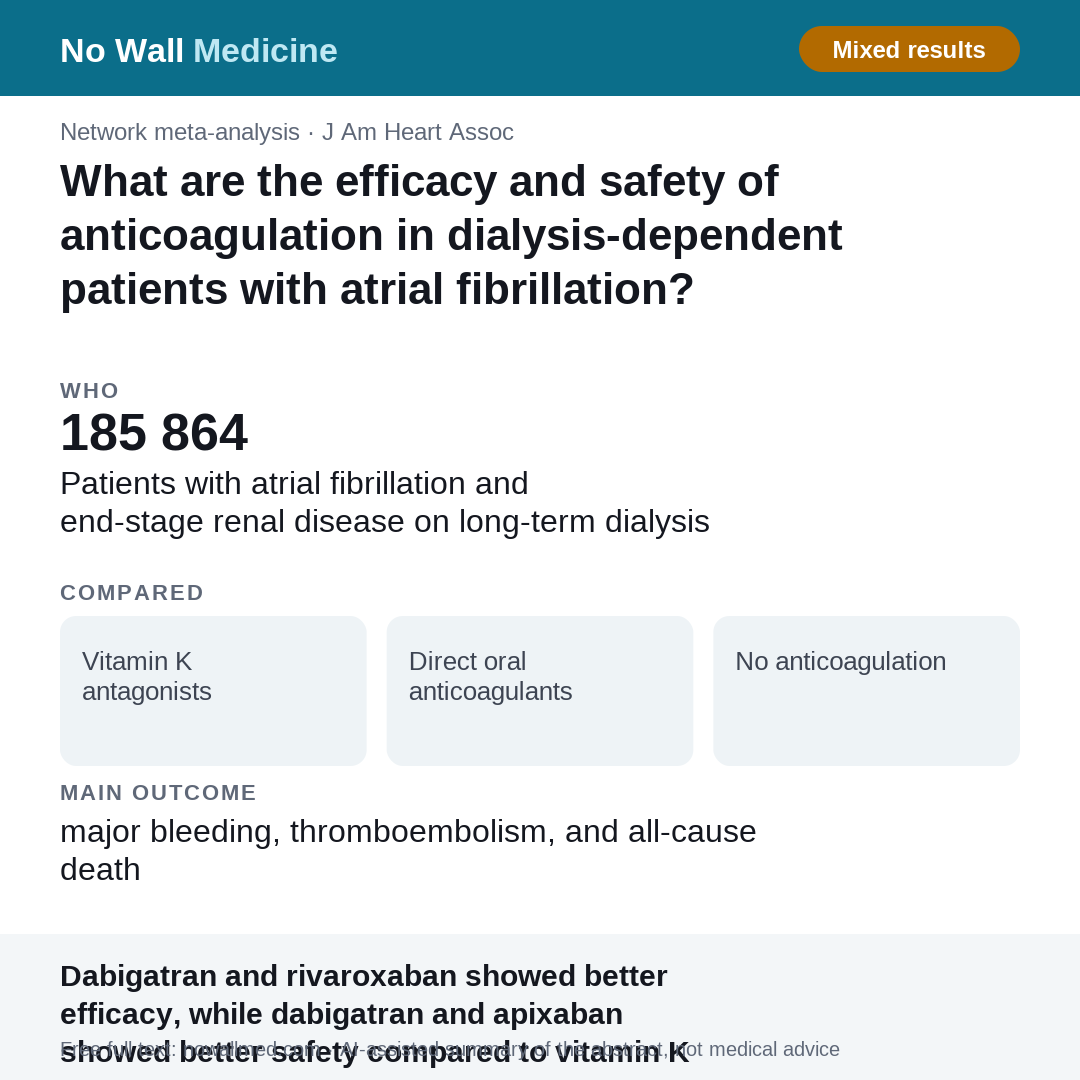
Clinical question: What are the efficacy and safety of anticoagulation in dialysis-dependent patients with atrial fibrillation?
Why it matters: The applicability of oral anticoagulants to prevent blood clots in patients undergoing long-term dialysis remains debatable.
Key points
- Researchers analyzed 42 studies involving 185,864 subjects to compare direct oral anticoagulants, vitamin K antagonists, and no anticoagulation in patients on dialysis.
- Vitamin K antagonists were associated with a higher risk of major bleeding compared to no anticoagulation (hazard ratio 1.47) or direct oral anticoagulants (hazard ratio 0.74).
- While dabigatran and rivaroxaban were associated with fewer embolic events, no differences in all-cause death were found between the treatment groups.
Headline and key points written with AI from the paper’s abstract, with every number checked against it. Read the paper before relying on them.
Was this summary helpful?
Subject terms
Cite this article
Kao TW, Chen ZW, Lin YH. Anticoagulation for Patients With Concomitant Atrial Fibrillation and End-Stage Renal Disease: A Systematic Review and Network Meta-Analysis. J Am Heart Assoc. 2024. doi:10.1161/JAHA.123.034176
Spotted a mistake? Suggest a correction