Anticoagulation for Patients With Concomitant Atrial Fibrillation and End-Stage Renal Disease: A Systematic Review and Network Meta-Analysis
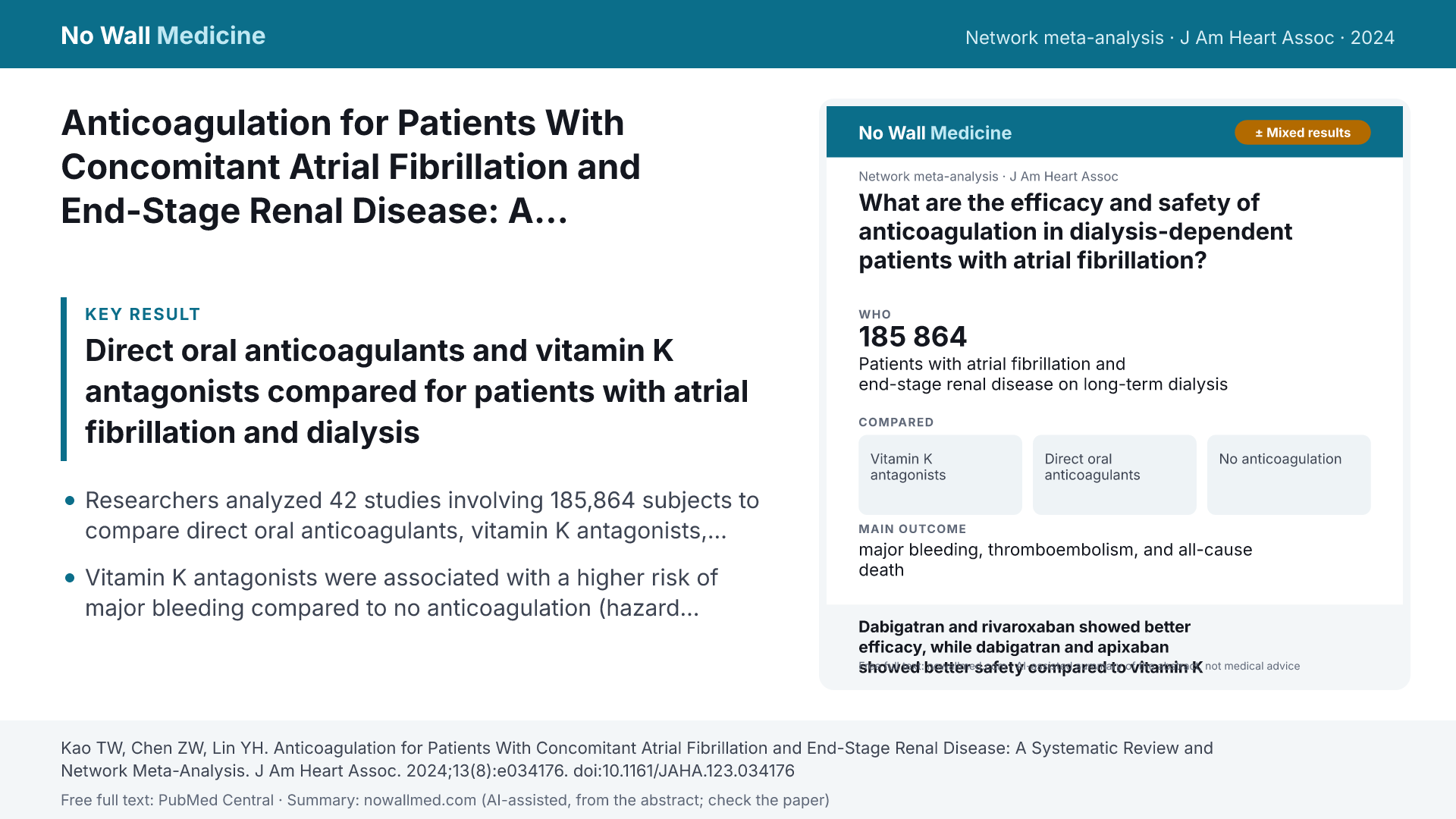
Key result: Direct oral anticoagulants and vitamin K antagonists compared for patients with atrial fibrillation and dialysis
Network meta-analysisMixed results
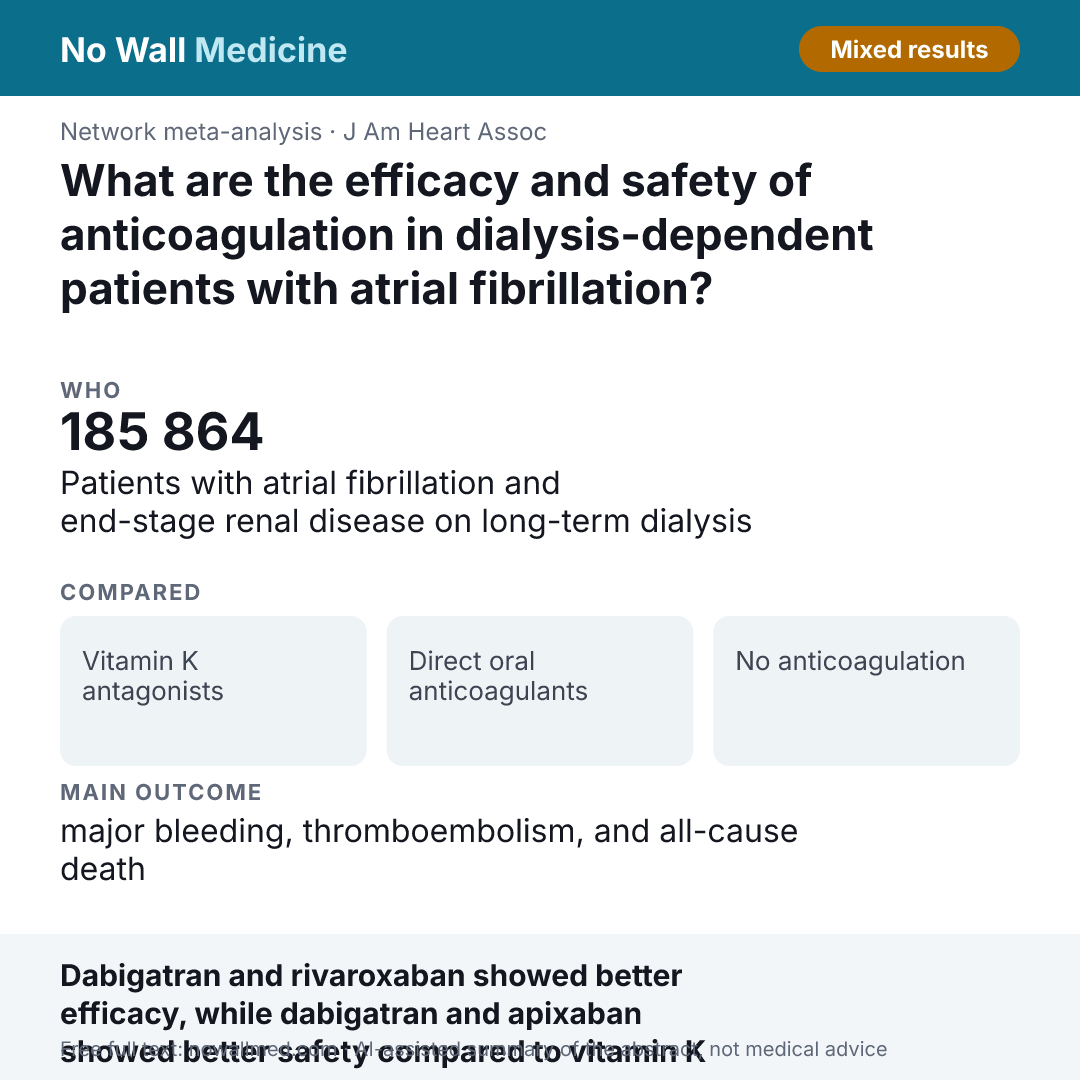
What are the efficacy and safety of anticoagulation in dialysis-dependent patients with atrial fibrillation?
Who
185 864
Patients with atrial fibrillation and end-stage renal disease on long-term dialysis · MEDLINE, EMBASE, and the Cochrane Library
Compared
Vitamin K antagonists
Direct oral anticoagulants
No anticoagulation
Main outcome
major bleeding, thromboembolism, and all-cause death
Result: hazard ratio 0.74 (95% CI 0.64-0.84) for DOACs versus VKAs for major bleeding
Bottom line: Dabigatran and rivaroxaban showed better efficacy, while dabigatran and apixaban showed better safety compared to vitamin K antagonists.
J Am Heart Assoc · 2024-04-12 · Save PNG
Key points
- Researchers analyzed 42 studies involving 185,864 subjects to compare direct oral anticoagulants, vitamin K antagonists, and no anticoagulation in patients on dialysis.
- Vitamin K antagonists were associated with a higher risk of major bleeding compared to no anticoagulation (hazard ratio 1.47) or direct oral anticoagulants (hazard ratio 0.74).
- While dabigatran and rivaroxaban were associated with fewer embolic events, no differences in all-cause death were found between the treatment groups.
Why it matters: The applicability of oral anticoagulants to prevent blood clots in patients undergoing long-term dialysis remains debatable.
Discussion prompts
- Would these patients look like yours? Who was left out?
- Is the main outcome one that matters to patients?
- Is the difference large enough to change what you do?
Cite: Kao TW, Chen ZW, Lin YH. Anticoagulation for Patients With Concomitant Atrial Fibrillation and End-Stage Renal Disease: A Systematic Review and Network Meta-Analysis. J Am Heart Assoc. 2024;13(8):e034176. doi:10.1161/JAHA.123.034176
Free full text: PubMed Central · Summary and visual abstract: nowallmed.com/a/anticoagulation-for-patients-with-concomitant-atrial-fibrillation-and-1rtdopb/ (AI-assisted from the abstract; check the paper before relying on it).