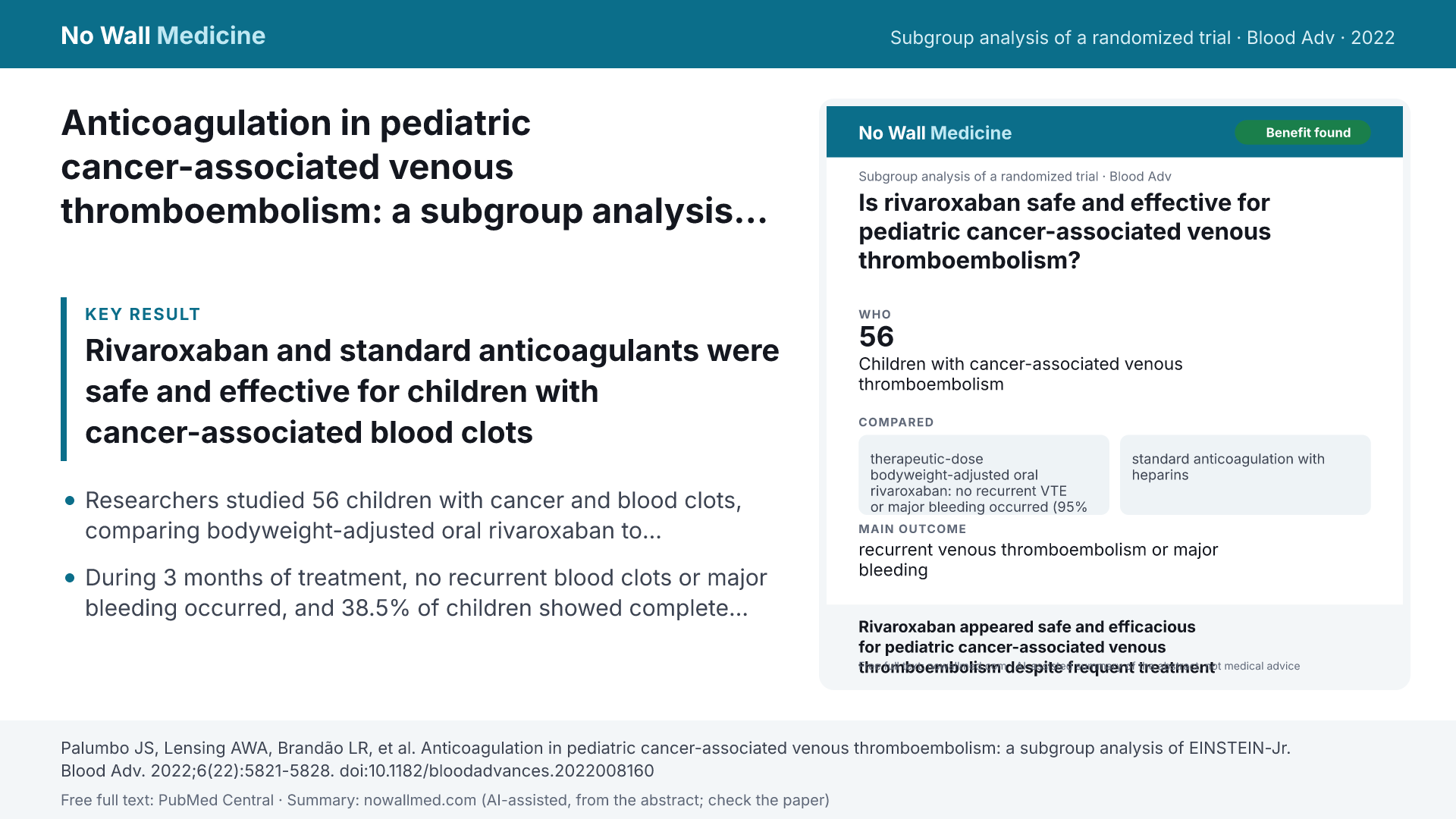
Rivaroxaban and standard anticoagulants were safe and effective for children with cancer-associated blood clots
Anticoagulation in pediatric cancer-associated venous thromboembolism: a subgroup analysis of EINSTEIN-Jr
Subgroup analysis of a randomized trialBenefit found
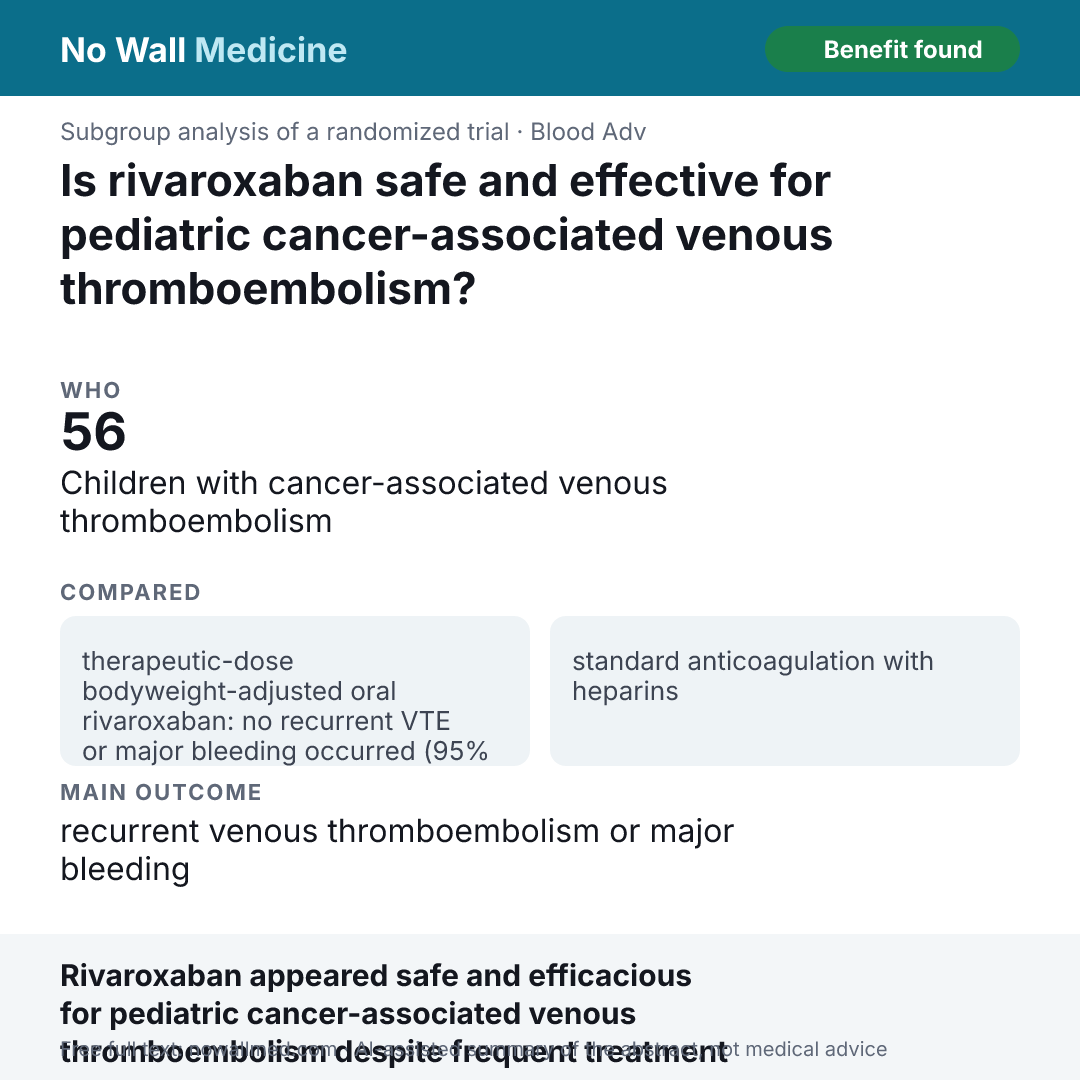
Is rivaroxaban safe and effective for pediatric cancer-associated venous thromboembolism?
Who
56
Children with cancer-associated venous thromboembolism
Compared
therapeutic-dose bodyweight-adjusted oral rivaroxaban: no recurrent VTE or major bleeding occurred (95% confidence interval, 0.0%-6.4%)
standard anticoagulation with heparins
Main outcome
recurrent venous thromboembolism or major bleeding
Bottom line: Rivaroxaban appeared safe and efficacious for pediatric cancer-associated venous thromboembolism despite frequent treatment interruptions.
Blood Adv · 2022-08-26 · Save PNG
Same trial (NCT02234843)
Papers we list that report this registered trial, oldest first. Read a secondary analysis alongside the main results.
- Main results
Rivaroxaban showed similar safety and efficacy to standard anticoagulants for pediatric cerebral venous thrombosis Blood Adv 2020-12 - Secondary analysis Benefit found
This paper Blood Adv 2022-08
Clinical question: Is rivaroxaban safe and effective for pediatric cancer-associated venous thromboembolism?
Why it matters: The management of blood clots in children with cancer is often difficult due to drug interactions and frequent treatment interruptions.
Key points
- Researchers studied 56 children with cancer and blood clots, comparing bodyweight-adjusted oral rivaroxaban to standard heparin or vitamin K antagonist treatments.
- During 3 months of treatment, no recurrent blood clots or major bleeding occurred, and 38.5% of children showed complete vein recanalization.
- Anticoagulant treatment was interrupted 70 times in 46.4% of children, but resuming therapy was not associated with new clots or bleeding.
Headline and key points written with AI from the paper’s abstract, with every number checked against it. Read the paper before relying on them.
Was this summary helpful?
Abstract
Anticoagulant treatment of pediatric cancer-associated venous thromboembolism (VTE) has not been prospectively evaluated. Management of anticoagulation for cancer-associated VTE is often challenged by drug interactions and treatment interruptions. A total of 56 of the 500 children (11.2%) with VTE who participated in the recent EINSTEIN-Jr randomized study had cancer (hematologic malignancy, 64.3%, solid malignant tumor, 35.7%). Children were allocated to either therapeutic-dose bodyweight-adjusted oral rivaroxaban (n=40) or standard anticoagulation with heparins, with or without vitamin K antagonists (n=16) and received a median of 30 concomitant medications. Based on sparse blood sampling at steady-state, pharmacokinetic (PK) parameters of rivaroxaban were derived using population PK modeling. During the 3 months of treatment, no recurrent VTE or major bleeding occurred (95% confidence interval, 0.0%-6.4%), and 3-month repeat imaging showed complete or partial vein recanalization in 20 and 24 of 52 evaluable children (38.5% and 46.2%, respectively). Anticoagulant treatment was interrupted 70 times in 26 (46.4%) children because of thrombocytopenia, invasive procedures, or adverse events, for a mean individual period of 5.8 days. Anticoagulant therapy was resumed in therapeutic doses and was not associated with thrombotic or bleeding complications. Rivaroxaban exposures were within the adult exposure range and similar to those observed in children with VTE who did not have cancer-associated VTE. Rivaroxaban and standard anticoagulants appeared safe and efficacious and were associated with reduced clot burden in most children with cancer-associated VTE, including those who had anticoagulant treatment interruptions. Rivaroxaban exposures were within the adult exposure range despite significant polypharmacy use. This trial was registered at www.clinicaltrials.gov as #NCT02234843.
Abstract reproduced under the article’s CC BY NC ND licence.
Subject terms
Headline, design, result, key points, caveat and citation as plain text.
Cite this article
Palumbo JS, Lensing AWA, Brandão LR, et al. Anticoagulation in pediatric cancer-associated venous thromboembolism: a subgroup analysis of EINSTEIN-Jr. Blood Adv. 2022;6(22):5821-5828. doi:10.1182/bloodadvances.2022008160
Spotted a mistake? Suggest a correction