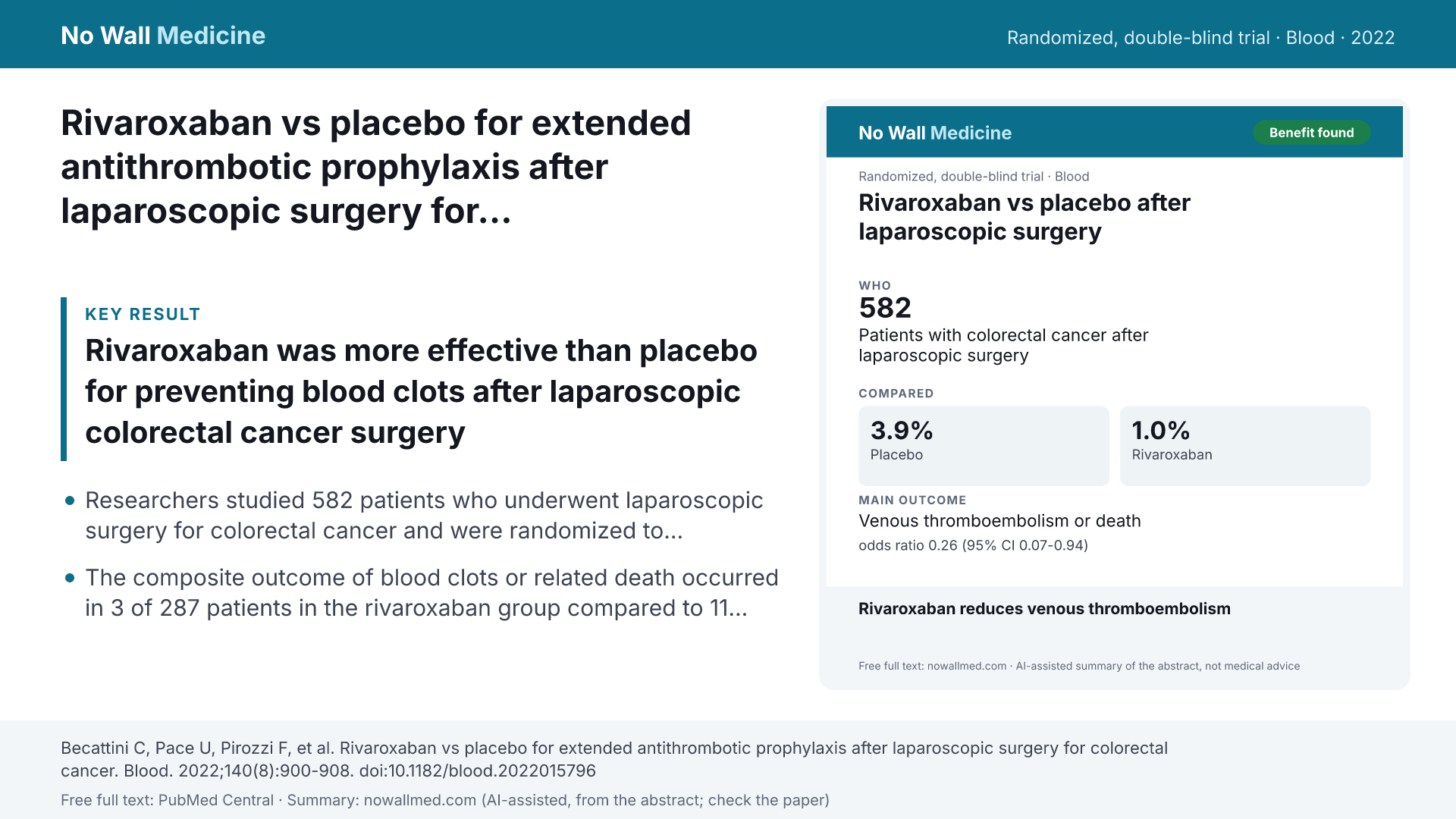
Rivaroxaban was more effective than placebo for preventing blood clots after laparoscopic colorectal cancer surgery
Rivaroxaban vs placebo for extended antithrombotic prophylaxis after laparoscopic surgery for colorectal cancer
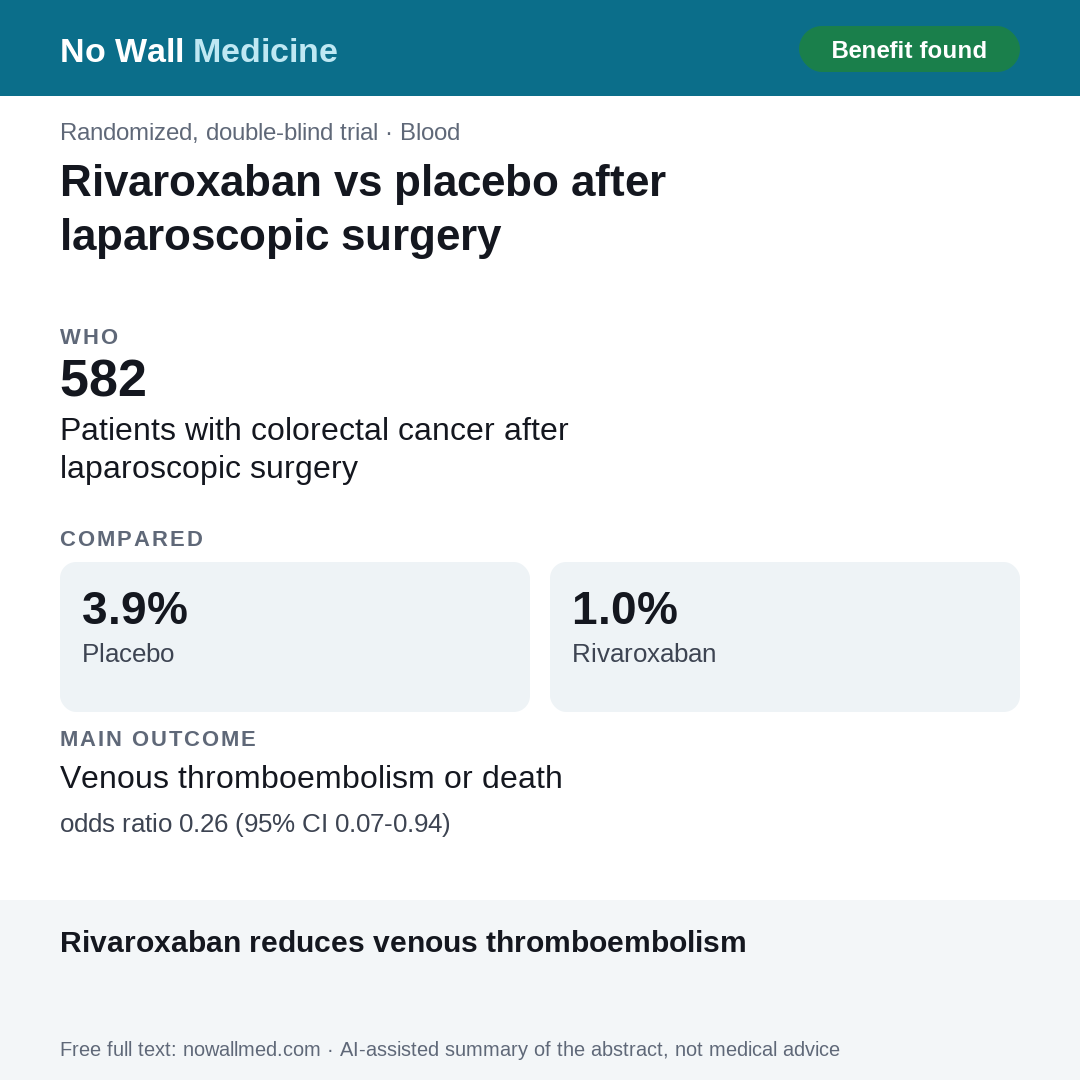
Randomized, double-blind trialBenefit found
Rivaroxaban vs placebo after laparoscopic surgery
Who
582
Patients with colorectal cancer after laparoscopic surgery
Compared
3.9%Placebo (11/282)
1.0%Rivaroxaban (3/287)
Main outcome
Venous thromboembolism or death
Result: odds ratio 0.26 (95% CI 0.07-0.94)
Bottom line: Rivaroxaban reduces venous thromboembolism
Blood · 2022-05-18Download image
Why it matters: The clinical benefit of extended prevention of venous thromboembolism, or blood clots, after laparoscopic surgery for cancer is unclear.
In absolute numbers
Placebo: 3.9% · Rivaroxaban: 1% → a difference of 2.9 percentage points, so about 35 people would need the treatment for 1 more to benefit (number needed to treat) over the trial’s follow-up.
Worked out by us from the two group results above, not reported by the authors. Check the paper for the exact outcome and timing.
Key points
- Researchers studied 582 patients who underwent laparoscopic surgery for colorectal cancer and were randomized to receive either 10 mg of rivaroxaban once daily or a placebo.
- The composite outcome of blood clots or related death occurred in 3 of 287 patients in the rivaroxaban group compared to 11 of 282 in the placebo group (1.0% vs 3.9%).
- Major bleeding occurred in 2 patients in the rivaroxaban group (0.7%) and 0 patients in the placebo group.
Headline and key points written with AI from the paper’s abstract, with every number checked against it. Read the paper before relying on them.
Was this summary helpful?
Subject terms
Cite this article
Becattini C, Pace U, Pirozzi F, et al. Rivaroxaban vs placebo for extended antithrombotic prophylaxis after laparoscopic surgery for colorectal cancer. Blood. 2022. doi:10.1182/blood.2022015796
Spotted a mistake? Suggest a correction