Researchers developed a digital tool to help balance side-effects when prescribing antidepressants and antipsychotics
Antidepressant and antipsychotic side-effects and personalised prescribing: a systematic review and digital tool development
Umbrella review and digital tool developmentBenefit found
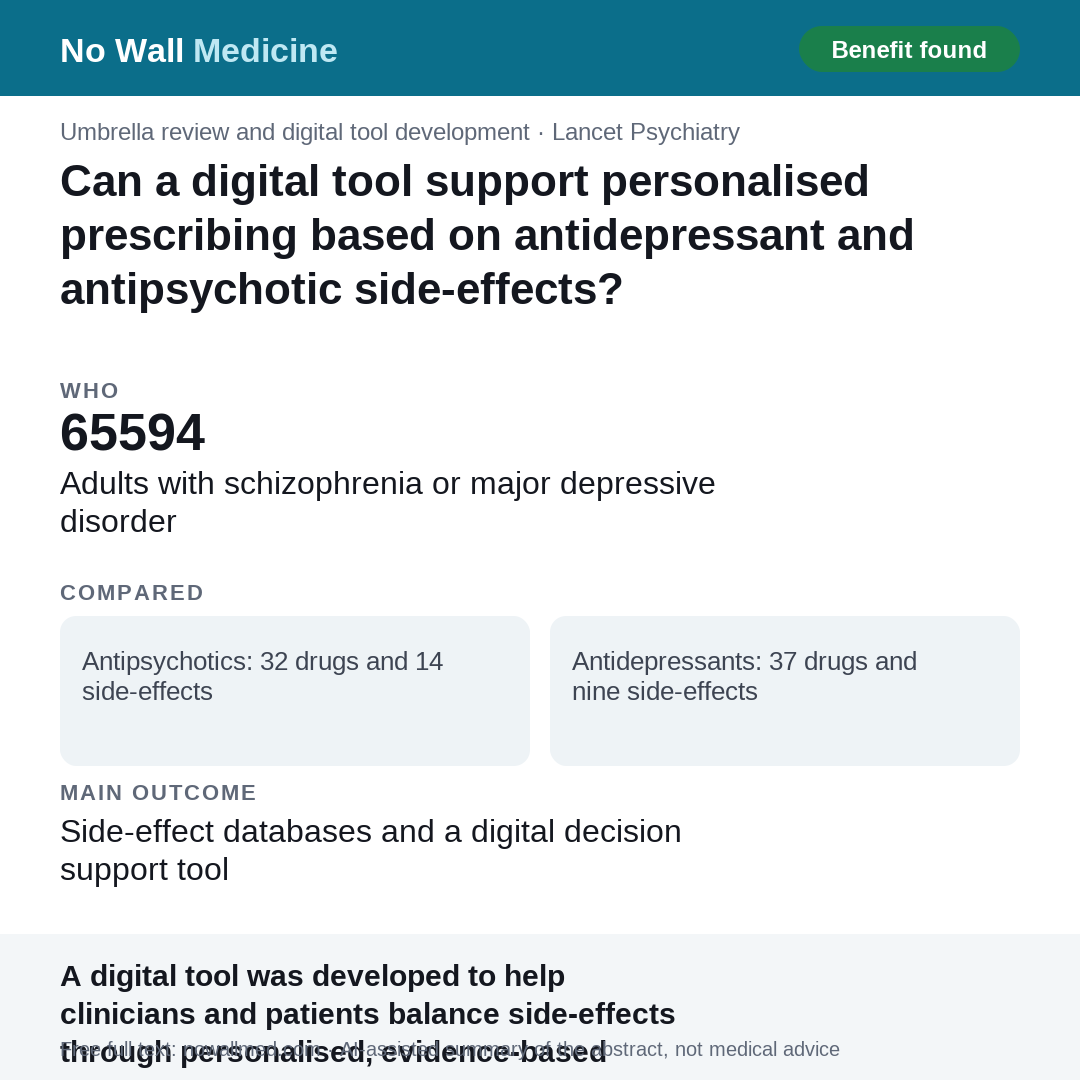
Can a digital tool support personalised prescribing based on antidepressant and antipsychotic side-effects?
Who
65594
Adults with schizophrenia or major depressive disorder
Compared
Antipsychotics: 32 drugs and 14 side-effects
Antidepressants: 37 drugs and nine side-effects
Main outcome
Side-effect databases and a digital decision support tool
Bottom line: A digital tool was developed to help clinicians and patients balance side-effects through personalised, evidence-based prescribing decisions.
Funded by: National Institute for Health and Care Research, Maudsley Charity, Wellcome Trust, Medical Research Council
Lancet Psychiatry · 2023-09-26Download image
Clinical question: Can a digital tool support personalised prescribing based on antidepressant and antipsychotic side-effects?
Why it matters: A synthesis of antidepressant and antipsychotic side-effects to guide clinical decision-making is missing, making it difficult to balance complex, multidimensional side-effect profiles.
Key points
- Researchers reviewed 14 articles containing 68 meta-analyses and 19 guidelines to create databases for 32 antipsychotics and 37 antidepressants.
- The databases showed that avoiding one side-effect, such as weight gain for antipsychotics, was associated with an increased risk of others, such as akathisia.
- The Psymatik Treatment Optimizer uses a multicriteria decision analysis method to rank treatments based on individual user concerns and side-effect data.
Headline and key points written with AI from the paper’s abstract, with every number checked against it. Read the paper before relying on them.
Abstract
Background
Side-effects of psychiatric medication impair quality of life and functioning. Furthermore, they contribute to morbidity, mortality, stigma, and poor treatment concordance resulting in relapse of psychiatric illness. Guidelines recommend discussing side-effects with patients when making treatment decisions, but a synthesis of antidepressant and antipsychotic side-effects to guide this process is missing, and considering all side-effects is a complex, multidimensional process. We aimed to create comprehensive databases of antipsychotic and antidepressant side-effects, and a digital tool to support database navigation. Methods
To create the databases, we did an umbrella review of Embase, PsycINFO, and MEDLINE from database inception to June 26, 2023. We included meta-analyses of randomised controlled trials examining antipsychotic monotherapy in the treatment of schizophrenia or antidepressant monotherapy in the treatment of major depressive disorder. We included meta-analyses in adults (aged ≥18 years) that assessed drugs with a common comparator. The search was complemented by a review of national and international guidelines and consensus statements for the treatment of major depressive disorder and schizophrenia in adults. Effect sizes for antipsychotic and antidepressant side-effects were extracted from meta-analyses examining the largest number of drugs. In cases of incomplete meta-analytic coverage, data were imputed on the basis of guideline-derived ordinal rankings or, if imputation was not possible, ordinal scores were extracted. Both meta-analytic and ordinal outcomes were normalised to provide values between 0 and 1. We then constructed a digital tool, the Psymatik Treatment Optimizer, to combine the side-effect databases with side-effect concerns of an individual user, to enable users to select side-effects of concern and the relative degree of concern for each side-effect. Concern weightings and the side-effect databases are synthesised via a multicriteria decision analysis method (technique for order of preference by similarity to ideal situation, or TOPSIS). Findings
Of 3724 citations, 14 articles containing 68 meta-analyses of individual side-effects met inclusion criteria. After review of 19 guidelines, seven provided ordinal data. Antipsychotic data were extracted from five studies (11 meta-analyses, n=65 594 patients) and four guidelines, and antidepressant data were extracted from three guidelines. The resultant databases included data on 32 antipsychotics (14 side-effects) and 37 antidepressants (nine side-effects). The databases highlighted the clinical dilemma associated with balancing side-effects, with avoidance of one side-effect (eg, weight gain for antipsychotics) increasing the risk of others (eg, akathisia). To aid with this dilemma, the Psymatik Treatment Optimizer synthesises the side-effect databases with individual user-defined concern weights. After computing up to 5851 pairwise comparisons for antidepressants and 5142 pairwise comparisons for antipsychotics, Psymatik ranks treatments in order of preference for the individual user, with the output presented in a heatmap. Interpretation
By facilitating collaborative, personalised, and evidence-based prescribing decisions, the side-effect databases and digital application supports care delivery that is consistent with international regulatory guidance for the treatment of schizophrenia and depression, and it therefore has promise for informing psychiatric practice and improving outcomes. Funding
National Institute for Health and Care Research, Maudsley Charity, Wellcome Trust, Medical Research Council.
Abstract reproduced under the article’s CC BY licence.
Topics
Cite this article
Pillinger T, Howes OD, Correll CU, Leucht S, Huhn M, Schneider-Thoma J. Antidepressant and antipsychotic side-effects and personalised prescribing: a systematic review and digital tool development. Lancet Psychiatry. 2023. doi:10.1016/S2215-0366(23)00262-6
Spotted a mistake? Suggest a correction
Top studies every Monday
The week’s key trials and guidelines in your specialties, plus any topics you follow. By email, free.
Get the weekly digest