Adding oral antihistamines provides clinically unimportant reductions in eczema severity and itch
Antihistamines for atopic dermatitis (eczema): systematic review and network meta-analysis of randomised trials
DermatologyAdult and pediatric
Systematic review and network meta-analysis of randomised trialsNo clear difference
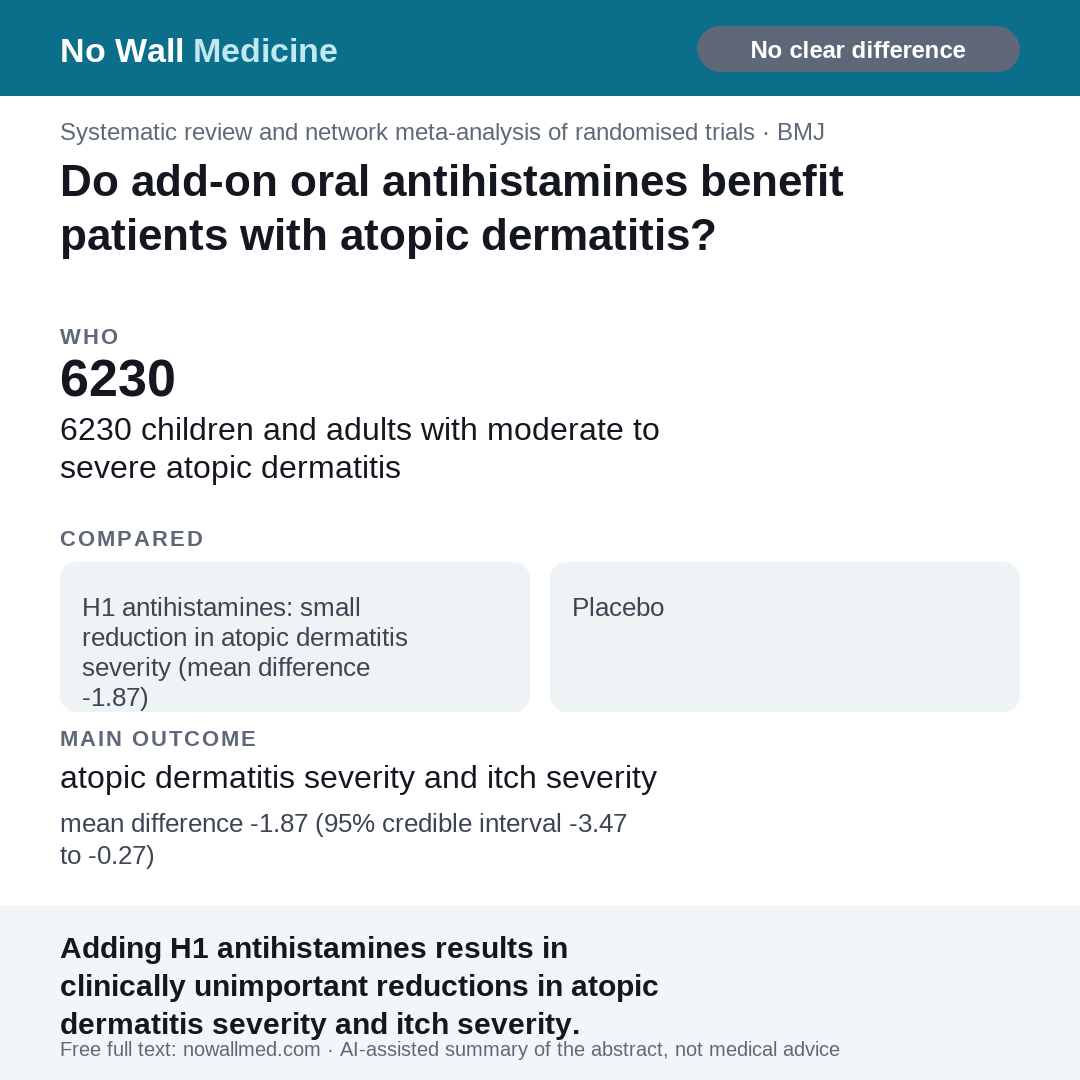
Do add-on oral antihistamines benefit patients with atopic dermatitis?
Who
6230
6230 children and adults with moderate to severe atopic dermatitis
Compared
H1 antihistamines: small reduction in atopic dermatitis severity (mean difference -1.87)
Placebo
Main outcome
atopic dermatitis severity and itch severity
Result: mean difference -1.87 (95% credible interval -3.47 to -0.27)
Bottom line: Adding H1 antihistamines results in clinically unimportant reductions in atopic dermatitis severity and itch severity.
Limitation: Effects are well below established minimal important differences.
BMJ · 2026-07-29Download image
Clinical question: Do add-on oral antihistamines benefit patients with atopic dermatitis?
Why it matters: Clinicians need to know if adding oral antihistamines to eczema management provides meaningful benefits for patients.
Key points
- Researchers analyzed 47 trials involving 6230 children and adults with moderate to severe atopic dermatitis, or eczema.
- Adding first or second generation H1 antihistamines resulted in small reductions in eczema severity and itch, but these changes were below the minimal important difference.
- First generation antihistamines likely increase cognitive impairment and may increase treatment discontinuation due to adverse events.
Headline and key points written with AI from the paper’s abstract, with every number checked against it. Read the paper before relying on them.
Abstract
Objective
To systematically synthesise the benefits and harms of add-on oral antihistamines for managing atopic dermatitis (eczema). Design
Systematic review and network meta-analysis of randomised trials. Data sources
Medline, Embase, CENTRAL, the United States Food and Drug Administration, and the European Medicines Agency databases from database inception to 5 May 2025. Study selection
Randomised trials assessing add-on oral H1 antihistamines, H2 blockers, mast cell stabilisers (nedocromil sodium and sodium cromoglycate), or their combinations. Paired reviewers independently screened records, extracted data, and assessed risk of bias using a modified Cochrane Risk of Bias tool version 2. Methods
Random effects bayesian meta-analyses synthesised atopic dermatitis severity (oSCORAD-objective scoring atopic dermatitis, 0-83; minimal important difference 8.2; lower better), itch severity (numerical rating scale, 0-10; minimal important difference 3; lower better), sleep disturbance, atopic dermatitis related quality of life, and harms. The network meta-analysis GRADE (Grading of Recommendations Assessment, Development and Evaluation) and Core GRADE approaches informed certainty of evidence ratings. Results
47 trials enrolled 6230 children and adults with primarily moderate to severe atopic dermatitis. With moderate certainty, compared with placebo, adding a first generation or second generation H1 antihistamine likely resulted in a small reduction in atopic dermatitis severity (mean difference -1.87, 95% credible interval -3.47 to -0.27) and itch severity (-0.89, -1.41 to -0.37). Although statistically detectable, these effects are well below established minimal important differences (smallest change in an outcome that a patient would identify as important). With low certainty, all studied interventions may not improve sleep disturbance or reduce atopic dermatitis exacerbations. First generation agents probably increase cognitive impairment and may increase treatment discontinuation because of adverse events (risk difference 66 more per 1000, 95% credible interval 0 to 231 more; moderate certainty). Second generation agents differ in their risk of cognitive impairment (range of mean effects 0 more per 1000 for loratadine, 16 more per 1000 for levocetirizine, and 17 more per 1000 for cetirizine). Conclusions
Among patients with atopic dermatitis, adding H1 antihistamines probably results in a clinically unimportant reduction in atopic dermatitis severity and itch severity, and may not reduce sleep disturbance or atopic dermatitis exacerbations. First generation agents increase cognitive impairment and may increase treatment discontinuation because of adverse events. Cognitive impairment risk differs among second generation agents. These findings provide evidence against routine antihistamine use in atopic dermatitis management and will inform updated clinical guidelines. Systematic review registration
PROSPERO CRD42022345643.
Abstract reproduced under the article’s CC BY NC licence.
Topics
Cite this article
Chu AWL, Wen A, Guyatt GH, Rao M, Bakaa L, Zhao IX. Antihistamines for atopic dermatitis (eczema): systematic review and network meta-analysis of randomised trials. BMJ. 2026. doi:10.1136/bmj-2026-100163
Spotted a mistake? Suggest a correction