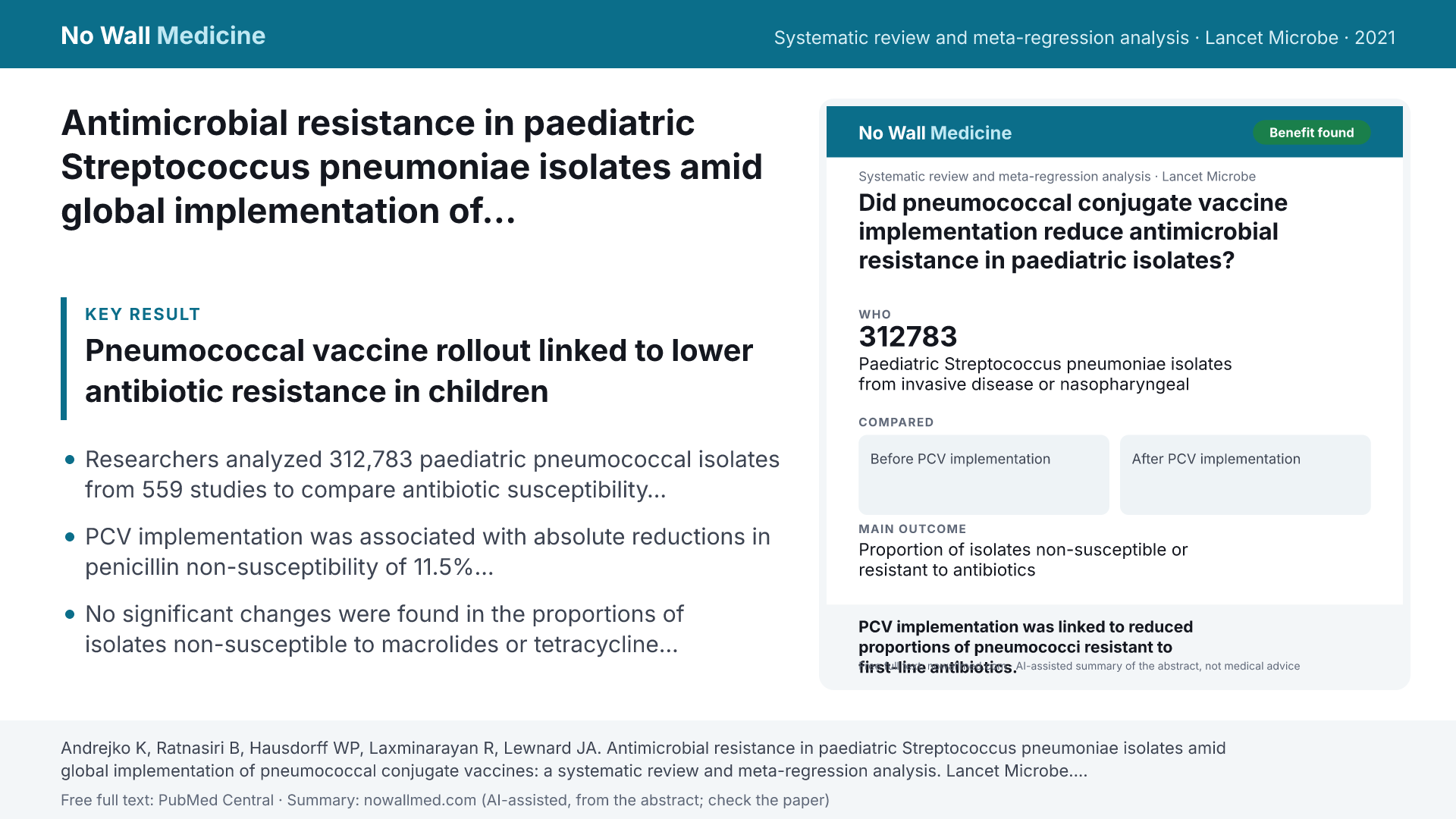
Pneumococcal conjugate vaccine implementation was associated with reduced antibiotic resistance in paediatric isolates
Antimicrobial resistance in paediatric Streptococcus pneumoniae isolates amid global implementation of pneumococcal conjugate vaccines: a systematic review and meta-regression analysis
Systematic review and meta-regression analysisBenefit found
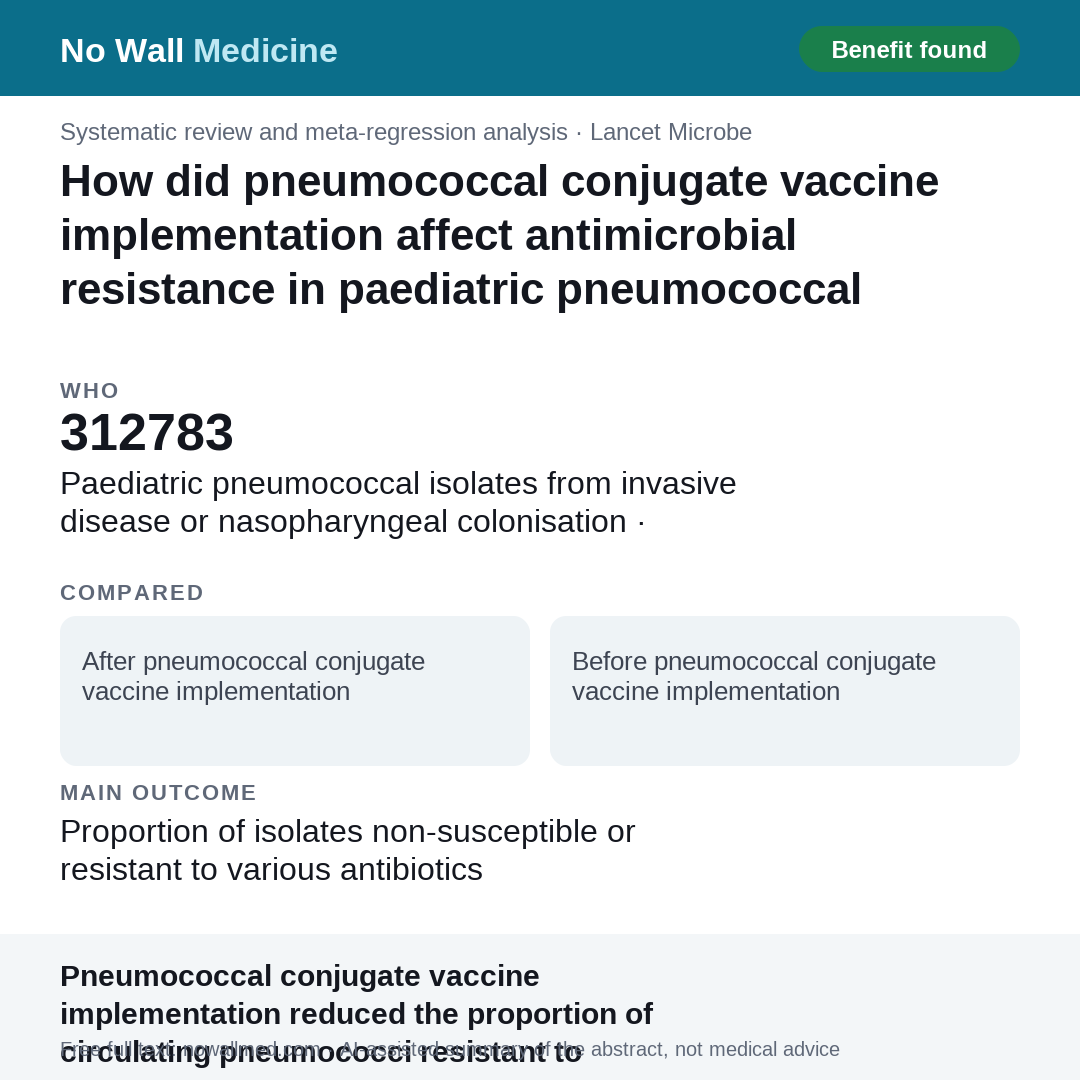
How did pneumococcal conjugate vaccine implementation affect antimicrobial resistance in paediatric pneumococcal isolates?
Who
312783
Paediatric pneumococcal isolates from invasive disease or nasopharyngeal colonisation · Global
Compared
After pneumococcal conjugate vaccine implementation
Before pneumococcal conjugate vaccine implementation
Main outcome
Proportion of isolates non-susceptible or resistant to various antibiotics
Result: absolute reductions in penicillin non-susceptibility (11·5%, 95% CI 8·6-14·4)
Bottom line: Pneumococcal conjugate vaccine implementation reduced the proportion of circulating pneumococci resistant to first-line antibiotic treatments for pneumonia.
Funded by: Bill & Melinda Gates Foundation
Lancet Microbe · 2021-09-06Download image
Clinical question: How did pneumococcal conjugate vaccine implementation affect antimicrobial resistance in paediatric pneumococcal isolates?
Why it matters: It was unknown how the global deployment of pneumococcal conjugate vaccines affects the susceptibility of paediatric pneumococcal isolates to various antimicrobial drugs.
Key points
- Researchers analyzed 559 studies involving 312,783 paediatric isolates to compare antibiotic susceptibility before and after vaccine deployment.
- The proportion of non-susceptible isolates decreased by 11.5% for penicillin, 9.7% for sulfamethoxazole-trimethoprim, and 7.5% for third-generation cephalosporins.
- Resistance levels also fell for penicillin by 7.3%, sulfamethoxazole-trimethoprim by 16.0%, third-generation cephalosporins by 4.5%, macrolides by 3.6%, and tetracycline by 2.0%.
Headline and key points written with AI from the paper’s abstract, with every number checked against it. Read the paper before relying on them.
Was this summary helpful?
Abstract
Background
Pneumococcal diseases are a leading cause of morbidity and mortality among children globally, and the burden of these diseases might be worsened by antimicrobial resistance. To understand the effect of pneumococcal conjugate vaccine (PCV) deployment on antimicrobial resistance in pneumococci, we assessed the susceptibility of paediatric pneumococcal isolates to various antimicrobial drugs before and after PCV implementation. Methods
We did a systematic review of studies reporting antimicrobial susceptibility profiles of paediatric pneumococcal isolates between 2000 and 2020 using PubMed and the Antimicrobial Testing Leadership and Surveillance database (ATLAS; Pfizer). Population-based studies of invasive pneumococcal disease or nasopharyngeal colonisation were eligible for inclusion. As primary outcome measures, we extracted the proportions of isolates that were non-susceptible or resistant to penicillin, macrolides, sulfamethoxazole-trimethoprim, third-generation cephalosporins, and tetracycline from each study. Where available, we also extracted data on pneumococcal serotypes. We estimated changes in the proportion of isolates with reduced susceptibility or resistance to each antibiotic class using random-effects meta-regression models, adjusting for study-level and region-level heterogeneity, as well as secular trends, invasive or colonising isolate source, and countries' per-capita gross domestic product. Findings
From 4910 studies screened for inclusion, we extracted data from 559 studies on 312 783 paediatric isolates. Susceptibility of isolates varied substantially across regions both before and after implementation of any PCV product. On average across all regions, we estimated significant absolute reductions in the proportions of pneumococci showing non-susceptibility to penicillin (11·5%, 95% CI 8·6-14·4), sulfamethoxazole-trimethoprim (9·7%, 4·3-15·2), and third-generation cephalosporins (7·5%, 3·1-11·9), over the 10 years after implementation of any PCV product, and absolute reductions in the proportions of pneumococci resistant to penicillin (7·3%, 5·3-9·4), sulfamethoxazole-trimethoprim (16·0%, 11·0-21·2), third-generation cephalosporins (4·5%, 0·3-8·7), macrolides (3·6%, 0·7-6·6) and tetracycline (2·0%, 0·3-3·7). We did not find evidence of changes in the proportion of isolates non-susceptible to macrolides or tetracycline after PCV implementation. Observed changes in penicillin non-susceptibility were driven, in part, by replacement of vaccine-targeted serotypes with non-vaccine serotypes that were less likely to be non-susceptible. Interpretation
Implementation of PCVs has reduced the proportion of circulating pneumococci resistant to first-line antibiotic treatments for pneumonia. This effect merits consideration in assessments of vaccine impact and investments in coverage improvements. Funding
Bill & Melinda Gates Foundation.
Abstract reproduced under the article’s CC BY licence.
Subject terms
Cite this article
Andrejko K, Ratnasiri B, Hausdorff WP, Laxminarayan R, Lewnard JA. Antimicrobial resistance in paediatric Streptococcus pneumoniae isolates amid global implementation of pneumococcal conjugate vaccines: a systematic review and meta-regression analysis. Lancet Microbe. 2021. doi:10.1016/S2666-5247(21)00064-1
Spotted a mistake? Suggest a correction
Top studies every Monday
The week’s key trials and guidelines in your specialties, plus any topics you follow. By email, free.
Get the weekly digest