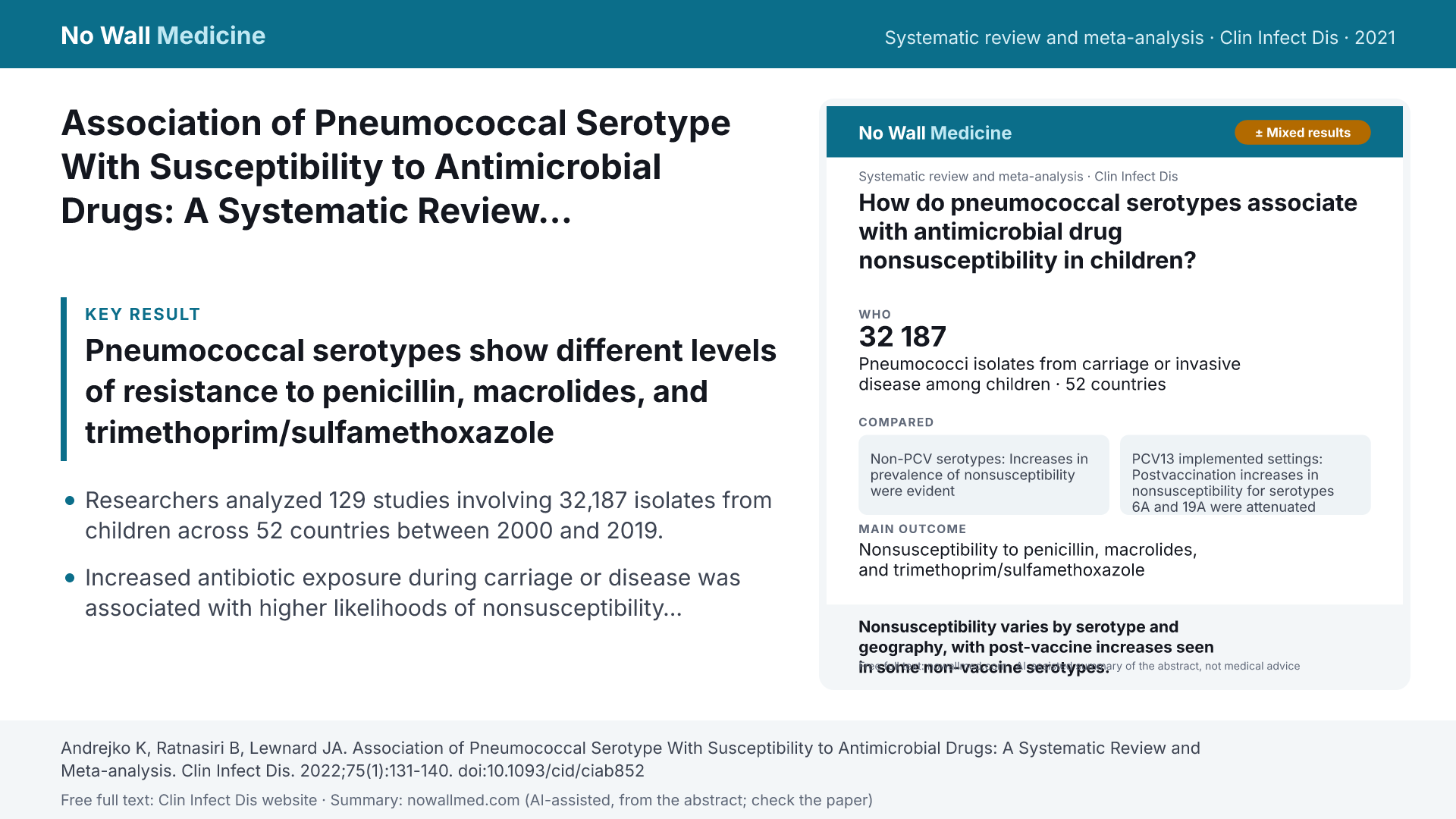
Pneumococcal serotypes show different levels of resistance to penicillin, macrolides, and trimethoprim/sulfamethoxazole
Association of Pneumococcal Serotype With Susceptibility to Antimicrobial Drugs: A Systematic Review and Meta-analysis
Systematic review and meta-analysisMixed results
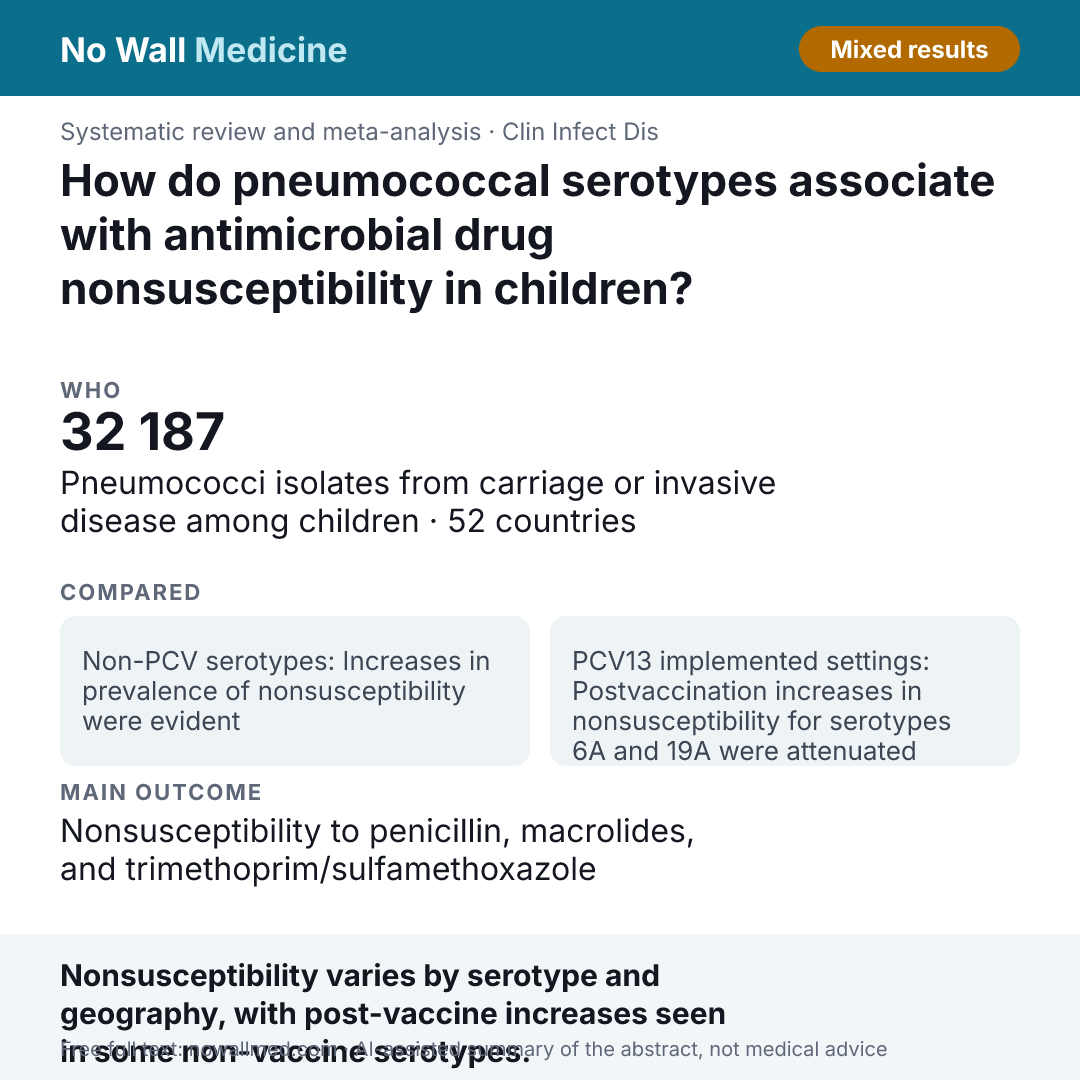
How do pneumococcal serotypes associate with antimicrobial drug nonsusceptibility in children?
Who
32 187
Pneumococci isolates from carriage or invasive disease among children · 52 countries
Compared
Non-PCV serotypes: Increases in prevalence of nonsusceptibility were evident
PCV13 implemented settings: Postvaccination increases in nonsusceptibility for serotypes 6A and 19A were attenuated
Main outcome
Nonsusceptibility to penicillin, macrolides, and trimethoprim/sulfamethoxazole
Bottom line: Nonsusceptibility varies by serotype and geography, with post-vaccine increases seen in some non-vaccine serotypes.
Clin Infect Dis · 2021-10-03 · Save PNG
Clinical question: How do pneumococcal serotypes associate with antimicrobial drug nonsusceptibility in children?
Why it matters: The patterns and causes of how different pneumococcal serotypes vary in their resistance to antimicrobial drugs were not comprehensively understood.
Key points
- Researchers analyzed 129 studies involving 32,187 isolates from children across 52 countries between 2000 and 2019.
- Increased antibiotic exposure during carriage or disease was associated with higher likelihoods of nonsusceptibility to penicillin, macrolides, and trimethoprim/sulfamethoxazole.
- Nonsusceptibility increased in certain non-vaccine serotypes like 6A, 6C, 15A, 15B/C, 19A, and 35B after vaccine implementation.
Headline and key points written with AI from the paper’s abstract, with every number checked against it. Read the paper before relying on them.
Was this summary helpful?
Subject terms
Headline, design, result, key points, caveat and citation as plain text.
Cite this article
Andrejko K, Ratnasiri B, Lewnard JA. Association of Pneumococcal Serotype With Susceptibility to Antimicrobial Drugs: A Systematic Review and Meta-analysis. Clin Infect Dis. 2022;75(1):131-140. doi:10.1093/cid/ciab852
Spotted a mistake? Suggest a correction