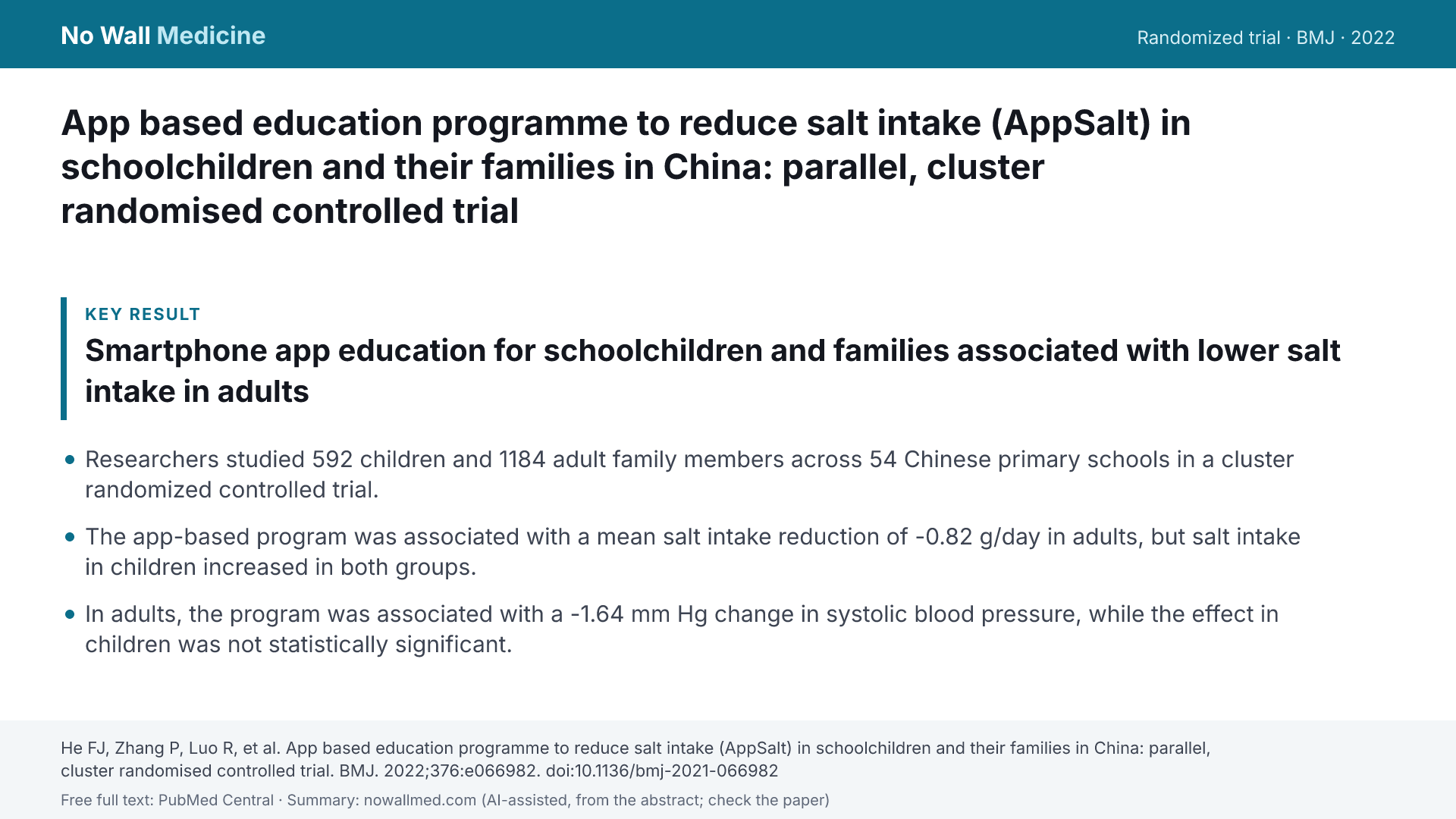
Smartphone app education for schoolchildren and families associated with lower salt intake in adults
App based education programme to reduce salt intake (AppSalt) in schoolchildren and their families in China: parallel, cluster randomised controlled trial
Same trial (ChiCTR1800017553)
Papers we list that report this registered trial, oldest first. Read a secondary analysis alongside the main results.
- Main results
This paper BMJ 2022-02 - Longer follow-up
Salt intake reduction in adults faded after 24 months following a school-based education program BMC Med 2025-01
Key points
- Researchers studied 592 children and 1184 adult family members across 54 Chinese primary schools in a cluster randomized controlled trial.
- The app-based program was associated with a mean salt intake reduction of -0.82 g/day in adults, but salt intake in children increased in both groups.
- In adults, the program was associated with a -1.64 mm Hg change in systolic blood pressure, while the effect in children was not statistically significant.
Headline and key points written with AI from the paper’s abstract, with every number checked against it. Read the paper before relying on them.
Was this summary helpful?
Abstract
Objective
To determine whether a smartphone application based education programme can lower salt intake in schoolchildren and their families. Design
Parallel, cluster randomised controlled trial, with schools randomly assigned to either intervention or control group (1:1). Setting
54 primary schools from three provinces in northern, central, and southern China, from 15 September 2018 to 27 December 2019. Participants
592 children (308 (52.0%) boys; mean age 8.58 (standard deviation 0.41) years) in grade 3 of primary school (about 11 children per school) and 1184 adult family members (551 (46.5%) men; mean age 45.80 (12.87) years). Intervention
Children in the intervention group were taught, with support of the app, about salt reduction and assigned homework to encourage their families to participate in activities to reduce salt consumption. Main outcome measures
Primary outcome was the difference in salt intake change (measured by 24 hour urinary sodium excretion) at 12 month follow-up, between the intervention and control groups. Results
After baseline assessment, 297 children and 594 adult family members (from 27 schools) were allocated to the intervention group, and 295 children and 590 adult family members (from 27 schools) were allocated to the control group. During the trial, 27 (4.6%) children and 112 (9.5%) adults were lost to follow-up, owing to children having moved to another school or adults unable to attend follow-up assessments. The remaining 287 children and 546 adults (from 27 schools) in the intervention group and 278 children and 526 adults (from 27 schools) in the control group completed the 12 month follow-up assessment. Mean salt intake at baseline was 5.5 g/day (standard deviation 1.9) in children and 10.0 g/day (3.5) in adults in the intervention group, and 5.6 g/day (2.1) in children and 10.0 g/day (3.6) in adults in the control group. During the study, salt intake of the children increased in both intervention and control groups but to a lesser extent in the intervention group (mean effect of intervention after adjusting for confounding factors -0.25 g/day, 95% confidence interval -0.61 to 0.12, P=0.18). In adults, salt intake decreased in both intervention and control groups but to a greater extent in the intervention group (mean effect -0.82 g/day, -1.24 to -0.40, P<0.001). The mean effect on systolic blood pressure was -0.76 mm Hg (-2.37 to 0.86, P=0.36) in children and -1.64 mm Hg (-3.01 to -0.27, P=0.02) in adults. Conclusions
The app based education programme delivered through primary school, using a child-to-parent approach, was effective in lowering salt intake and systolic blood pressure in adults, but the effects were not significant in children. Although this novel approach could potentially be scaled up to larger populations, the programme needs further strengthening to reduce salt intake across the whole population, including schoolchildren. Trial registration
Chinese Clinical Trial Registry ChiCTR1800017553.
Abstract reproduced under the article’s CC BY licence.
Subject terms
Headline, design, result, key points, caveat and citation as plain text.
Cite this article
He FJ, Zhang P, Luo R, et al. App based education programme to reduce salt intake (AppSalt) in schoolchildren and their families in China: parallel, cluster randomised controlled trial. BMJ. 2022;376:e066982. doi:10.1136/bmj-2021-066982
Spotted a mistake? Suggest a correction