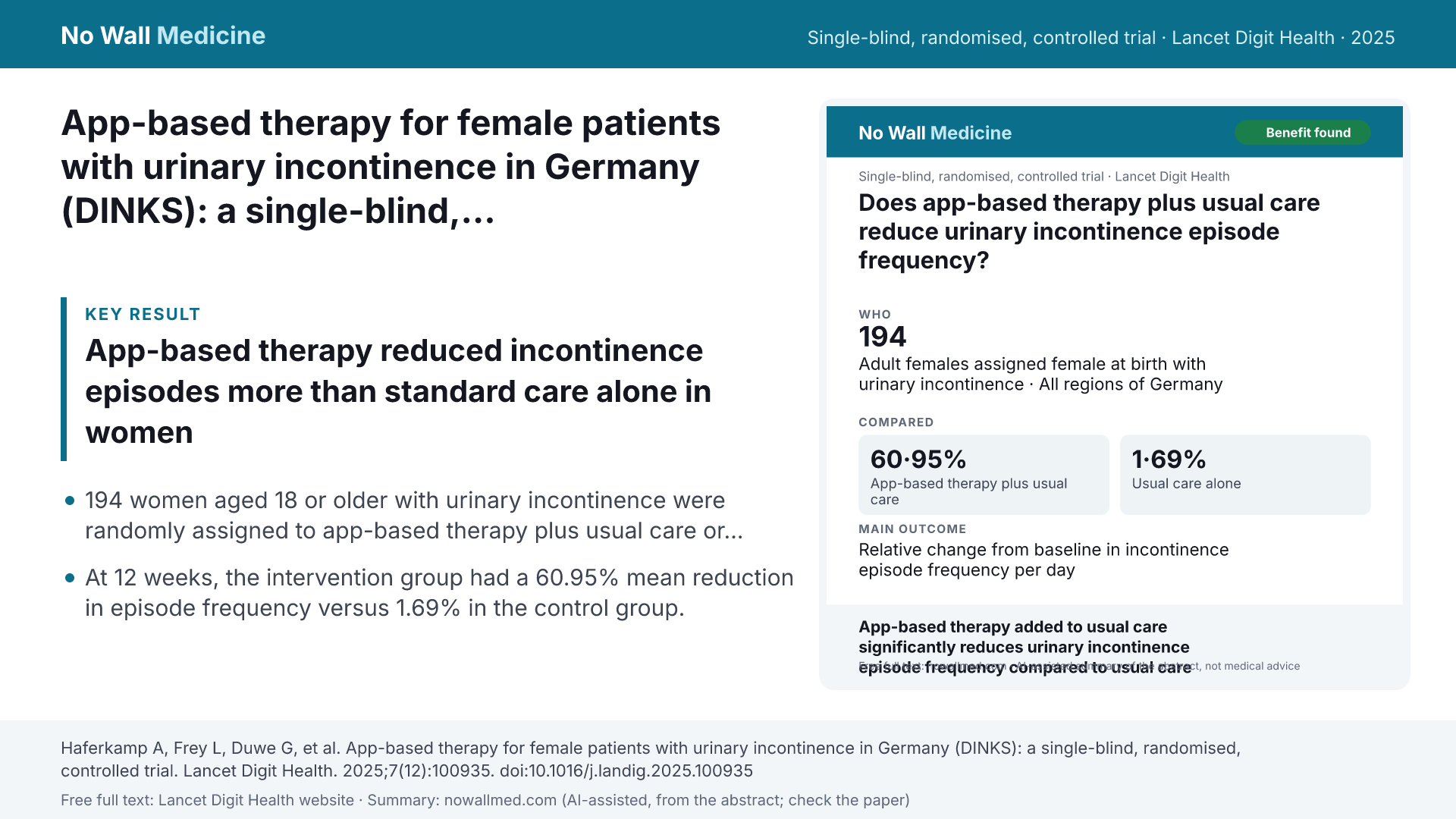
App-based therapy for female patients with urinary incontinence in Germany (DINKS): a single-blind, randomised, controlled trial
Key result: App-based therapy reduced incontinence episodes more than standard care alone in women
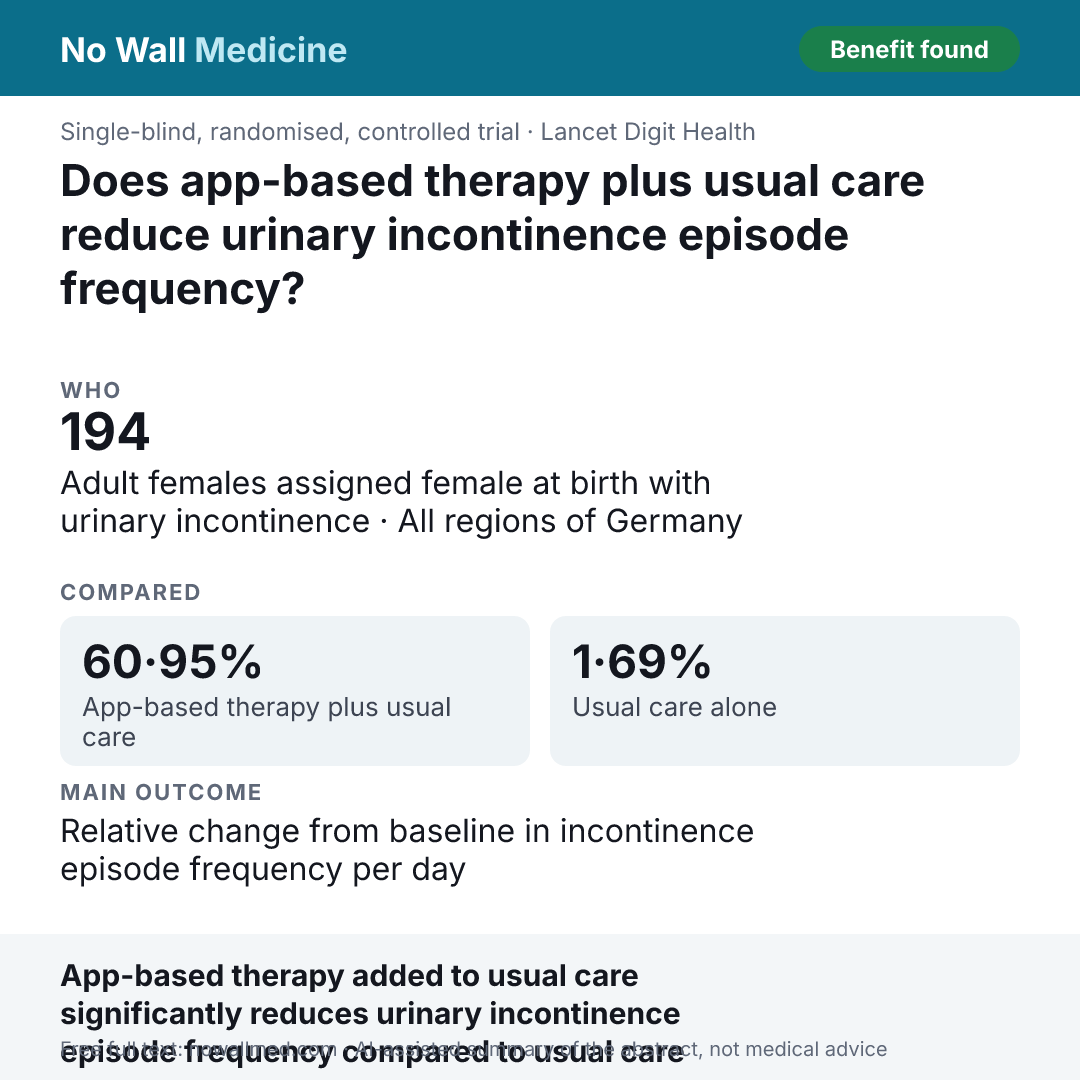
Single-blind, randomised, controlled trialBenefit found
Does app-based therapy plus usual care reduce urinary incontinence episode frequency?
Who
194
Adult females assigned female at birth with urinary incontinence · All regions of Germany
Compared
60·95%App-based therapy plus usual care (SD 44·32)
1·69%Usual care alone (43·75)
Main outcome
Relative change from baseline in incontinence episode frequency per day
Result: -59·2%, 95% CI -71·7 to -46·7
Bottom line: App-based therapy added to usual care significantly reduces urinary incontinence episode frequency compared to usual care alone.
Funded by: Kranus Health
Lancet Digit Health · 2025-12-16 · Save PNG
Key points
- 194 women aged 18 or older with urinary incontinence were randomly assigned to app-based therapy plus usual care or usual care alone.
- At 12 weeks, the intervention group had a 60.95% mean reduction in episode frequency versus 1.69% in the control group.
- The between-group difference was -59.2% (95% CI -71.7 to -46.7; p<0.0001), with no relevant treatment-related adverse events.
Why it matters: Conservative treatments for urinary incontinence are often underused despite guideline recommendations, leaving a gap in clinical practice.
Discussion prompts
- Would these patients look like yours? Who was left out?
- Is the main outcome one that matters to patients?
- Is the difference large enough to change what you do?
Cite: Haferkamp A, Frey L, Duwe G, et al. App-based therapy for female patients with urinary incontinence in Germany (DINKS): a single-blind, randomised, controlled trial. Lancet Digit Health. 2025;7(12):100935. doi:10.1016/j.landig.2025.100935
Free full text: Lancet Digit Health website · Summary and visual abstract: nowallmed.com/a/app-based-therapy-for-female-patients-with-urinary-incontinence-in-1s4oi5v/ (AI-assisted from the abstract; check the paper before relying on it).