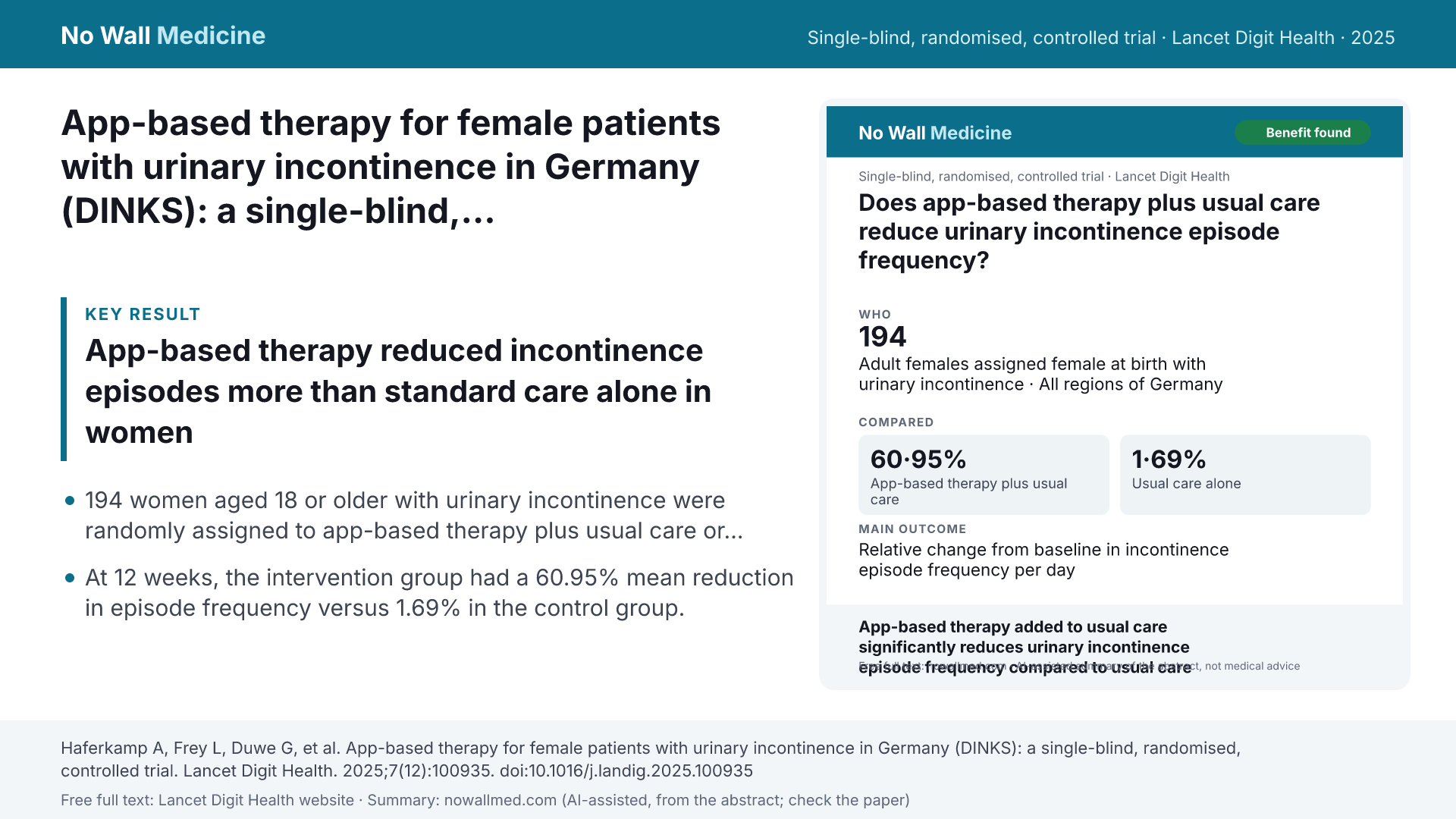
App-based therapy reduced urinary incontinence episode frequency more than standard care alone
App-based therapy for female patients with urinary incontinence in Germany (DINKS): a single-blind, randomised, controlled trial
Single-blind, randomised, controlled trialBenefit found
Does app-based therapy plus usual care reduce urinary incontinence episode frequency?
Who
194
Adult females assigned female at birth with urinary incontinence · All regions of Germany
Compared
60·95%App-based therapy plus usual care (SD 44·32)
1·69%Usual care alone (43·75)
Main outcome
Relative change from baseline in incontinence episode frequency per day
Result: -59·2%, 95% CI -71·7 to -46·7
Bottom line: App-based therapy added to usual care significantly reduces urinary incontinence episode frequency compared to usual care alone.
Funded by: Kranus Health
Lancet Digit Health · 2025-12-16Download image
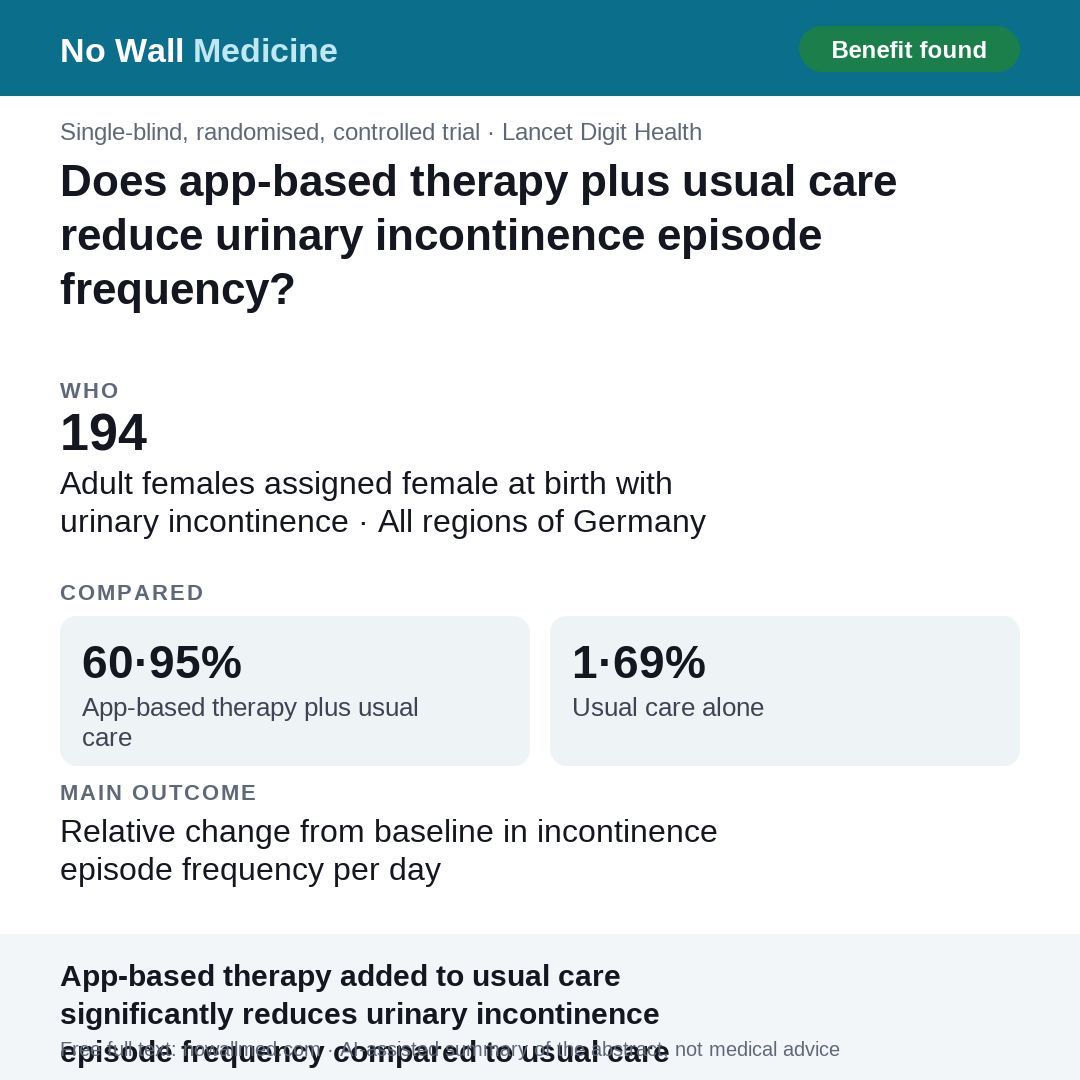
Clinical question: Does app-based therapy plus usual care reduce urinary incontinence episode frequency?
Why it matters: Conservative treatments for urinary incontinence are often underused despite being recommended in clinical guidelines.
Key points
- Researchers studied 194 female participants in Germany assigned to either an app-based therapy plus usual care or usual care alone.
- At week 12, the intervention group had a 60.95% mean relative reduction in incontinence episodes compared to a 1.69% reduction in the control group.
- No relevant treatment-related adverse events occurred during the study.
Headline and key points written with AI from the paper’s abstract, with every number checked against it. Read the paper before relying on them.
Was this summary helpful?
Subject terms
Cite this article
Haferkamp A, Frey L, Duwe G, et al. App-based therapy for female patients with urinary incontinence in Germany (DINKS): a single-blind, randomised, controlled trial. Lancet Digit Health. 2025. doi:10.1016/j.landig.2025.100935
Spotted a mistake? Suggest a correction