Pressure-mediated biofeedback improves outcomes for women with postpartum stress urinary incontinence
Pressure-Mediated Biofeedback With Pelvic Floor Muscle Training for Urinary Incontinence: A Randomized Clinical Trial
Multicenter assessor-blinded randomized clinical trialBenefit found
Does pressure-mediated biofeedback with pelvic floor muscle training improve urinary incontinence?
Who
452
Women with new-onset postpartum stress urinary incontinence · 5 participating tertiary hospitals in China
Compared
Pelvic floor muscle training with biofeedback: median 3.00 [IQR, 1.00-6.00] points reduction
Pelvic floor muscle training alone: median 2.00 [IQR, 0-4.00] points reduction
Main outcome
Severity of urinary incontinence
Bottom line: Adding a home-based pressure-mediated biofeedback device to pelvic floor muscle training improves incontinence severity and cure rates.
JAMA Netw Open · 2024-11-04Download image
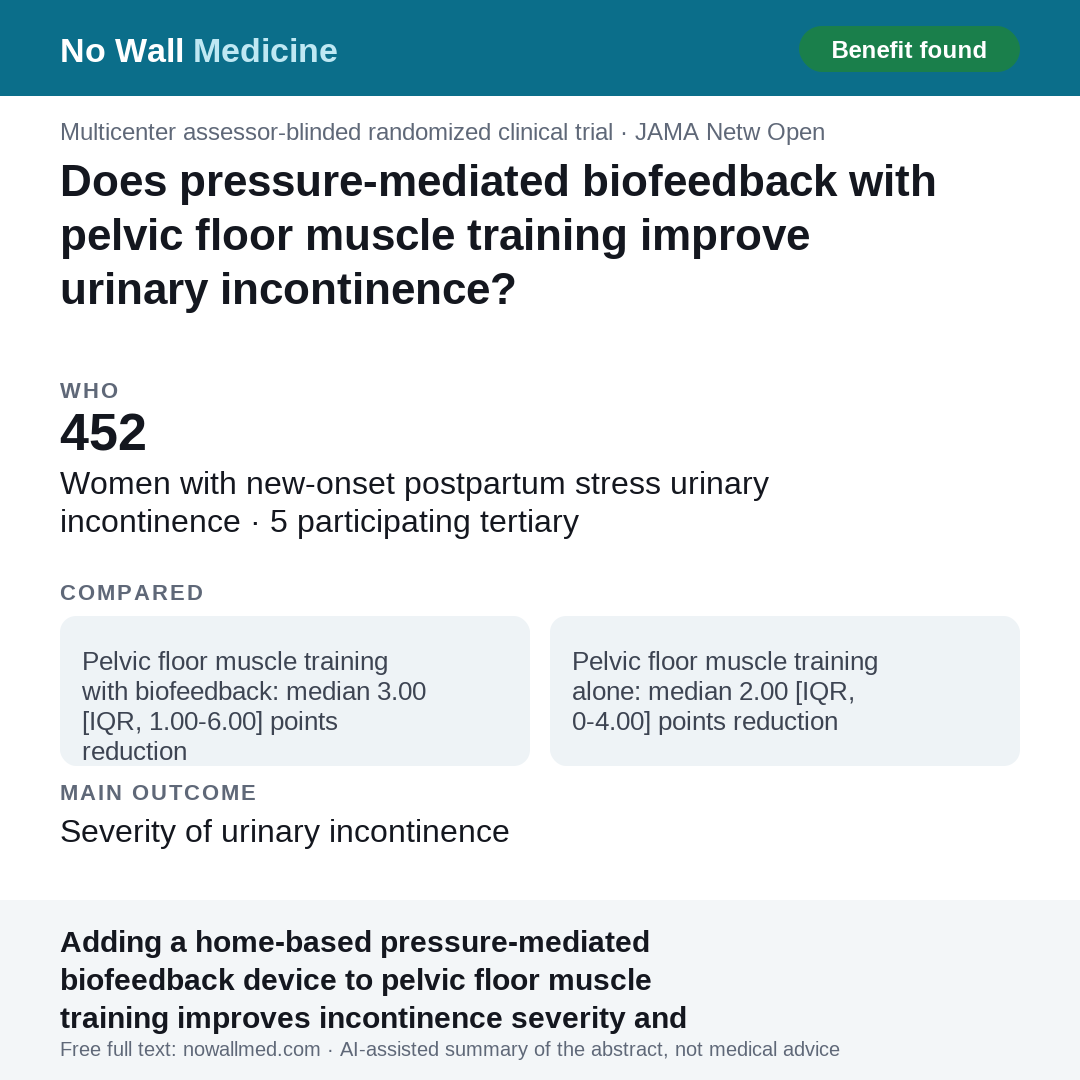
Clinical question: Does pressure-mediated biofeedback with pelvic floor muscle training improve urinary incontinence?
Why it matters: It is unknown whether adding a home-based pressure-mediated biofeedback device to supervised pelvic floor muscle training provides additional benefits for women with stress urinary incontinence.
Key points
- Researchers studied 452 women with new-onset postpartum stress urinary incontinence, comparing pelvic floor muscle training alone to training combined with a home-based pressure-mediated biofeedback device.
- The group using the biofeedback device had a higher cure rate of 20.2% compared to 8.7% in the control group and a greater reduction in incontinence severity.
- Women using the biofeedback device also showed significantly greater pelvic floor muscle strength, with a median of 26.00 cm H2O versus 21.00 cm H2O in the control group.
Headline and key points written with AI from the paper’s abstract, with every number checked against it. Read the paper before relying on them.
Topics
Cite this article
Wang X, Qiu J, Li D, Wang Z, Yang Y, Fan G. Pressure-Mediated Biofeedback With Pelvic Floor Muscle Training for Urinary Incontinence: A Randomized Clinical Trial. JAMA Netw Open. 2024. doi:10.1001/jamanetworkopen.2024.42925
Spotted a mistake? Suggest a correction
Top studies every Monday
The week’s key trials and guidelines in your specialties, plus any topics you follow. By email, free.
Get the weekly digest