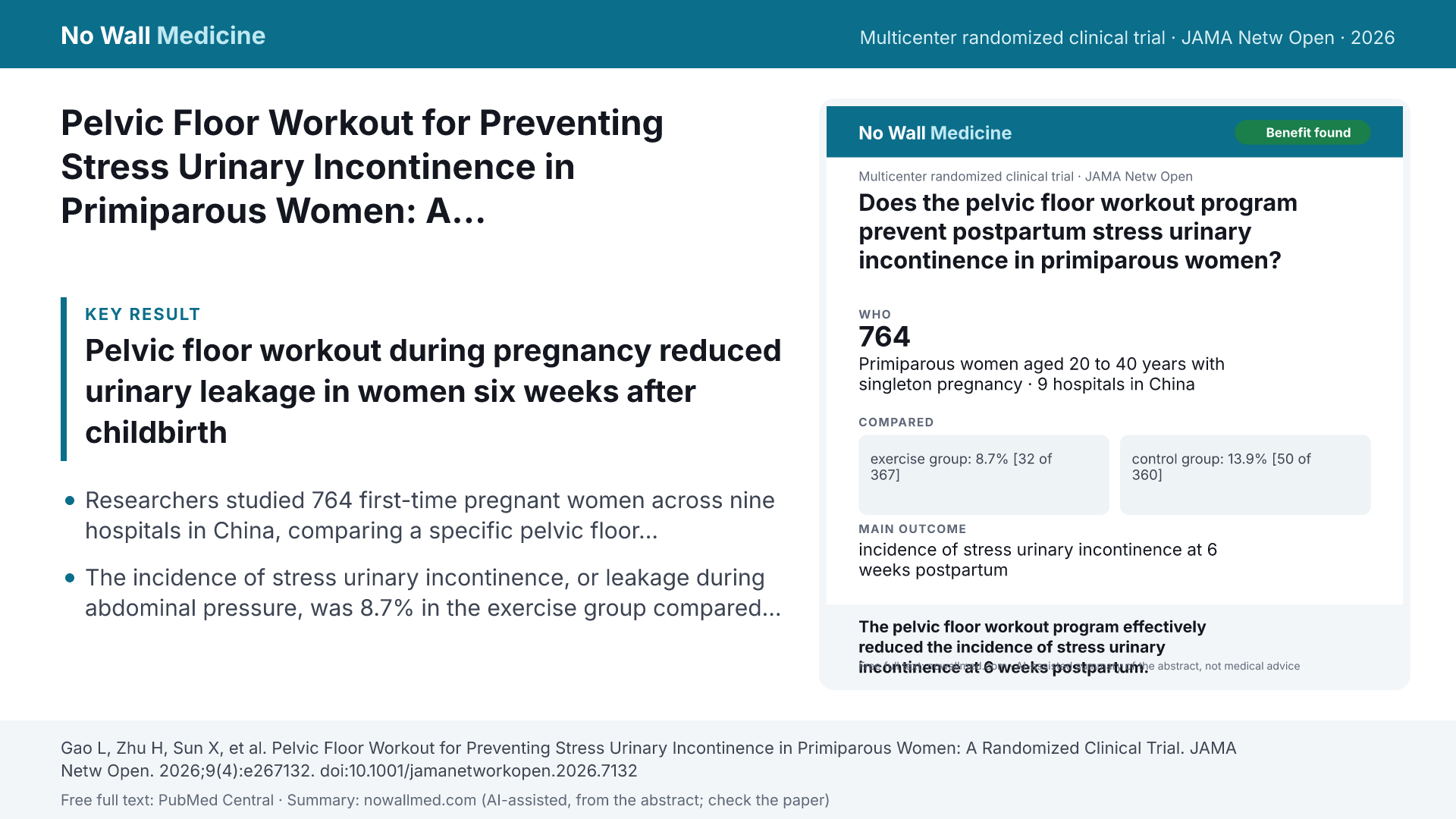
Pelvic floor workout during pregnancy reduced urinary leakage in women six weeks after childbirth
Pelvic Floor Workout for Preventing Stress Urinary Incontinence in Primiparous Women: A Randomized Clinical Trial
Multicenter randomized clinical trialBenefit found
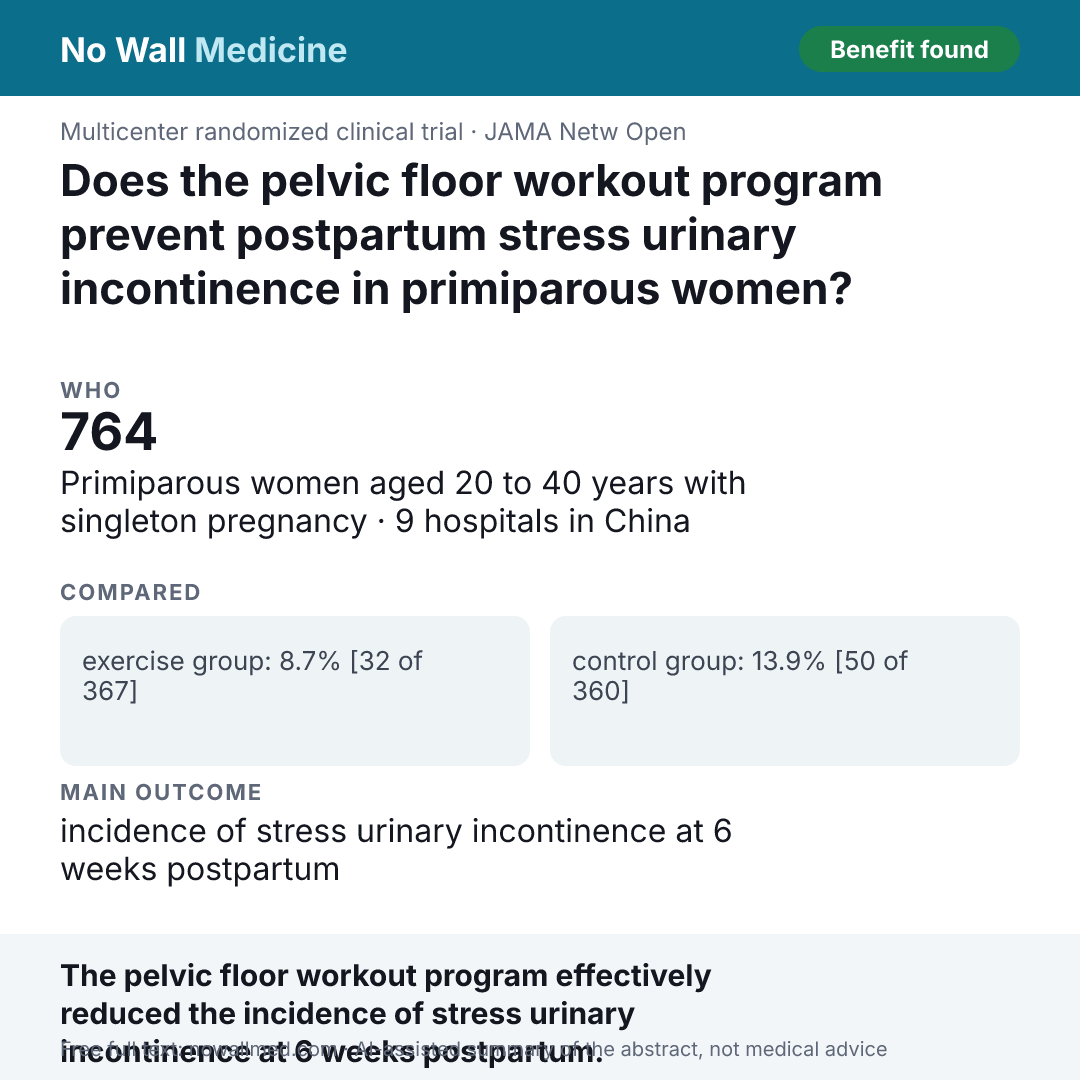
Does the pelvic floor workout program prevent postpartum stress urinary incontinence in primiparous women?
Who
764
Primiparous women aged 20 to 40 years with singleton pregnancy · 9 hospitals in China
Compared
exercise group: 8.7% [32 of 367]
control group: 13.9% [50 of 360]
Main outcome
incidence of stress urinary incontinence at 6 weeks postpartum
Result: risk difference 5.17 (95% CI, 0.36-10.03) percentage points
Bottom line: The pelvic floor workout program effectively reduced the incidence of stress urinary incontinence at 6 weeks postpartum.
JAMA Netw Open · 2026-04-01 · Save PNG
Clinical question: Does the pelvic floor workout program prevent postpartum stress urinary incontinence in primiparous women?
Why it matters: Rehabilitation methods for stress urinary incontinence need to be based on global postural exercises involving core strength, stability, and pelvic balance.
In absolute numbers
exercise group: 8.7% · control group: 13.9% → a difference of 5.2 percentage points, so about 20 people would need the treatment for 1 more to benefit (number needed to treat) over the trial’s follow-up.
Worked out by us from the two group results above, not reported by the authors. Check the paper for the exact outcome and timing.
Key points
- Researchers studied 764 first-time pregnant women across nine hospitals in China, comparing a specific pelvic floor workout to usual medical care.
- The incidence of stress urinary incontinence, or leakage during abdominal pressure, was 8.7% in the exercise group compared to 13.9% in the control group.
- A higher proportion of women in the exercise group achieved a Modified Oxford Scale score of 4 or higher at six weeks postpartum.
Headline and key points written with AI from the paper’s abstract, with every number checked against it. Read the paper before relying on them.
Was this summary helpful?
Subject terms
Headline, design, result, key points, caveat and citation as plain text.
Cite this article
Gao L, Zhu H, Sun X, et al. Pelvic Floor Workout for Preventing Stress Urinary Incontinence in Primiparous Women: A Randomized Clinical Trial. JAMA Netw Open. 2026;9(4):e267132. doi:10.1001/jamanetworkopen.2026.7132
Spotted a mistake? Suggest a correction