Application of Machine Learning for Patients With Cardiac Arrest: Systematic Review and Meta-Analysis
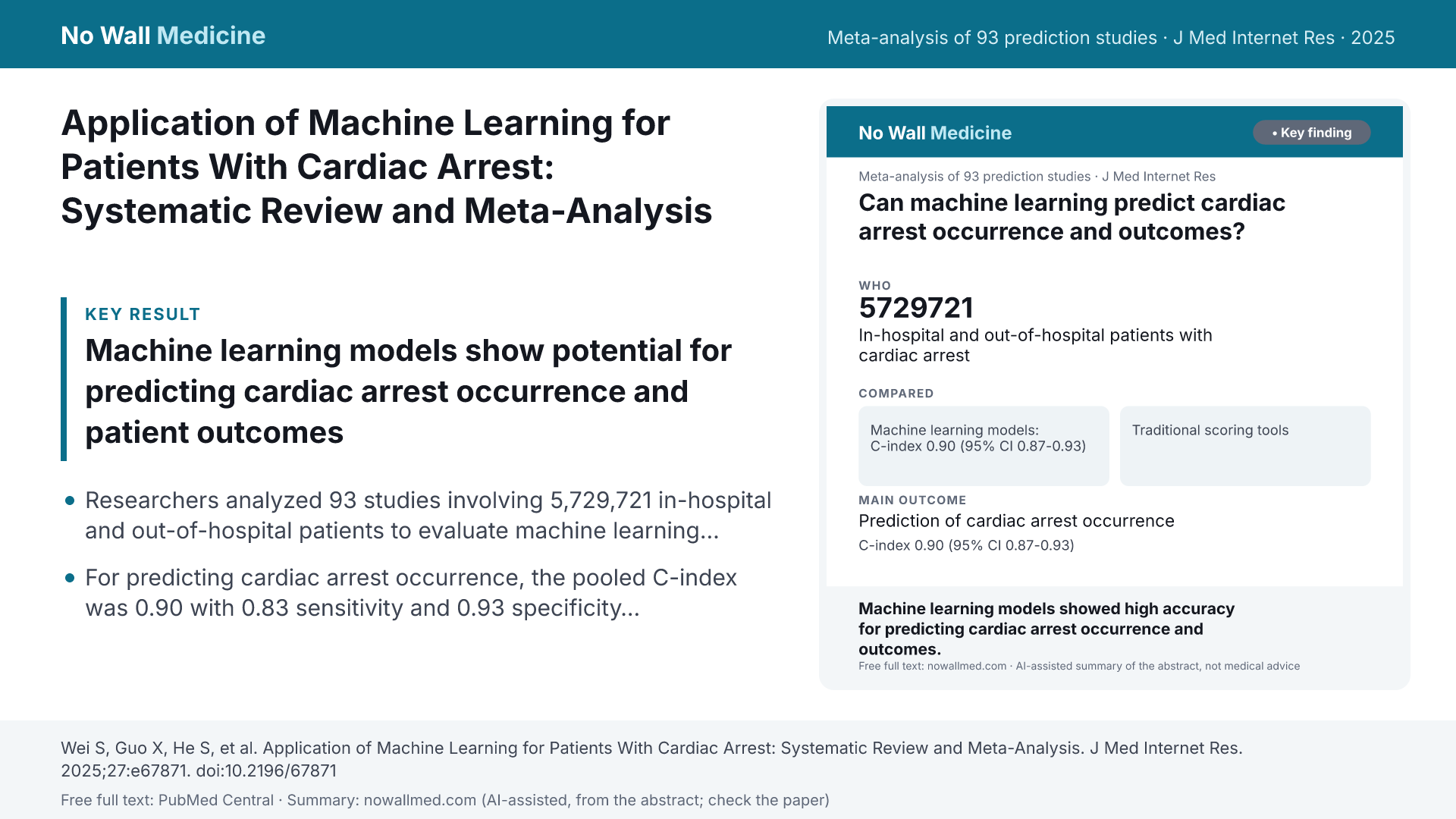
Key result: Machine learning models show potential for predicting cardiac arrest occurrence and patient outcomes
Meta-analysis of 93 prediction studiesKey finding
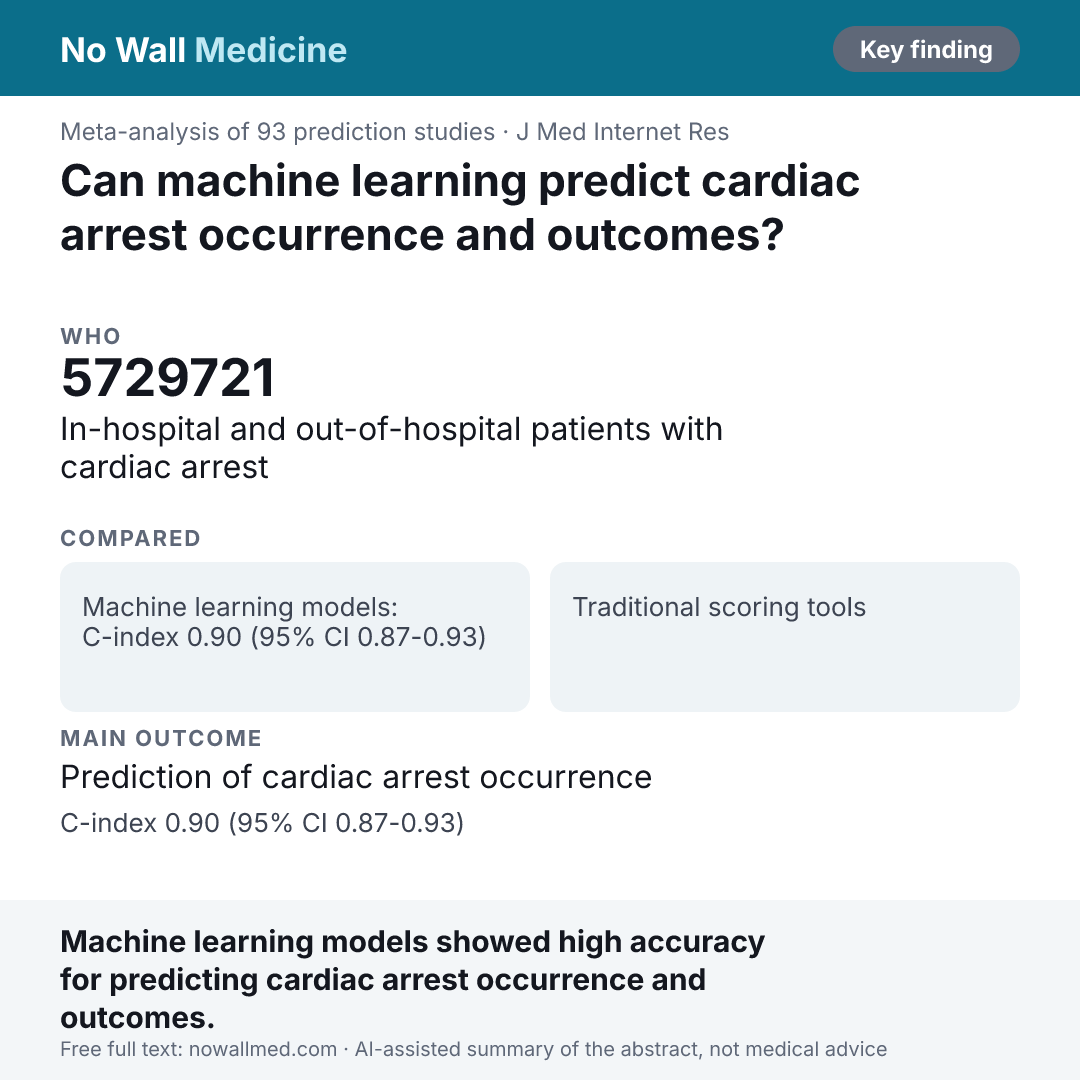
Can machine learning predict cardiac arrest occurrence and outcomes?
Who
5729721
In-hospital and out-of-hospital patients with cardiac arrest
Compared
Machine learning models: C-index 0.90 (95% CI 0.87-0.93)
Traditional scoring tools
Main outcome
Prediction of cardiac arrest occurrence
Result: C-index 0.90 (95% CI 0.87-0.93)
Bottom line: Machine learning models showed high accuracy for predicting cardiac arrest occurrence and outcomes.
J Med Internet Res · 2025-03-10 · Save PNG
Key points
- Researchers analyzed 93 studies involving 5,729,721 in-hospital and out-of-hospital patients to evaluate machine learning for cardiac arrest prediction.
- For predicting cardiac arrest occurrence, the pooled C-index was 0.90 with 0.83 sensitivity and 0.93 specificity in imbalanced validation datasets.
- Machine learning models showed pooled C-indices of 0.86 for good neurological prognosis, 0.85 for mortality, and 0.77 for return of spontaneous circulation.
Why it matters: Effective early assessment tools for predicting the onset and development of cardiac arrest are currently lacking.
Discussion prompts
- Would these patients look like yours? Who was left out?
- Is the main outcome one that matters to patients?
- Is the difference large enough to change what you do?
Cite: Wei S, Guo X, He S, et al. Application of Machine Learning for Patients With Cardiac Arrest: Systematic Review and Meta-Analysis. J Med Internet Res. 2025;27:e67871. doi:10.2196/67871
Free full text: PubMed Central · Summary and visual abstract: nowallmed.com/a/application-of-machine-learning-for-patients-with-cardiac-arrest-1sy3mey/ (AI-assisted from the abstract; check the paper before relying on it).