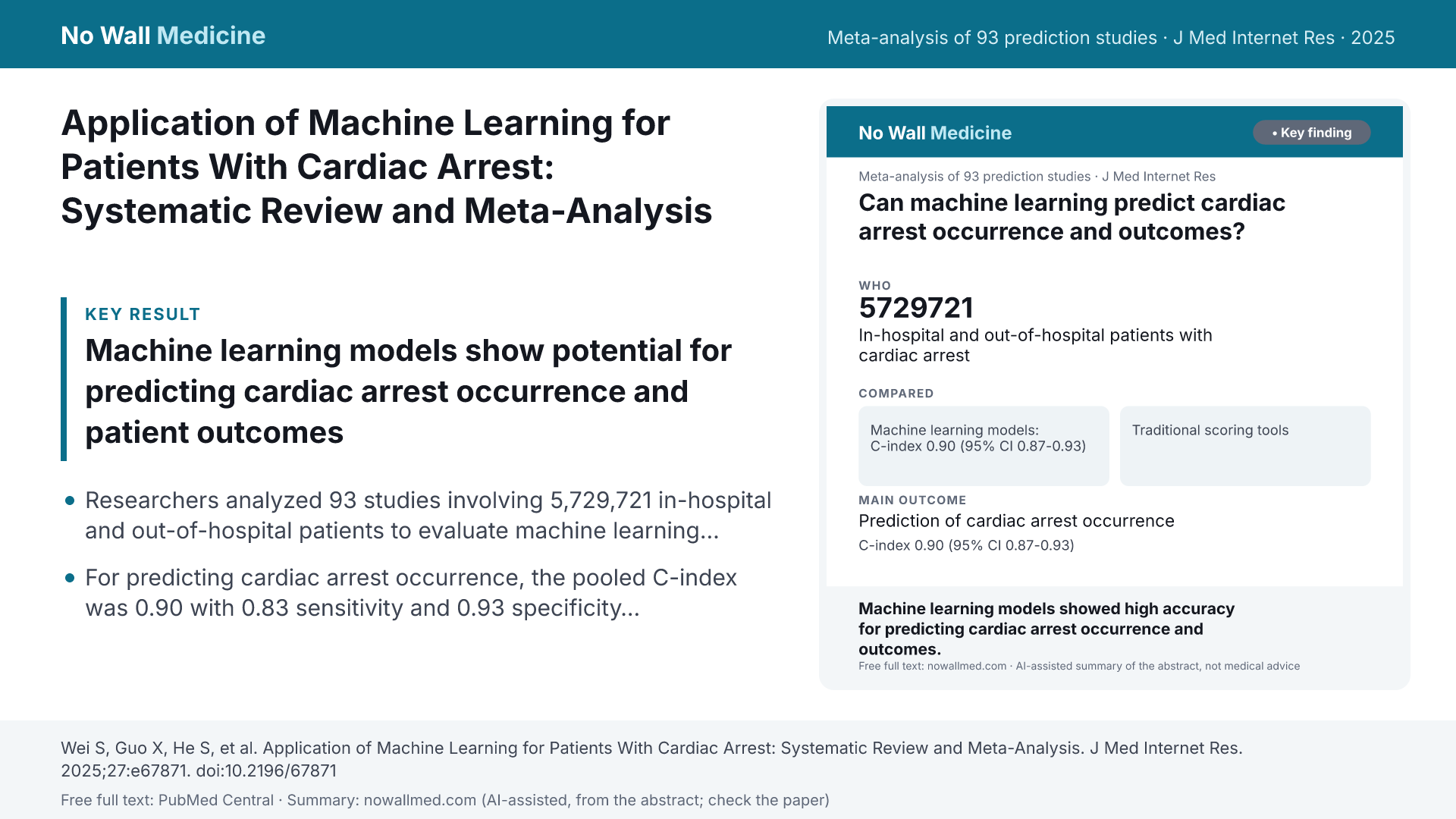
Machine learning models show potential for predicting cardiac arrest occurrence and patient outcomes
Application of Machine Learning for Patients With Cardiac Arrest: Systematic Review and Meta-Analysis
Systematic review and meta-analysisBenefit found
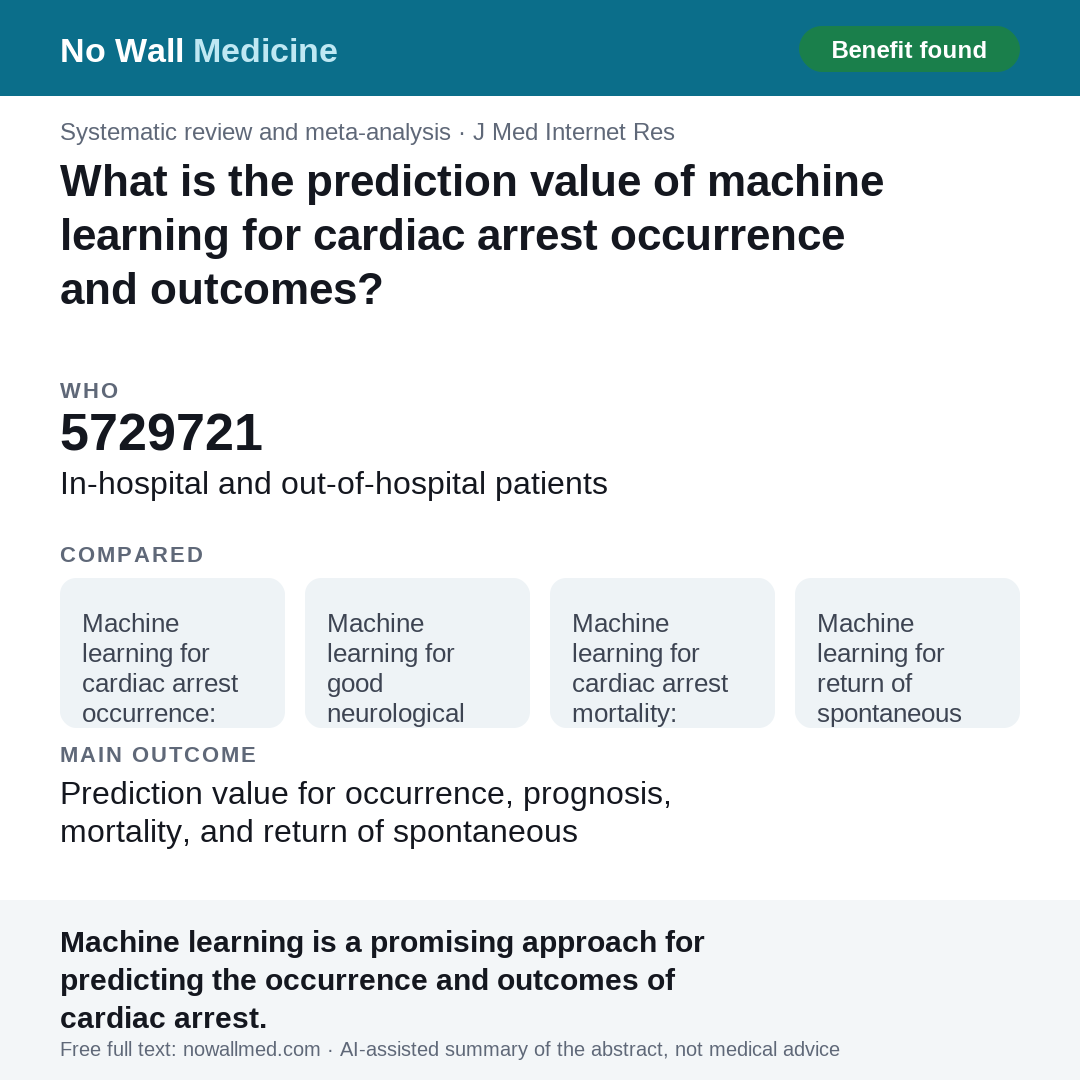
What is the prediction value of machine learning for cardiac arrest occurrence and outcomes?
Who
5729721
In-hospital and out-of-hospital patients
Compared
Machine learning for cardiac arrest occurrence: C-index 0.90 (95% CI 0.87-0.93)
Machine learning for good neurological prognosis: C-index 0.86 (95% CI 0.85-0.87)
Machine learning for cardiac arrest mortality: C-index 0.85 (95% CI 0.82-0.87)
Machine learning for return of spontaneous circulation: C-index 0.77 (95% CI 0.74-0.80)
Main outcome
Prediction value for occurrence, prognosis, mortality, and return of spontaneous circulation
Bottom line: Machine learning is a promising approach for predicting the occurrence and outcomes of cardiac arrest.
J Med Internet Res · 2025-03-10Download image
Clinical question: What is the prediction value of machine learning for cardiac arrest occurrence and outcomes?
Why it matters: Effective early assessment tools for predicting the onset and development of cardiac arrest are currently lacking.
Key points
- Researchers analyzed 93 studies involving 5,729,721 in-hospital and out-of-hospital patients to evaluate machine learning for cardiac arrest prediction.
- For predicting cardiac arrest occurrence, the pooled C-index was 0.90 with 0.83 sensitivity and 0.93 specificity in imbalanced validation datasets.
- Machine learning models showed pooled C-indices of 0.86 for good neurological prognosis, 0.85 for mortality, and 0.77 for return of spontaneous circulation.
Headline and key points written with AI from the paper’s abstract, with every number checked against it. Read the paper before relying on them.
Was this summary helpful?
Subject terms
Cite this article
Wei S, Guo X, He S, Zhang C, Chen Z, Chen J. Application of Machine Learning for Patients With Cardiac Arrest: Systematic Review and Meta-Analysis. J Med Internet Res. 2025. doi:10.2196/67871
Spotted a mistake? Suggest a correction