Personalized medication recommendations for physicians may improve quality of life in terminal care patients
Appropriate medication use in Dutch terminal care: study protocol of a multicentre stepped-wedge cluster randomized controlled trial (the AMUSE study)
Multicentre stepped-wedge cluster randomized controlled trialUnclear result
Does CDSS-OPTIMED software improve quality of life in patients with limited life expectancy?
Who
Patients with a life expectancy of three months or less · Seven sites in the Netherlands
Compared
Control period (care as usual)
Intervention period (CDSS-OPTIMED)
Main outcome
Quality of life measured by EORTC QLQ-C15-PAL questionnaire
Bottom line: This study protocol aims to investigate if personalized medication recommendations improve quality of life in terminal care.
BMC Palliat Care · 2024-01-03Download image
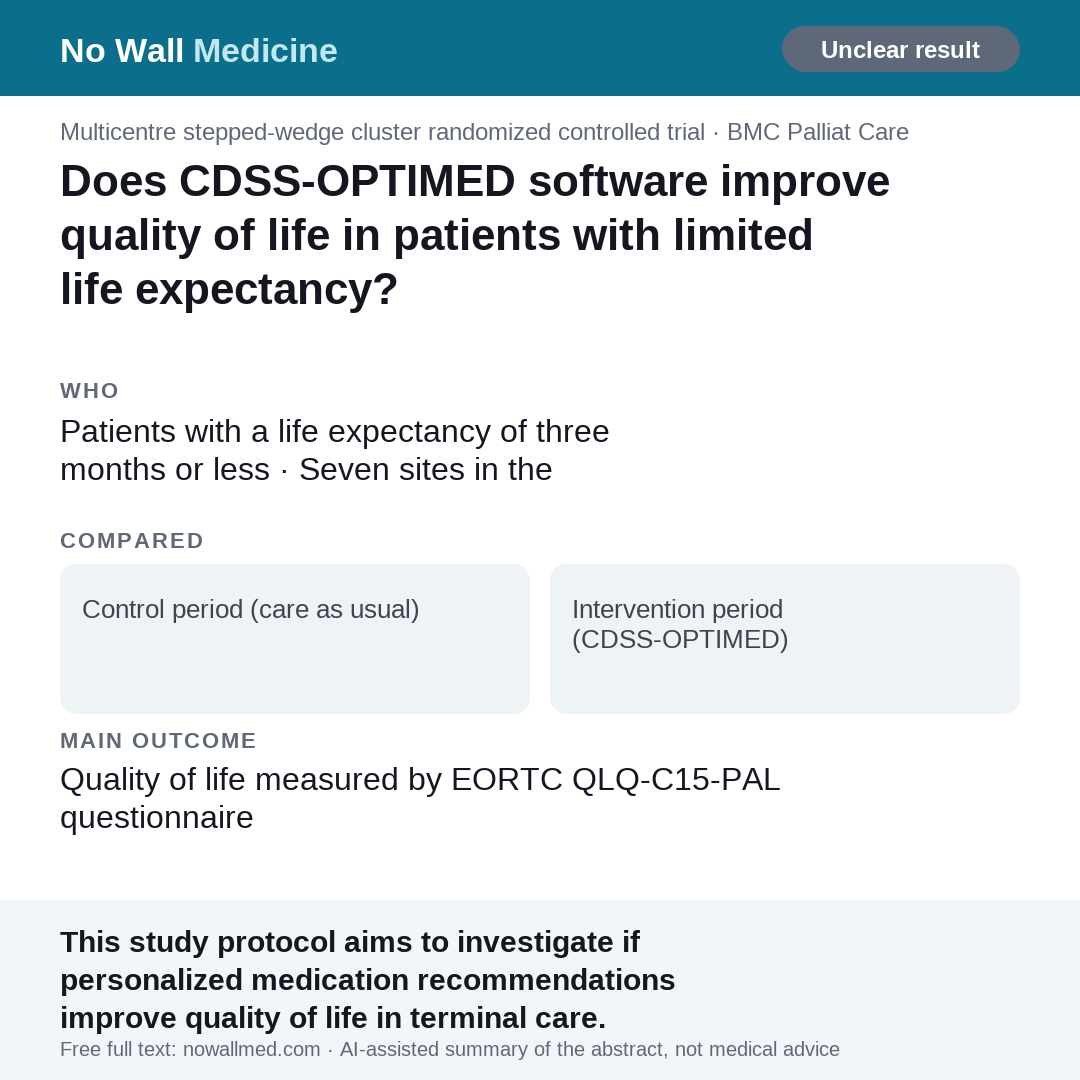
Clinical question: Does CDSS-OPTIMED software improve quality of life in patients with limited life expectancy?
Why it matters: Physicians may be reluctant to stop medications in terminal care due to a lack of evidence regarding appropriate medication management for patients in their final life phase.
Key points
- The AMUSE study will involve patients with a life expectancy of three months or less across seven sites including hospitals, general practices, and a hospice.
- Researchers will compare standard care to the use of CDSS-OPTIMED, a software program providing weekly personalized medication recommendations to attending physicians.
- The primary goal is to measure changes in patient quality of life using the EORTC QLQ-C15-PAL questionnaire two weeks after the baseline assessment.
Headline and key points written with AI from the paper’s abstract, with every number checked against it. Read the paper before relying on them.
Was this summary helpful?
Subject terms
Cite this article
van Hylckama Vlieg MAM, Pot IE, Visser HPJ, Jong MAC, van der Vorst MJDL, van Mastrigt BJ. Appropriate medication use in Dutch terminal care: study protocol of a multicentre stepped-wedge cluster randomized controlled trial (the AMUSE study). BMC Palliat Care. 2024. doi:10.1186/s12904-023-01334-x
Spotted a mistake? Suggest a correction
Top studies every Monday
The week’s key trials and guidelines in your specialties, plus any topics you follow. By email, free.
Get the weekly digest