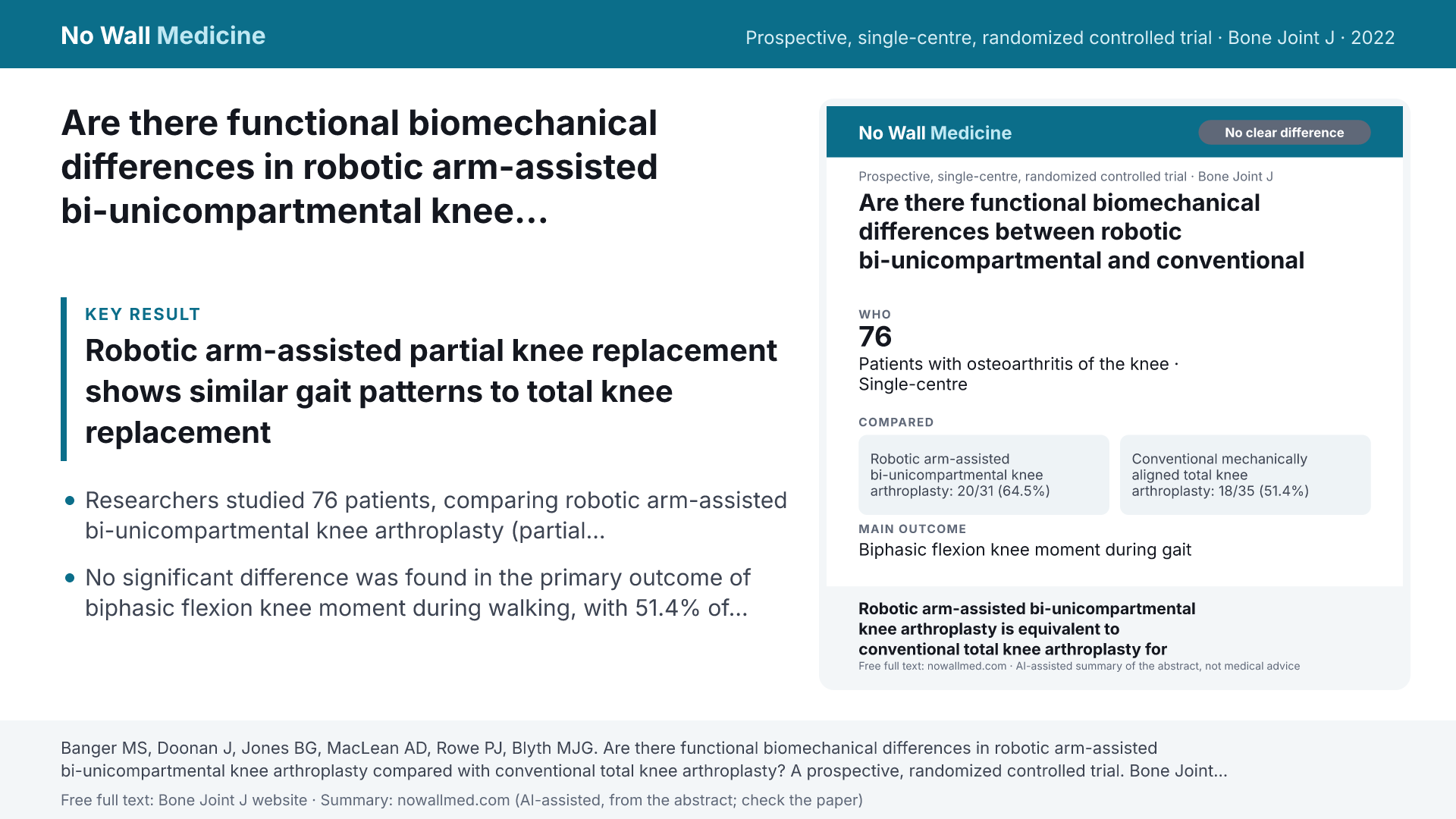
Are there functional biomechanical differences in robotic arm-assisted bi-unicompartmental knee arthroplasty compared with conventional total knee arthroplasty? A prospective, randomized controlled trial
Key result: Robotic arm-assisted partial knee replacement shows similar gait patterns to total knee replacement
Key points
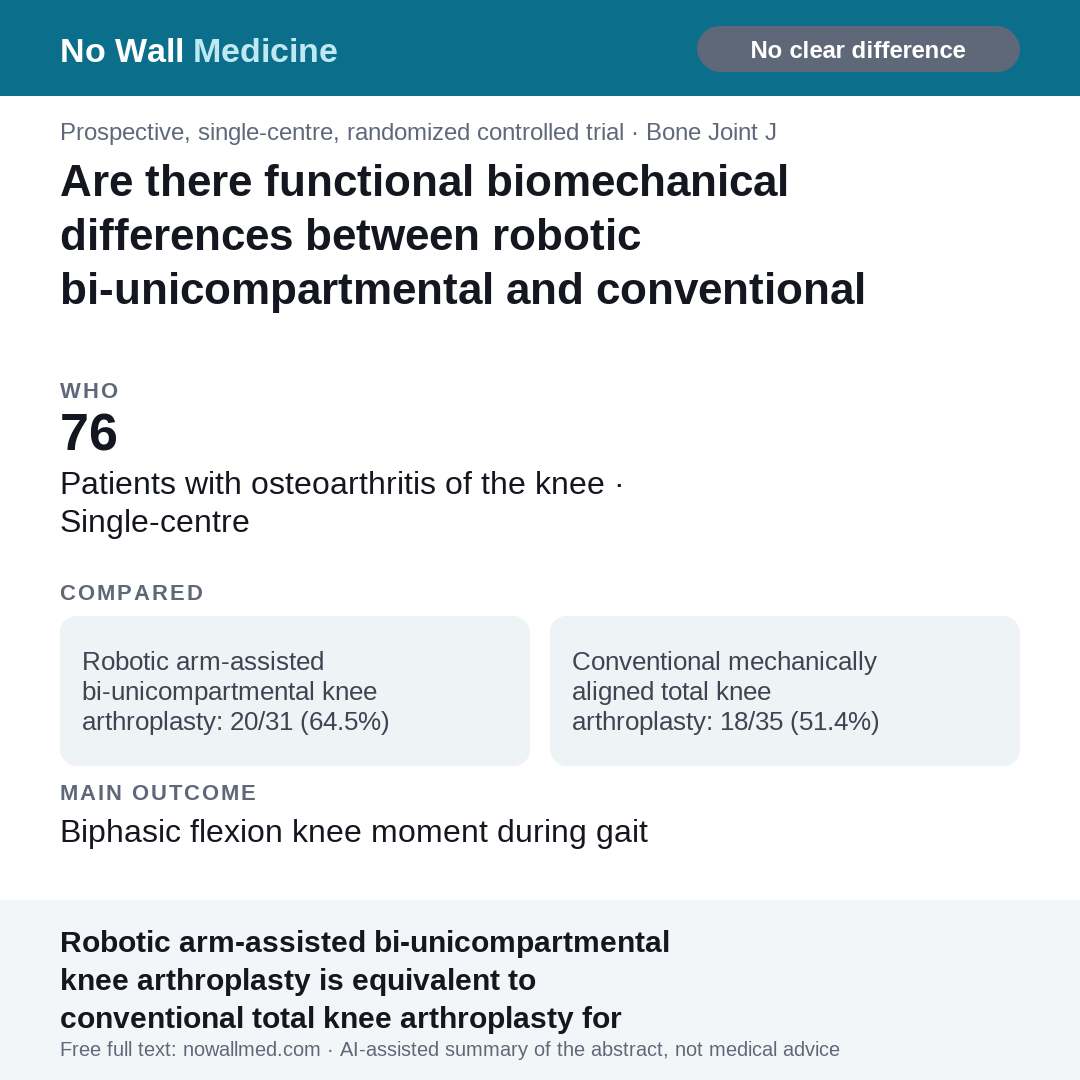
- Researchers studied 76 patients, comparing robotic arm-assisted bi-unicompartmental knee arthroplasty (partial knee replacement) to conventional mechanically aligned total knee arthroplasty (full knee replacement).
- No significant difference was found in the primary outcome of biphasic flexion knee moment during walking, with 51.4% of TKA patients and 64.5% of bi-UKA patients achieving it.
- Both surgical groups showed functional deficits compared to a healthy age-matched group, though the bi-UKA group had a significant increase in joint position sense during testing.
Why it matters: It is unknown if robotic arm-assisted partial knee replacement offers different biomechanical gait advantages compared to conventional total knee replacement.
Limitation the authors note: The study was a single-centre trial.
Discussion prompts
- Would these patients look like yours? Who was left out?
- Is the main outcome one that matters to patients?
- Is the difference large enough to change what you do?
Cite: Banger MS, Doonan J, Jones BG, MacLean AD, Rowe PJ, Blyth MJG. Are there functional biomechanical differences in robotic arm-assisted bi-unicompartmental knee arthroplasty compared with conventional total knee arthroplasty? A prospective, randomized controlled trial. Bone Joint J. 2022. doi:10.1302/0301-620X.104B4.BJJ-2021-0837.R1
Free full text: Bone Joint J website · Summary and visual abstract: nowallmed.com/a/are-there-functional-biomechanical-differences-in-robotic-arm-1oaiwrv/ (AI-assisted from the abstract; check the paper before relying on it).