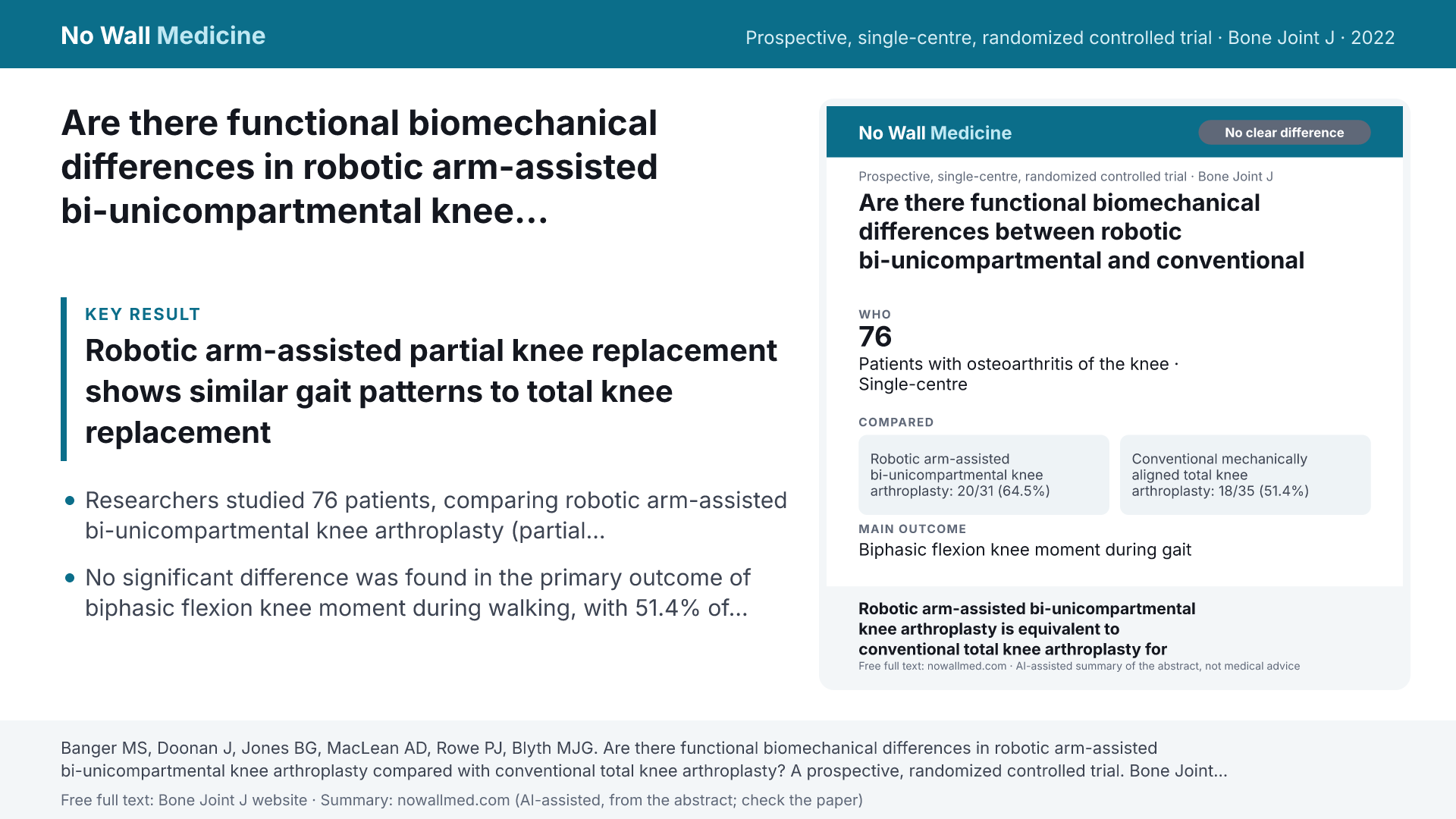
Robotic arm-assisted partial knee replacement shows similar gait patterns to total knee replacement
Are there functional biomechanical differences in robotic arm-assisted bi-unicompartmental knee arthroplasty compared with conventional total knee arthroplasty? A prospective, randomized controlled trial
Prospective, single-centre, randomized controlled trialNo clear difference
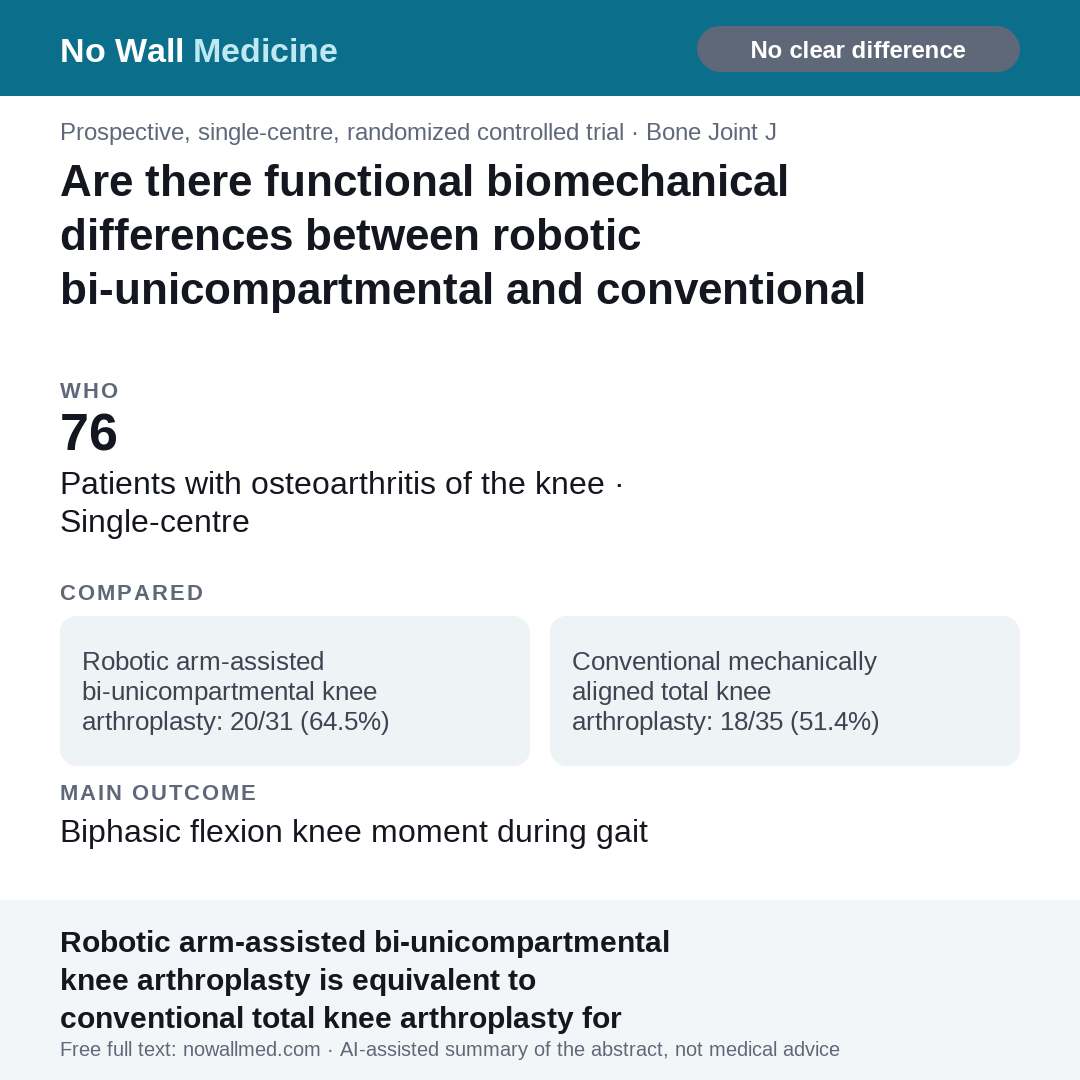
Are there functional biomechanical differences between robotic bi-unicompartmental and conventional total knee arthroplasty?
Who
76
Patients with osteoarthritis of the knee · Single-centre
Compared
Robotic arm-assisted bi-unicompartmental knee arthroplasty: 20/31 (64.5%)
Conventional mechanically aligned total knee arthroplasty: 18/35 (51.4%)
Main outcome
Biphasic flexion knee moment during gait
Bottom line: Robotic arm-assisted bi-unicompartmental knee arthroplasty is equivalent to conventional total knee arthroplasty for biphasic gait patterns.
Limitation: Both surgical groups showed residual deficits compared to healthy age-matched controls.
Bone Joint J · 2022-04-01Download image
Clinical question: Are there functional biomechanical differences between robotic bi-unicompartmental and conventional total knee arthroplasty?
Why it matters: It is unknown if robotic arm-assisted partial knee replacement offers different biomechanical gait advantages compared to conventional total knee replacement.
Key points
- Researchers studied 76 patients, comparing robotic arm-assisted bi-unicompartmental knee arthroplasty (partial knee replacement) to conventional mechanically aligned total knee arthroplasty (full knee replacement).
- No significant difference was found in the primary outcome of biphasic flexion knee moment during walking, with 51.4% of TKA patients and 64.5% of bi-UKA patients achieving it.
- Both surgical groups showed functional deficits compared to a healthy age-matched group, though the bi-UKA group had a significant increase in joint position sense during testing.
Limitation the authors note: The study was a single-centre trial.
Headline and key points written with AI from the paper’s abstract, with every number checked against it. Read the paper before relying on them.
Was this summary helpful?
Subject terms
Cite this article
Banger MS, Doonan J, Jones BG, MacLean AD, Rowe PJ, Blyth MJG. Are there functional biomechanical differences in robotic arm-assisted bi-unicompartmental knee arthroplasty compared with conventional total knee arthroplasty? A prospective, randomized controlled trial. Bone Joint J. 2022. doi:10.1302/0301-620X.104B4.BJJ-2021-0837.R1
Spotted a mistake? Suggest a correction
Top studies every Monday
The week’s key trials and guidelines in your specialties, plus any topics you follow. By email, free.
Get the weekly digest