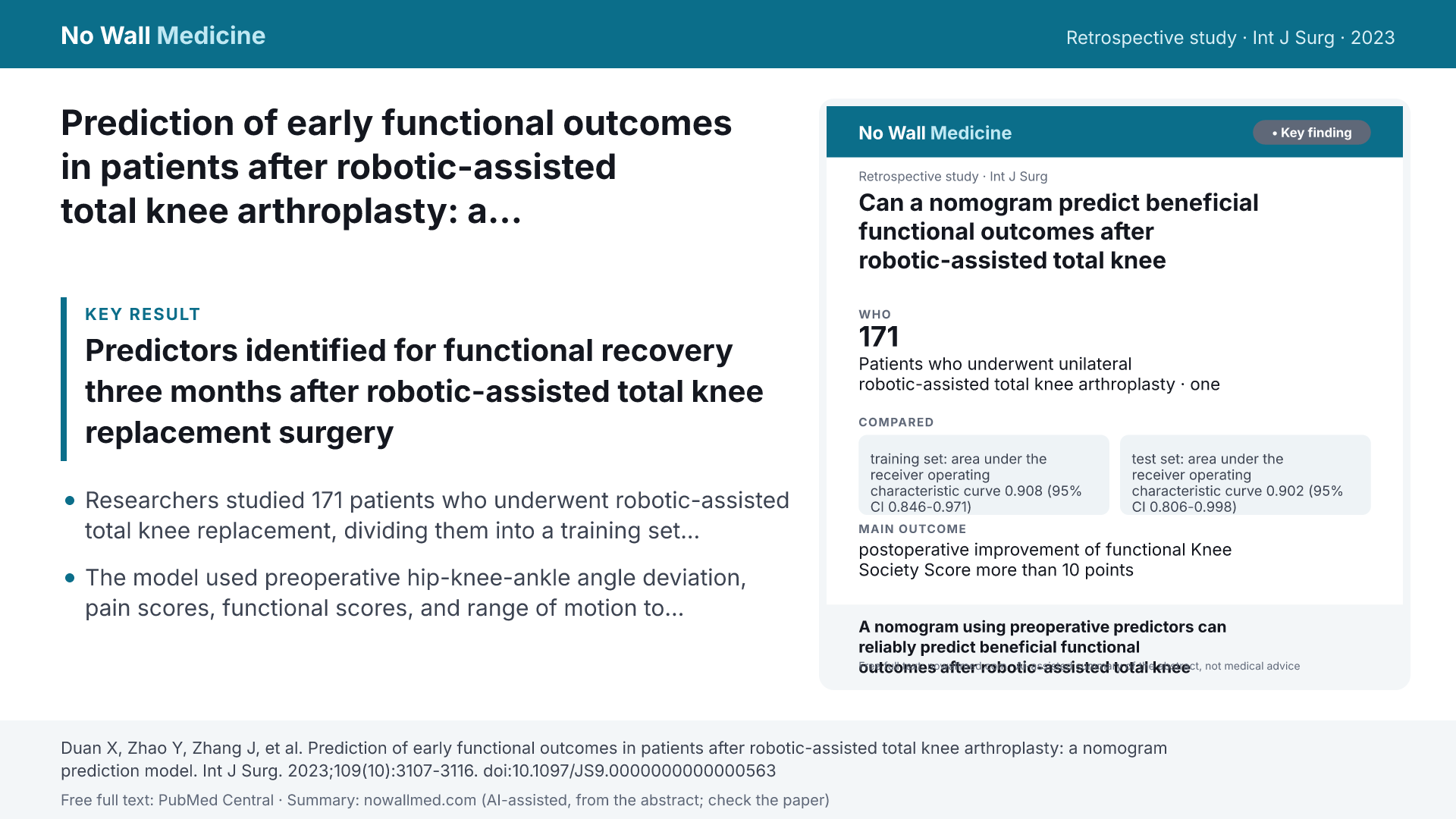
Predictors identified for functional recovery three months after robotic-assisted total knee replacement surgery
Prediction of early functional outcomes in patients after robotic-assisted total knee arthroplasty: a nomogram prediction model
Retrospective studyKey finding
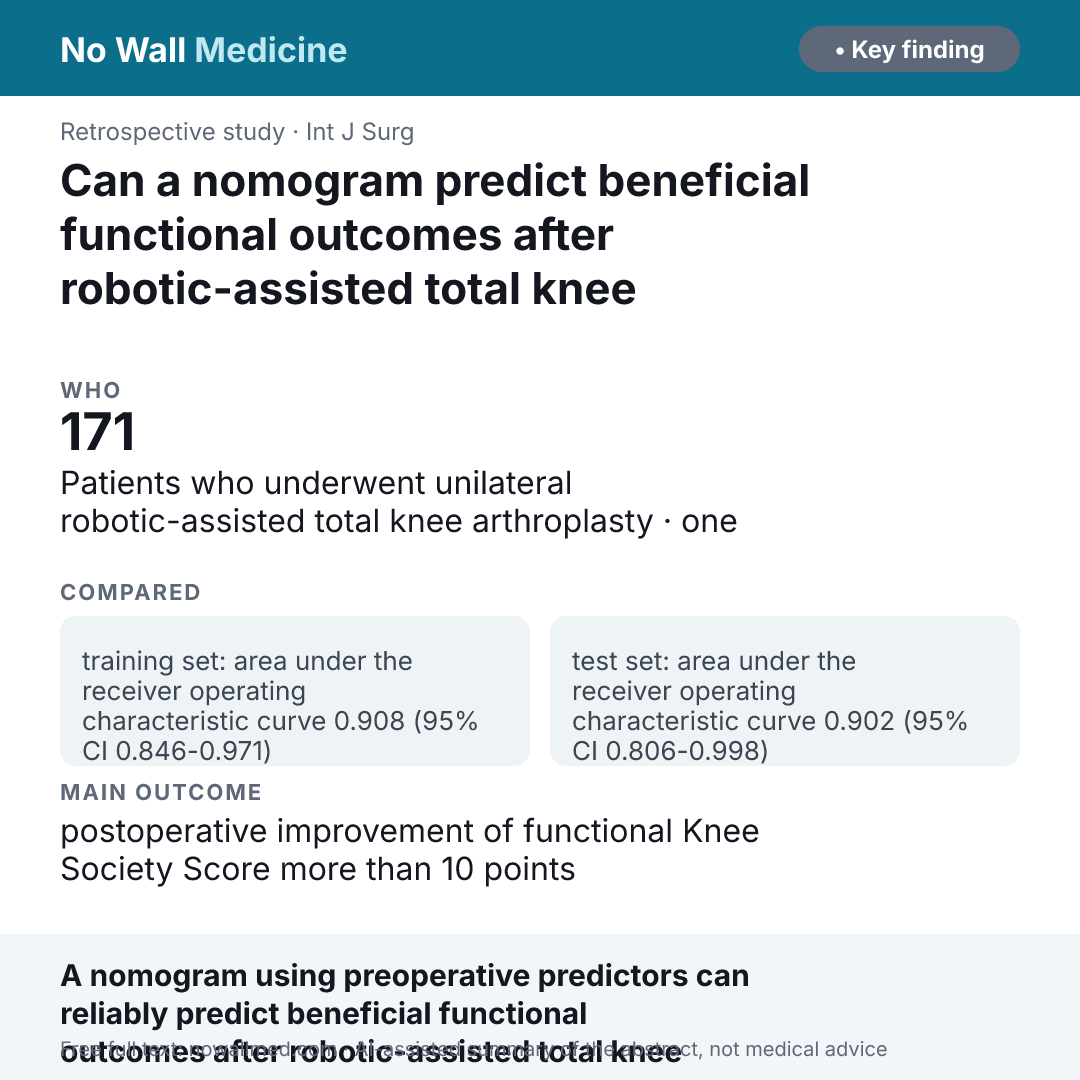
Can a nomogram predict beneficial functional outcomes after robotic-assisted total knee arthroplasty?
Who
171
Patients who underwent unilateral robotic-assisted total knee arthroplasty · one hospital
Compared
training set: area under the receiver operating characteristic curve 0.908 (95% CI 0.846-0.971)
test set: area under the receiver operating characteristic curve 0.902 (95% CI 0.806-0.998)
Main outcome
postoperative improvement of functional Knee Society Score more than 10 points
Bottom line: A nomogram using preoperative predictors can reliably predict beneficial functional outcomes after robotic-assisted total knee arthroplasty.
Limitation: This was a retrospective study.
Int J Surg · 2023-10-01 · Save PNG
Clinical question: Can a nomogram predict beneficial functional outcomes after robotic-assisted total knee arthroplasty?
Why it matters: It is challenging to develop accurate prediction models for postoperative outcomes following robotic-assisted total knee replacement.
Key points
- Researchers studied 171 patients who underwent robotic-assisted total knee replacement, dividing them into a training set of 120 and a test set of 51.
- The model used preoperative hip-knee-ankle angle deviation, pain scores, functional scores, and range of motion to predict a functional improvement of more than 10 points.
- The model showed an area under the receiver operating characteristic curve of 0.908 in the training set and 0.902 in the test set.
Limitation the authors note: This was a retrospective study.
Headline and key points written with AI from the paper’s abstract, with every number checked against it. Read the paper before relying on them.
Was this summary helpful?
Subject terms
Headline, design, result, key points, caveat and citation as plain text.
Cite this article
Duan X, Zhao Y, Zhang J, et al. Prediction of early functional outcomes in patients after robotic-assisted total knee arthroplasty: a nomogram prediction model. Int J Surg. 2023;109(10):3107-3116. doi:10.1097/JS9.0000000000000563
Spotted a mistake? Suggest a correction