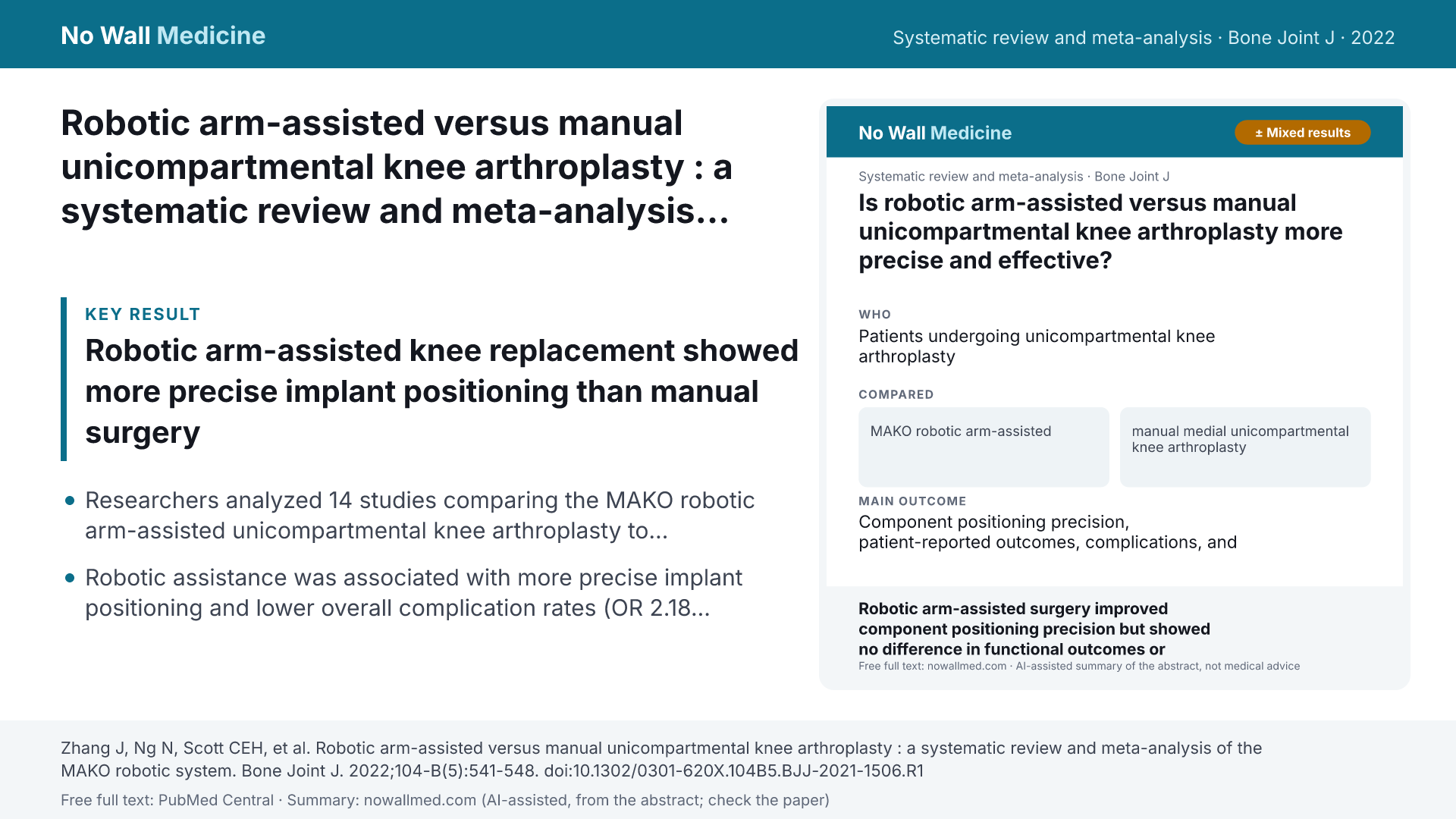
Robotic arm-assisted knee replacement showed more precise implant positioning than manual surgery
Robotic arm-assisted versus manual unicompartmental knee arthroplasty : a systematic review and meta-analysis of the MAKO robotic system
Systematic review and meta-analysisMixed results
Is robotic arm-assisted versus manual unicompartmental knee arthroplasty more precise and effective?
Who
Patients undergoing unicompartmental knee arthroplasty
Compared
MAKO robotic arm-assisted
manual medial unicompartmental knee arthroplasty
Main outcome
Component positioning precision, patient-reported outcomes, complications, and survivorship
Result: OR 2.18 (95% confidence interval 1.06 to 4.49)
Bottom line: Robotic arm-assisted surgery improved component positioning precision but showed no difference in functional outcomes or infection rates.
Bone Joint J · 2022-05-02Download image
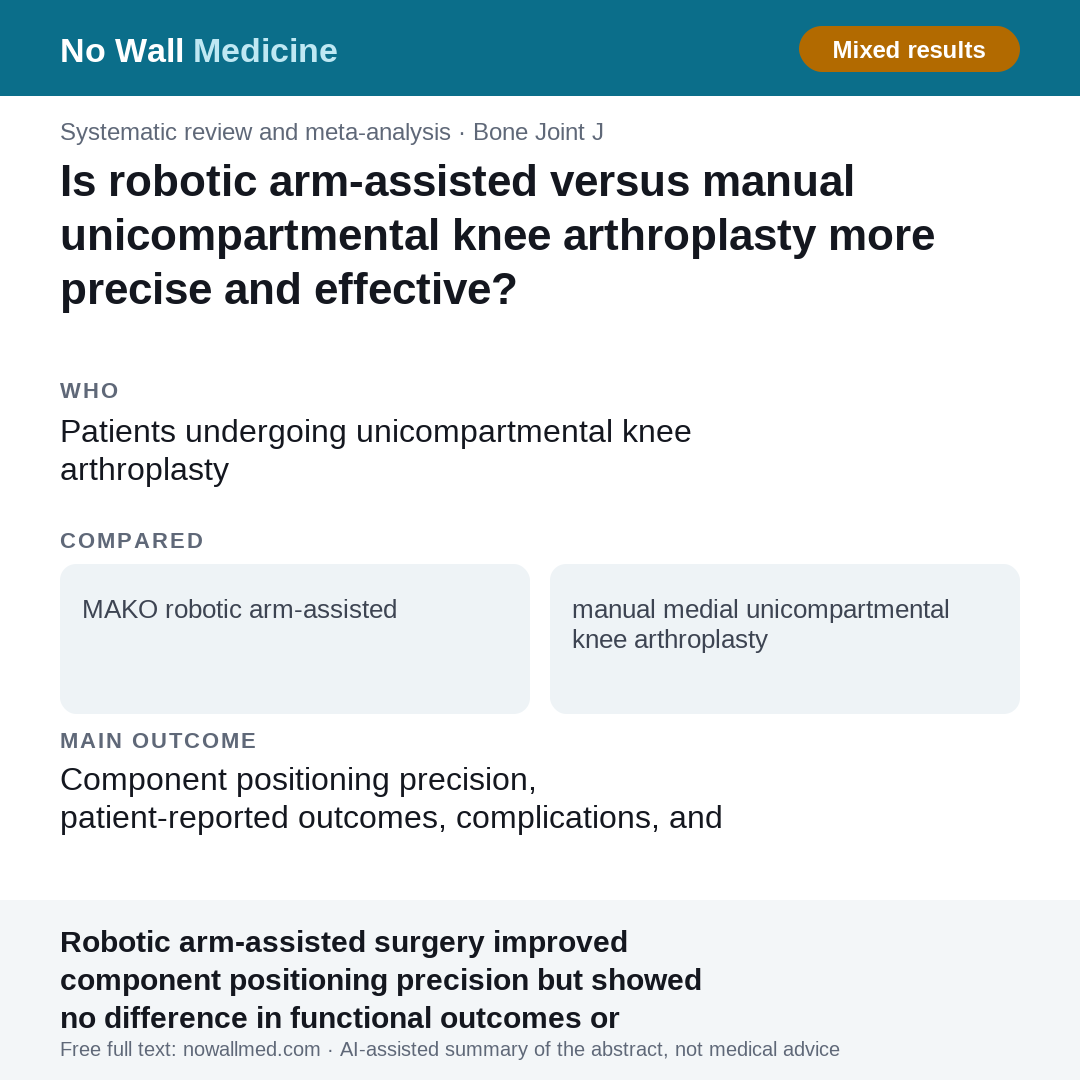
Clinical question: Is robotic arm-assisted versus manual unicompartmental knee arthroplasty more precise and effective?
Key points
- Researchers analyzed 14 studies comparing the MAKO robotic arm-assisted unicompartmental knee arthroplasty to manual medial unicompartmental knee arthroplasty.
- Robotic assistance was associated with more precise implant positioning and lower overall complication rates (OR 2.18 (95% CI 1.06 to 4.49); p = 0.040).
- The robotic method showed no difference in infection, re-intervention, Knee Society Score (mean difference 1.64 (95% CI -3.00 to 6.27); p = 0.490), or Western Ontario and McMaster Universities Arthritis Index score (mean difference -0.58 (95% CI -3.55 to 2.38); p = 0.700).
Headline and key points written with AI from the paper’s abstract, with every number checked against it. Read the paper before relying on them.
Was this summary helpful?
Subject terms
Headline, design, result, key points, caveat and citation as plain text.
Cite this article
Zhang J, Ng N, Scott CEH, et al. Robotic arm-assisted versus manual unicompartmental knee arthroplasty : a systematic review and meta-analysis of the MAKO robotic system. Bone Joint J. 2022. doi:10.1302/0301-620X.104B5.BJJ-2021-1506.R1
Spotted a mistake? Suggest a correction