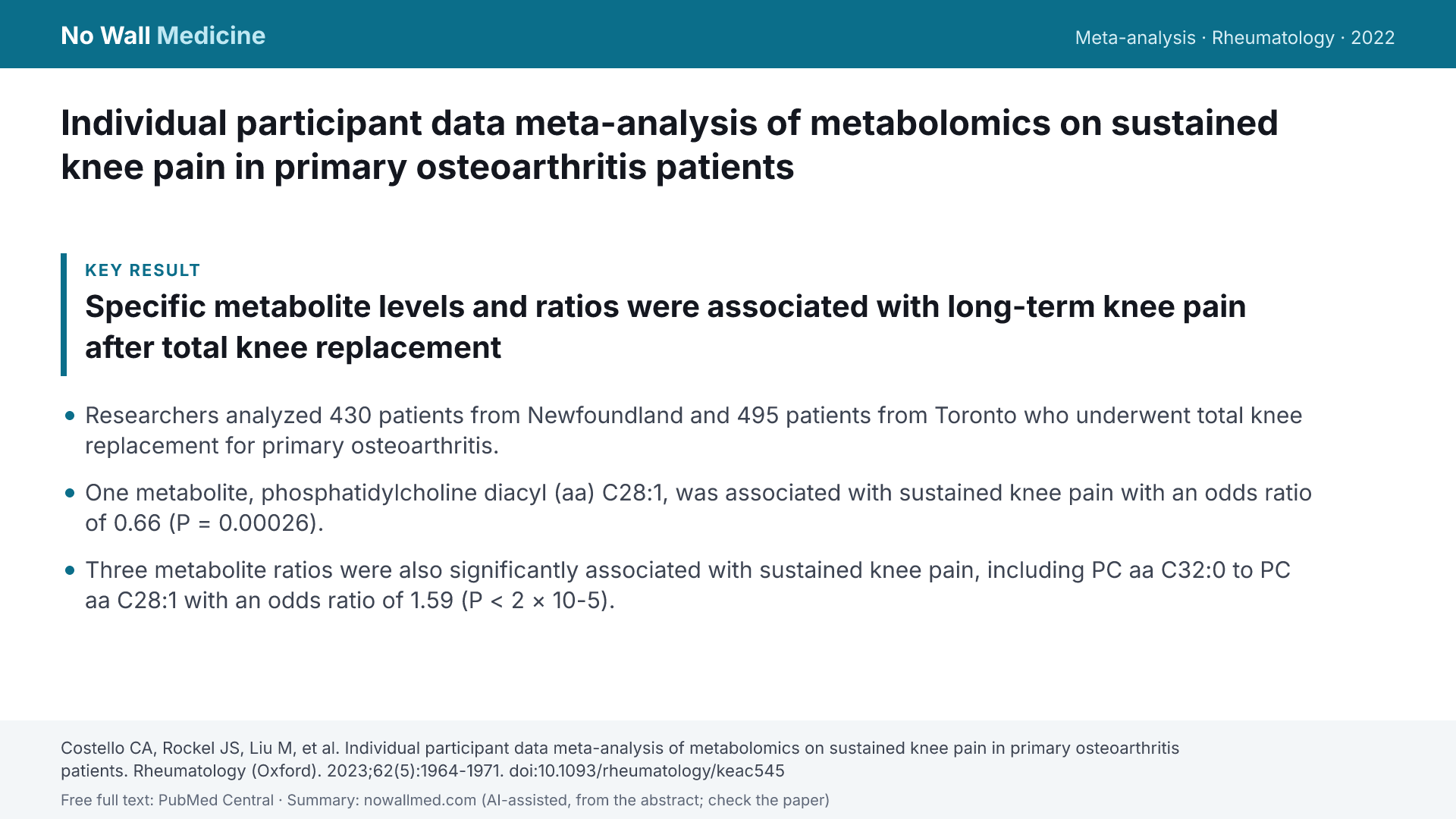
Specific metabolite levels and ratios were associated with long-term knee pain after total knee replacement
Individual participant data meta-analysis of metabolomics on sustained knee pain in primary osteoarthritis patients
Why it matters: It is unknown what underlying biological mechanisms or metabolic signatures are linked to the 20% of patients who report long-term pain after total knee replacement.
Key points
- Researchers analyzed 430 patients from Newfoundland and 495 patients from Toronto who underwent total knee replacement for primary osteoarthritis.
- One metabolite, phosphatidylcholine diacyl (aa) C28:1, was associated with sustained knee pain with an odds ratio of 0.66 (P = 0.00026).
- Three metabolite ratios were also significantly associated with sustained knee pain, including PC aa C32:0 to PC aa C28:1 with an odds ratio of 1.59 (P < 2 × 10⁻⁵).
Headline and key points written with AI from the paper’s abstract, with every number checked against it. Read the paper before relying on them.
Was this summary helpful?
Subject terms
Cite this article
Costello CA, Rockel JS, Liu M, et al. Individual participant data meta-analysis of metabolomics on sustained knee pain in primary osteoarthritis patients. Rheumatology. 2022. doi:10.1093/rheumatology/keac545
Spotted a mistake? Suggest a correction