Pressure sensors improve soft-tissue balance but do not change clinical outcomes after knee replacement
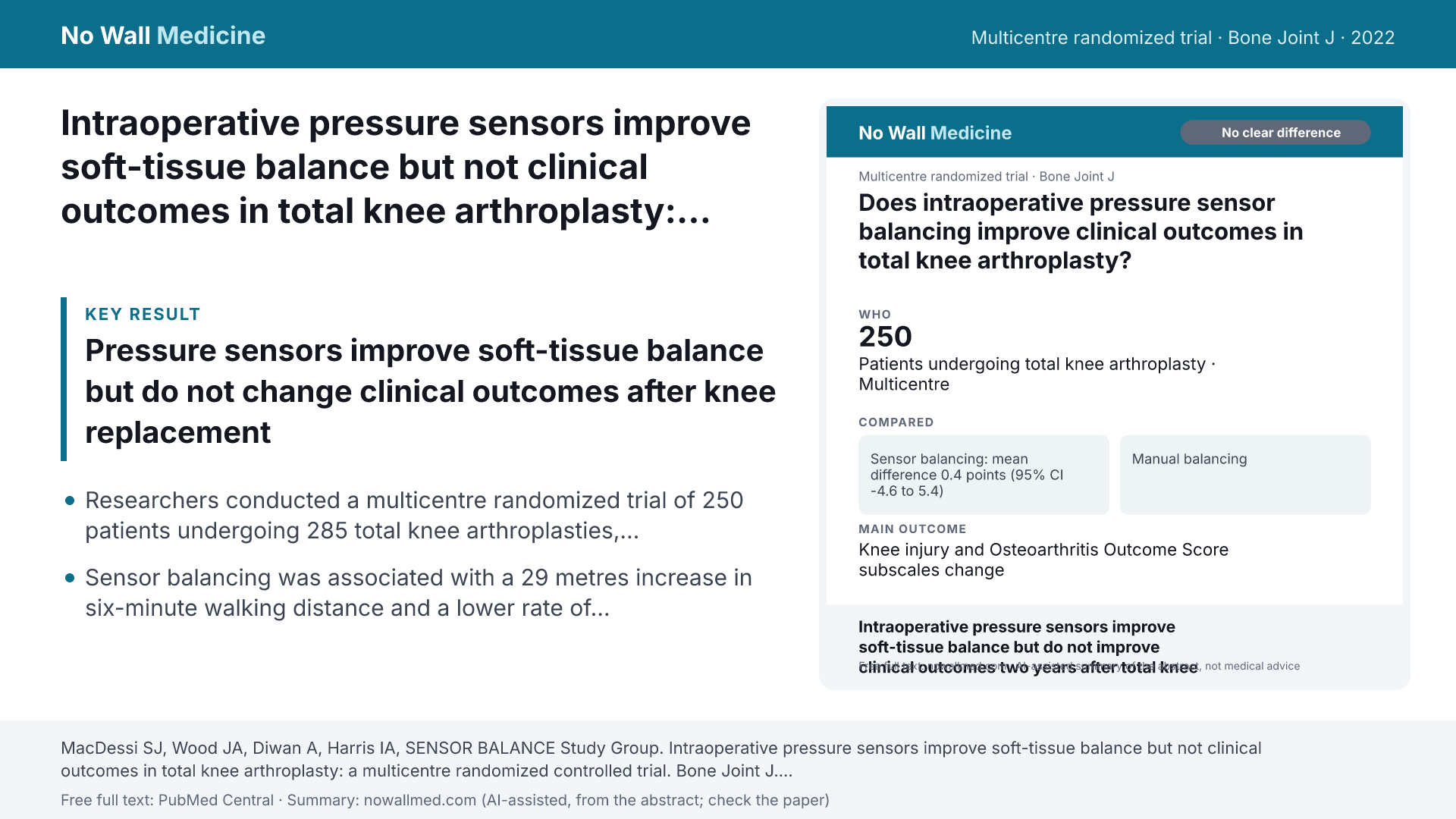
Intraoperative pressure sensors improve soft-tissue balance but not clinical outcomes in total knee arthroplasty: a multicentre randomized controlled trial
Multicentre randomized trialNo clear difference
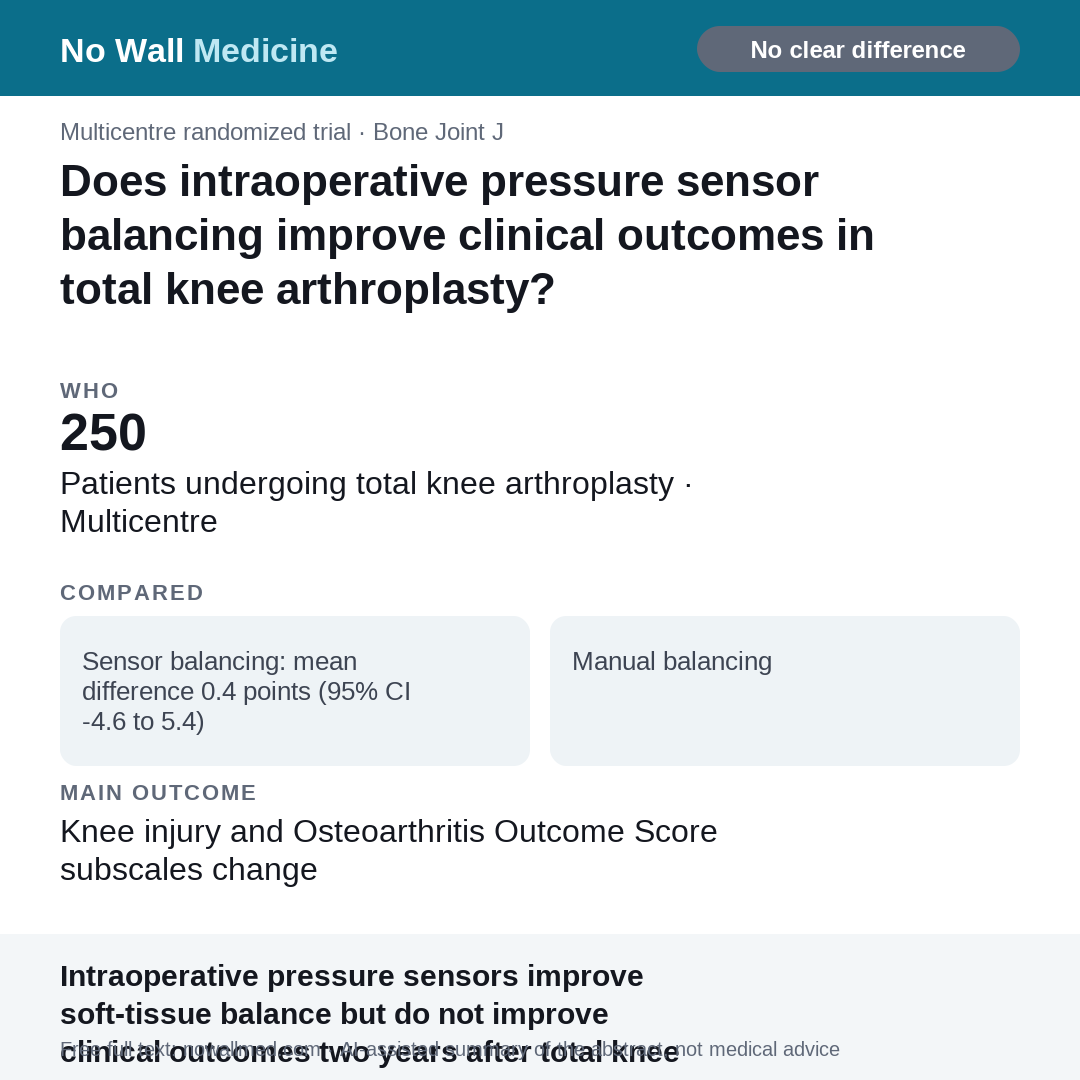
Does intraoperative pressure sensor balancing improve clinical outcomes in total knee arthroplasty?
Who
250
Patients undergoing total knee arthroplasty · Multicentre
Compared
Sensor balancing: mean difference 0.4 points (95% CI -4.6 to 5.4)
Manual balancing
Main outcome
Knee injury and Osteoarthritis Outcome Score subscales change
Result: mean difference 0.4 points (95% CI -4.6 to 5.4)
Bottom line: Intraoperative pressure sensors improve soft-tissue balance but do not improve clinical outcomes two years after total knee arthroplasty.
Bone Joint J · 2022-05-02Download image
Clinical question: Does intraoperative pressure sensor balancing improve clinical outcomes in total knee arthroplasty?
Why it matters: It is unknown whether using sensors to quantify soft-tissue balance during total knee arthroplasty leads to better clinical or functional outcomes than manual balancing.
Key points
- Researchers conducted a multicentre randomized trial of 250 patients undergoing 285 total knee arthroplasties, comparing sensor balancing to manual balancing.
- Sensor balancing was associated with a 29 metres increase in six-minute walking distance and a lower rate of unbalanced knees (9.4% vs 36.8%).
- There was no significant difference in the mean change of the four Knee injury and Osteoarthritis Outcome Score subscales at two years (0.4 points; 95% CI -4.6 to 5.4).
Headline and key points written with AI from the paper’s abstract, with every number checked against it. Read the paper before relying on them.
Was this summary helpful?
Subject terms
Cite this article
MacDessi SJ, Wood JA, Diwan A, Harris IA, SENSOR BALANCE Study Group. Intraoperative pressure sensors improve soft-tissue balance but not clinical outcomes in total knee arthroplasty: a multicentre randomized controlled trial. Bone Joint J. 2022. doi:10.1302/0301-620X.104B5.BJJ-2021-1299.R2
Spotted a mistake? Suggest a correction