No difference in long-term micromotion between fully cemented and hybrid fixation in revision total knee arthroplasty: a randomized controlled trial
Randomized controlled trialNo clear difference
Is there a difference in long-term micromotion between fully cemented and hybrid fixation in revision total knee arthroplasty?
Who
19
Patients undergoing revision total knee arthroplasty with type I or II osseous defects
Compared
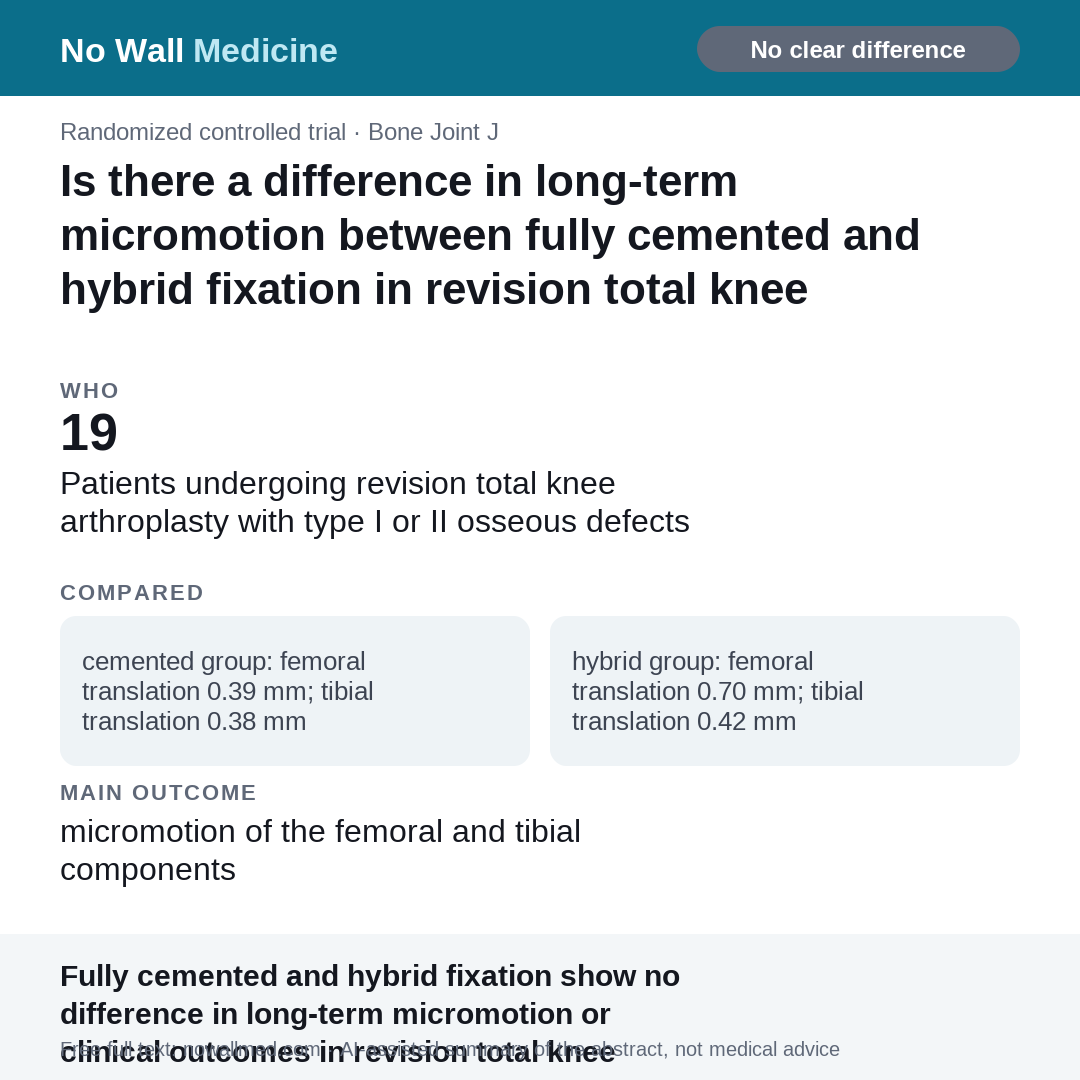
cemented group: femoral translation 0.39 mm; tibial translation 0.38 mm
hybrid group: femoral translation 0.70 mm; tibial translation 0.42 mm
Main outcome
micromotion of the femoral and tibial components
Bottom line: Fully cemented and hybrid fixation show no difference in long-term micromotion or clinical outcomes in revision total knee arthroplasty.
Bone Joint J · 2022-07-01Download image
Clinical question: Is there a difference in long-term micromotion between fully cemented and hybrid fixation in revision total knee arthroplasty?
Abstract
Aims
Both the femoral and tibial component are usually cemented at revision total knee arthroplasty (rTKA), while stems can be added with either cemented or press-fit (hybrid) fixation. The aim of this study was to compare the long-term stability of rTKA with cemented and press-fitted stems, using radiostereometric analysis (RSA). Methods
This is a follow-up of a randomized controlled trial, initially involving 32 patients, of whom 19 (nine cemented, ten hybrid) were available for follow-up ten years postoperatively, when further RSA measurements were made. Micromotion of the femoral and tibial components was assessed using model-based RSA software (RSAcore). The clinical outcome was evaluated using the Knee Society Score (KSS), the Knee injury and Osteoarthritis Outcome Score (KOOS), and visual analogue scale (pain and satisfaction). Results
The median total femoral translation and rotation at ten years were 0.39 mm (interquartile range (IQR) 0.20 to 0.54) and 0.59° (IQR 0.46° to 0.73°) for the cemented group and 0.70 mm (IQR 0.15 to 0.77) and 0.78° (IQR 0.47° to 1.43°) for the hybrid group. For the tibial components this was 0.38 mm (IQR 0.33 to 0.85) and 0.98° (IQR 0.38° to 1.34°) for the cemented group and 0.42 mm (IQR 0.30 to 0.52) and 0.72° (IQR 0.62° to 0.82°) for the hybrid group. None of these values were significantly different between the two groups and there were no significant differences between the clinical scores in the two groups at this time. There was only one re-revision, in the hybrid group, for infection and not for aseptic loosening. Conclusion
These results show good long-term fixation with no difference in micromotion and clinical outcome between fully cemented and hybrid fixation in rTKA, which builds on earlier short- to mid-term results. The patients all had type I or II osseous defects, which may in part explain the good results. Cite this article: Bone Joint J 2022;104-B(7):875-883.
Subject terms
Cite this article
Mills K, Wymenga AB, van Hellemondt GG, Heesterbeek PJC. No difference in long-term micromotion between fully cemented and hybrid fixation in revision total knee arthroplasty: a randomized controlled trial. Bone Joint J. 2022. doi:10.1302/0301-620X.104B7.BJJ-2021-1600.R1
Spotted a mistake? Suggest a correction
Top studies every Monday
The week’s key trials and guidelines in your specialties, plus any topics you follow. By email, free.
Get the weekly digest