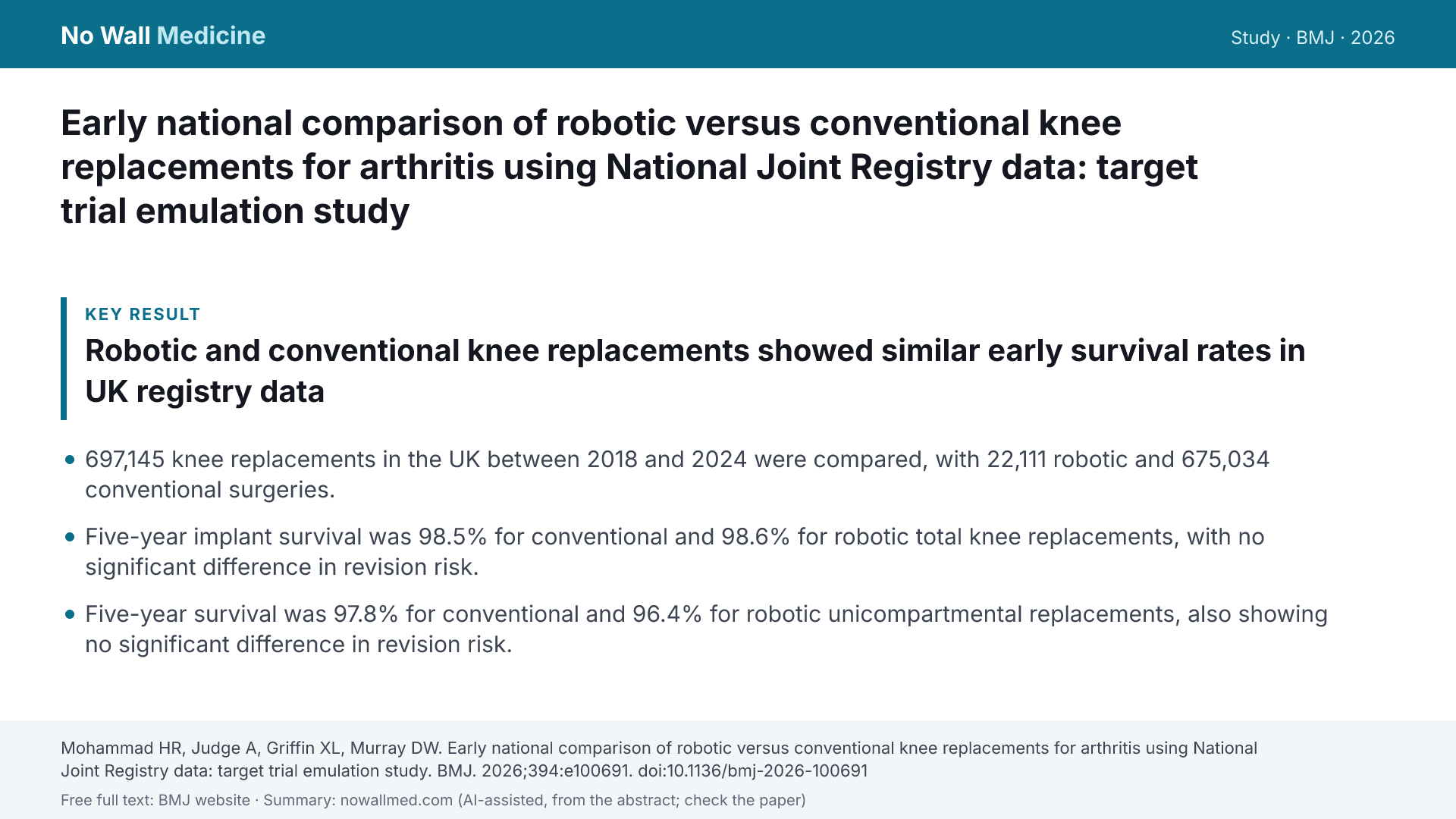
Robotic and conventional knee replacements showed similar early survival rates in UK registry data
Early national comparison of robotic versus conventional knee replacements for arthritis using National Joint Registry data: target trial emulation study
Key points
- 697,145 knee replacements in the UK between 2018 and 2024 were compared, with 22,111 robotic and 675,034 conventional surgeries.
- Five-year implant survival was 98.5% for conventional and 98.6% for robotic total knee replacements, with no significant difference in revision risk.
- Five-year survival was 97.8% for conventional and 96.4% for robotic unicompartmental replacements, also showing no significant difference in revision risk.
Limitation the authors note: The observational design means the possibility of unmeasured and residual confounding cannot be ruled out.
Study type: Observational study: it can show a link, but not prove that one thing causes another.
Headline and key points written with AI from the paper’s abstract, with every number checked against it. Read the paper before relying on them.
Was this summary helpful?
Abstract
Objective
To evaluate the early comparative effectiveness of robotic versus conventional total knee replacement (TKR) and unicompartmental knee replacement (UKR) in the UK. Design
Target trial emulation study. Setting
Public and private hospitals using data from the National Joint Registry of England, Wales, Northern Ireland, the Isle of Man, Guernsey, and Jersey. Participants
697 145 knee replacement surgeries between 2018 and 2024: 675 034 were conventional (TKRs and UKRs) and 22 111 were robotic. Main outcome measures
The main outcome was five year knee replacement survival (mean 2.5 years follow-up); all cause revision risk; cause specific revision risk; intraoperative complications; and revision complexity of robotic versus conventional (TKR and UKR) knee replacement. Kaplan-Meier and Cox regression analyses were used to compare implant survival and indications for revision surgery. Propensity score matching using target trial emulation framework was used to estimate the average treatment effect in the treated population. Results
The five year implant survival of the matched conventional and robotic TKR groups was 98.5% (95% confidence interval (CI) 98.3% to 98.7%) and 98.6% (98.2% to 99.0%), respectively, with no between group difference in revision risk (hazard ratio 1.03, 95% CI 0.86 to 1.26; P=0.71). The five year implant survival of the matched conventional and robotic UKR groups was 97.8% (95% CI 97.2% to 98.3%) and 96.4% (92.4% to 98.3%), respectively, with no between group difference in revision risk (hazard ratio 1.03, 95% CI 0.75 to 1.42; P=0.86). Cause specific revision risk and intraoperative complication risks did not differ between groups for either TKR or UKR. Conclusions
No statistically significant differences were detected in revision risk, cause specific risk, or intraoperative complication risk between the robotic and conventional groups. This was consistent for both TKR and UKR. The possibility of unmeasured and residual confounding cannot be ruled out, however, owing to the observational design of the study. These results highlight the importance of careful evaluation of robotic technology in publicly funded healthcare systems, given the substantially higher capital and procedural costs involved.
Abstract reproduced under the article’s CC BY NC licence.
Subject terms
Headline, design, result, key points, caveat and citation as plain text.
Cite this article
Mohammad HR, Judge A, Griffin XL, Murray DW. Early national comparison of robotic versus conventional knee replacements for arthritis using National Joint Registry data: target trial emulation study. BMJ. 2026;394:e100691. doi:10.1136/bmj-2026-100691
Spotted a mistake? Suggest a correction