Web-based cognitive behavioral therapy reduced alcohol use and anxiety in emerging adults
Are we making Inroads? A randomized controlled trial of a psychologist-supported, web-based, cognitive behavioral therapy intervention to reduce anxiety and hazardous alcohol use among emerging adults
Randomized controlled trialBenefit found
Does a psychologist-supported web-based cognitive behavioral therapy intervention reduce anxiety and hazardous alcohol use?
Who
123
123 emerging adults aged 17-24 reporting anxiety and hazardous alcohol use
Compared
Inroads intervention: greater alcohol reductions by 6-month follow-up
Control: assessment plus alcohol information
Main outcome
alcohol consumption, alcohol-related consequences, and general anxiety symptoms
Result: mean difference -0.74, 95% CI: -1.47 to -0.01
Bottom line: The Inroads program demonstrated beneficial effects on alcohol consumption, hazardous alcohol use, and anxiety symptoms in emerging adults.
Funded by: Australian Rotary Health, Australian National Health and Medical Research Council
eClinicalMedicine · 2021-08-08 · Save PNG
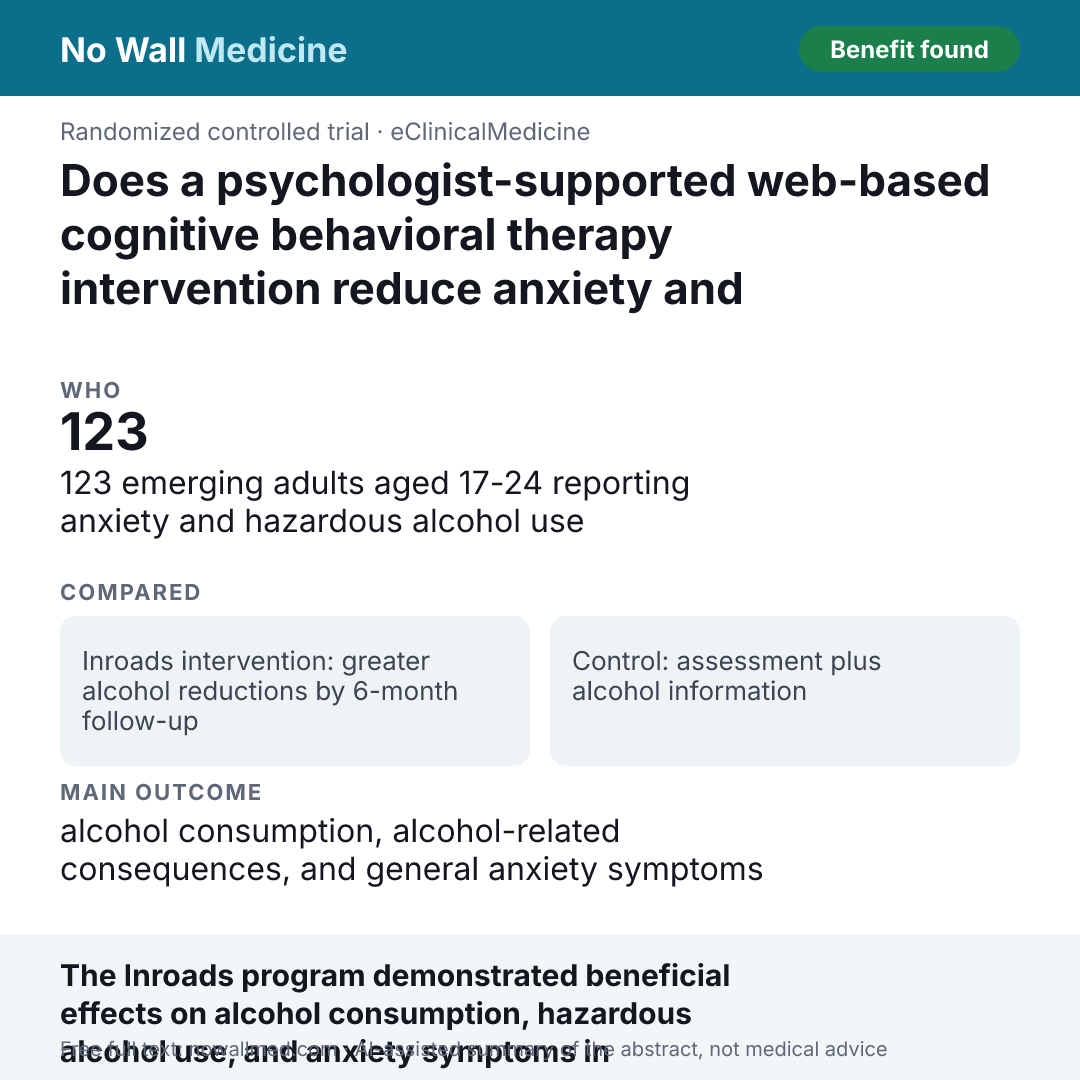
Clinical question: Does a psychologist-supported web-based cognitive behavioral therapy intervention reduce anxiety and hazardous alcohol use?
Why it matters: Anxiety and alcohol use disorders are common and often escalate during emerging adulthood, but people frequently endure these conditions for years before accessing treatment.
Key points
- The study randomized 123 emerging adults aged 17-24 with anxiety and hazardous alcohol use to either a psychologist-supported web program or a control group.
- At 6-month follow-up, the web program group showed greater reductions in alcohol consumption compared to controls with a mean difference of -0.74.
- Participants in the web program also reported lower general anxiety symptoms with a mean difference of -3.06 and lower social anxiety with a mean difference of -3.21 at 2 months.
Headline and key points written with AI from the paper’s abstract, with every number checked against it. Read the paper before relying on them.
Was this summary helpful?
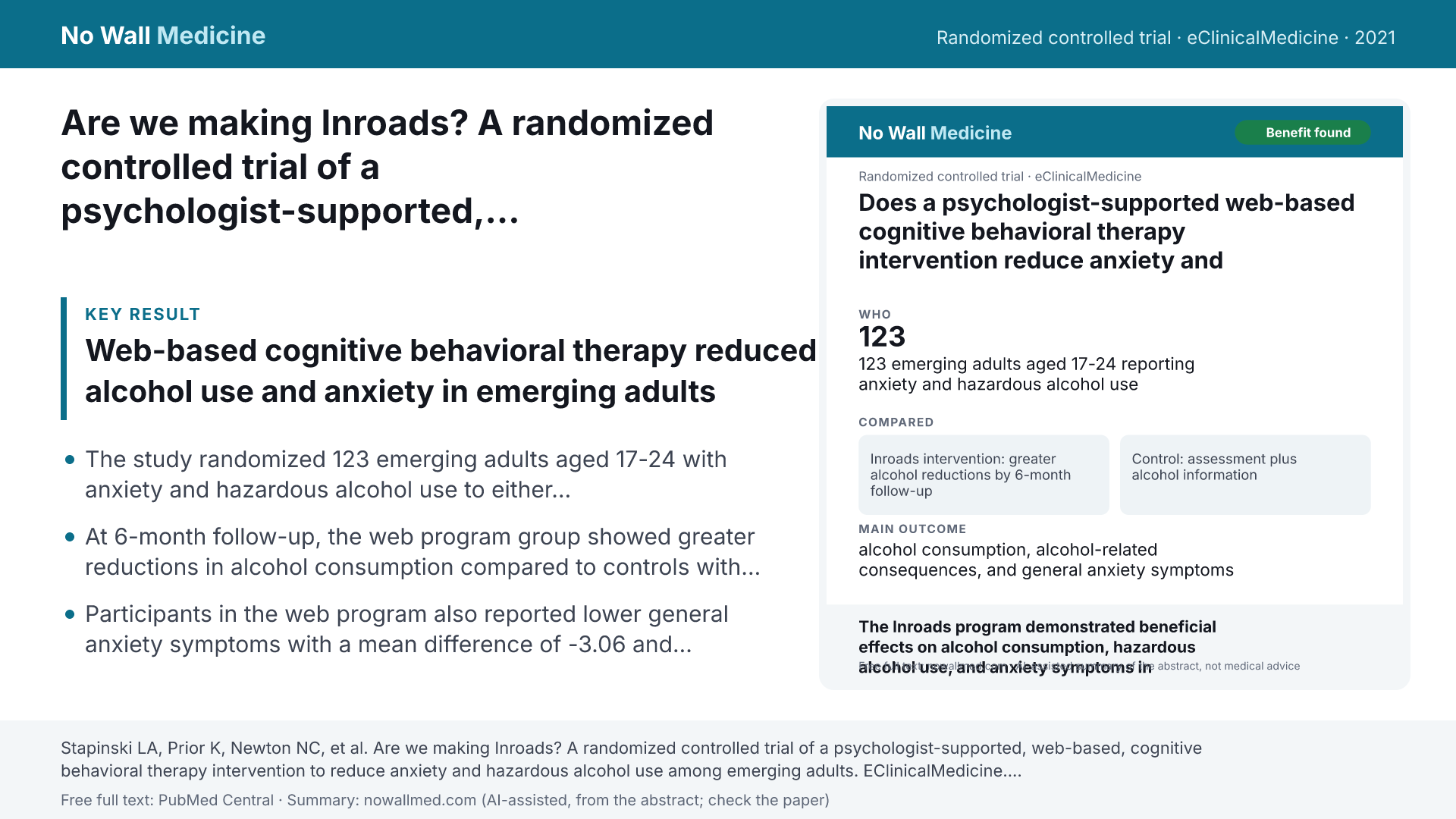
Headline, design, result, key points, caveat and citation as plain text.
Cite this article
Stapinski LA, Prior K, Newton NC, et al. Are we making Inroads? A randomized controlled trial of a psychologist-supported, web-based, cognitive behavioral therapy intervention to reduce anxiety and hazardous alcohol use among emerging adults. eClinicalMedicine. 2021. doi:10.1016/j.eclinm.2021.101048
Spotted a mistake? Suggest a correction