Continuous monitoring shows high arrhythmia burden in heart failure patients regardless of congestion management strategy
Arrhythmia Burden and Clinical Responses Under Continuous Monitoring in Heart Failure: Observations From the ALLEVIATE-HF Trial
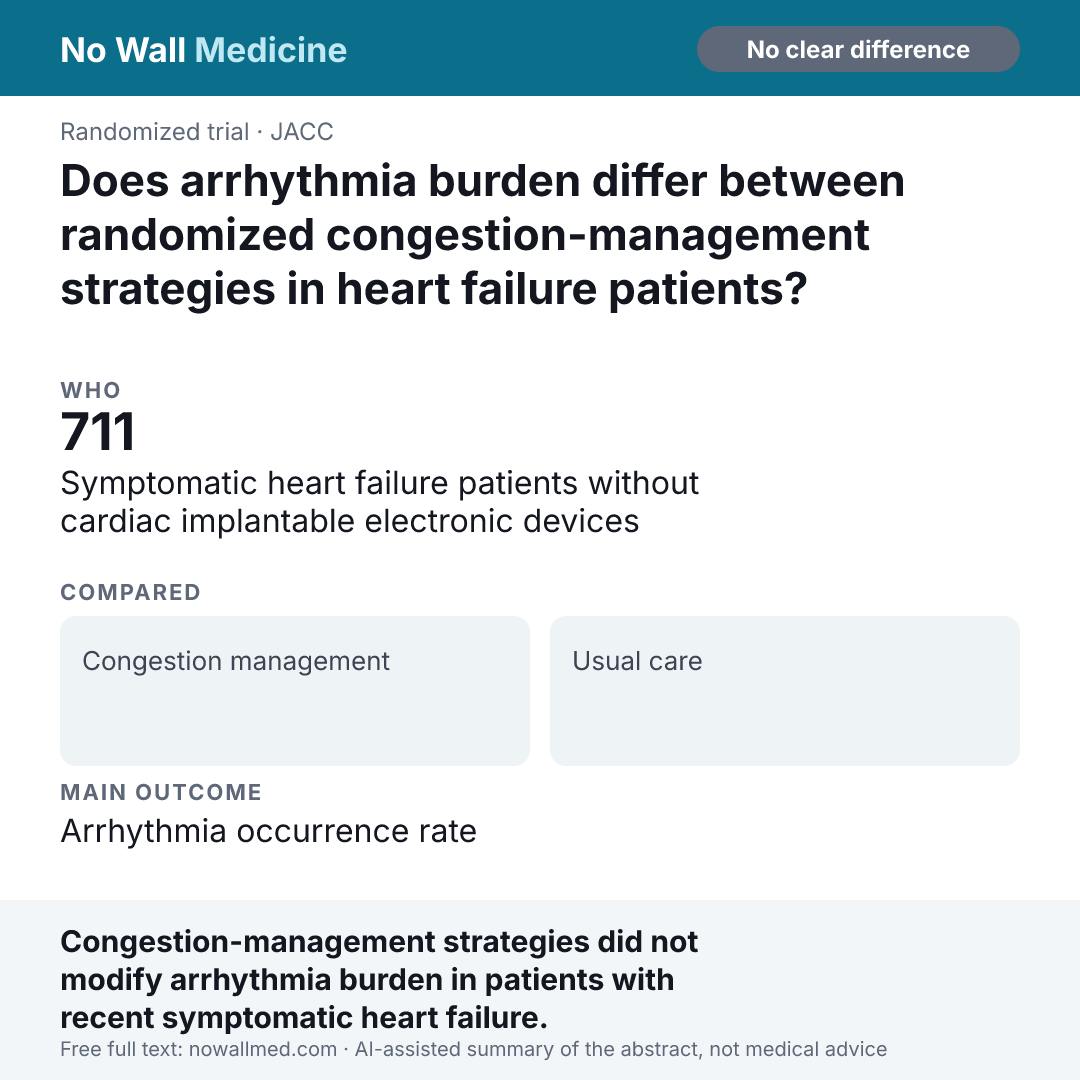
Randomized trialNo clear difference
Does arrhythmia burden differ between randomized congestion-management strategies in heart failure patients?
Who
711
Symptomatic heart failure patients without cardiac implantable electronic devices
Compared
Congestion management
Usual care
Main outcome
Arrhythmia occurrence rate
Bottom line: Congestion-management strategies did not modify arrhythmia burden in patients with recent symptomatic heart failure.
JACC · 2026-05-27 · Save PNG
Same trial (NCT04452149)
Papers we list that report this registered trial, oldest first. Read a secondary analysis alongside the main results.
- Main results
Personalized medication adjustments based on cardiac monitor risk scores were safe in heart failure patients J Am Heart Assoc 2024-10 - Related analysis No clear difference
This paper JACC 2026-05 - Related analysis No clear difference
Nurse-managed diuretic interventions based on heart monitors did not improve heart failure outcomes JACC 2026-05
Clinical question: Does arrhythmia burden differ between randomized congestion-management strategies in heart failure patients?
Why it matters: The arrhythmia burden in ambulatory patients with symptomatic heart failure without implanted electronic devices is not well defined.
Key points
- Researchers studied 711 patients with symptomatic heart failure and recent events to compare different congestion management strategies using insertable cardiac monitors.
- The rate of arrhythmia occurrence did not differ between the management arms, though 66.6% of patients experienced atrial fibrillation over three years.
- Recorded arrhythmias were associated with an increased risk of all-cause hospitalization and heart failure events.
Headline and key points written with AI from the paper’s abstract, with every number checked against it. Read the paper before relying on them.
Was this summary helpful?
Subject terms
Headline, design, result, key points, caveat and citation as plain text.
Cite this article
Kahwash R, Butler J, Khan MS, et al. Arrhythmia Burden and Clinical Responses Under Continuous Monitoring in Heart Failure: Observations From the ALLEVIATE-HF Trial. J Am Coll Cardiol. 2026;87(25):3611-3628. doi:10.1016/j.jacc.2026.03.174
Spotted a mistake? Suggest a correction