Artificial intelligence assisted colonoscopy increased adenoma detection rates compared to conventional colonoscopy in asymptomatic patients
Artificial Intelligence-Assisted Colonoscopy for Colorectal Cancer Screening: A Multicenter Randomized Controlled Trial
Multicenter randomized controlled trialBenefit found
Does artificial intelligence-assisted colonoscopy improve adenoma detection rate in asymptomatic populations?
Who
3059
Asymptomatic subjects 45-75 years of age · 6 referral centers in China
Compared
39.9%Artificial intelligence-assisted colonoscopy
32.4%Conventional colonoscopy
Main outcome
overall adenoma detection rate
Bottom line: Artificial intelligence-assisted colonoscopy improved overall adenoma detection rate in asymptomatic patients compared to conventional colonoscopy.
Clin Gastroenterol Hepatol · 2022-07-19Download image
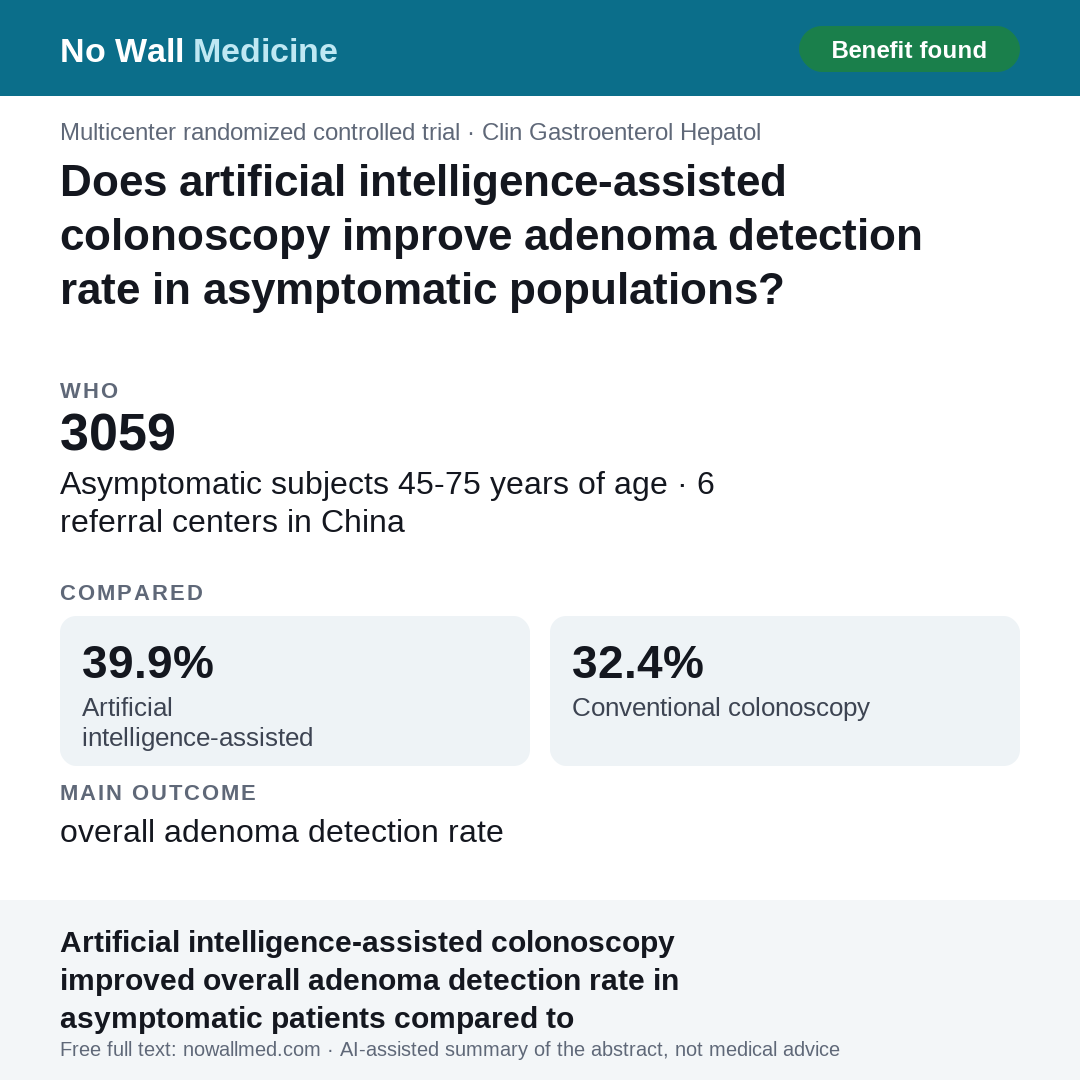
Clinical question: Does artificial intelligence-assisted colonoscopy improve adenoma detection rate in asymptomatic populations?
Why it matters: Large-scale multicenter randomized controlled trial data regarding the use of artificial intelligence for polyp detection in asymptomatic populations were lacking.
In absolute numbers
Artificial intelligence-assisted colonoscopy: 39.9% · Conventional colonoscopy: 32.4% → a difference of 7.5 percentage points, so about 14 people would need the treatment for 1 more to benefit (number needed to treat) over the trial’s follow-up.
Worked out by us from the two group results above, not reported by the authors. Check the paper for the exact outcome and timing.
Key points
- Researchers studied 3059 asymptomatic subjects randomized to receive either artificial intelligence assisted colonoscopy or conventional colonoscopy.
- The overall adenoma detection rate, which is the percentage of patients found to have polyps, was 39.9% for artificial intelligence assisted colonoscopy versus 32.4% for conventional colonoscopy.
- The median colonoscopy withdrawal time was 8.3 minutes for the artificial intelligence group compared to 7.8 minutes for the conventional group.
Headline and key points written with AI from the paper’s abstract, with every number checked against it. Read the paper before relying on them.
Topics
Cite this article
Xu H, Tang RSY, Lam TYT, Zhao G, Lau JYW, Liu Y. Artificial Intelligence-Assisted Colonoscopy for Colorectal Cancer Screening: A Multicenter Randomized Controlled Trial. Clin Gastroenterol Hepatol. 2022. doi:10.1016/j.cgh.2022.07.006
Spotted a mistake? Suggest a correction
Top studies every Monday
The week’s key trials and guidelines in your specialties, plus any topics you follow. By email, free.
Get the weekly digest