Advanced neoplasia rates at second surveillance colonoscopy depend on baseline and first surveillance findings
Yield of Advanced Neoplasia at Second Post-polypectomy Surveillance Colonoscopy: A Systematic Review and Meta-analysis
Systematic review and meta-analysisMixed results
What is the yield of advanced neoplasia at the second surveillance colonoscopy?
Who
5912
Individuals with at least one prior surveillance colonoscopy
Compared
Baseline no adenoma: 4% (95% CI 2.5%-6.5%) after no adenoma
Baseline nonadvanced neoplasia: 9.1% (95% CI 6.7%-12.3%) after nonadvanced neoplasia
Baseline advanced neoplasia: 26.1% (95% CI 18.4%-35.5%) after advanced neoplasia
Main outcome
Advanced neoplasia rate at second surveillance colonoscopy
Bottom line: Risk of advanced neoplasia at second surveillance depends on both baseline and first surveillance findings.
Limitation: Included 11 observational studies
Clin Gastroenterol Hepatol · 2025-06-13Download image
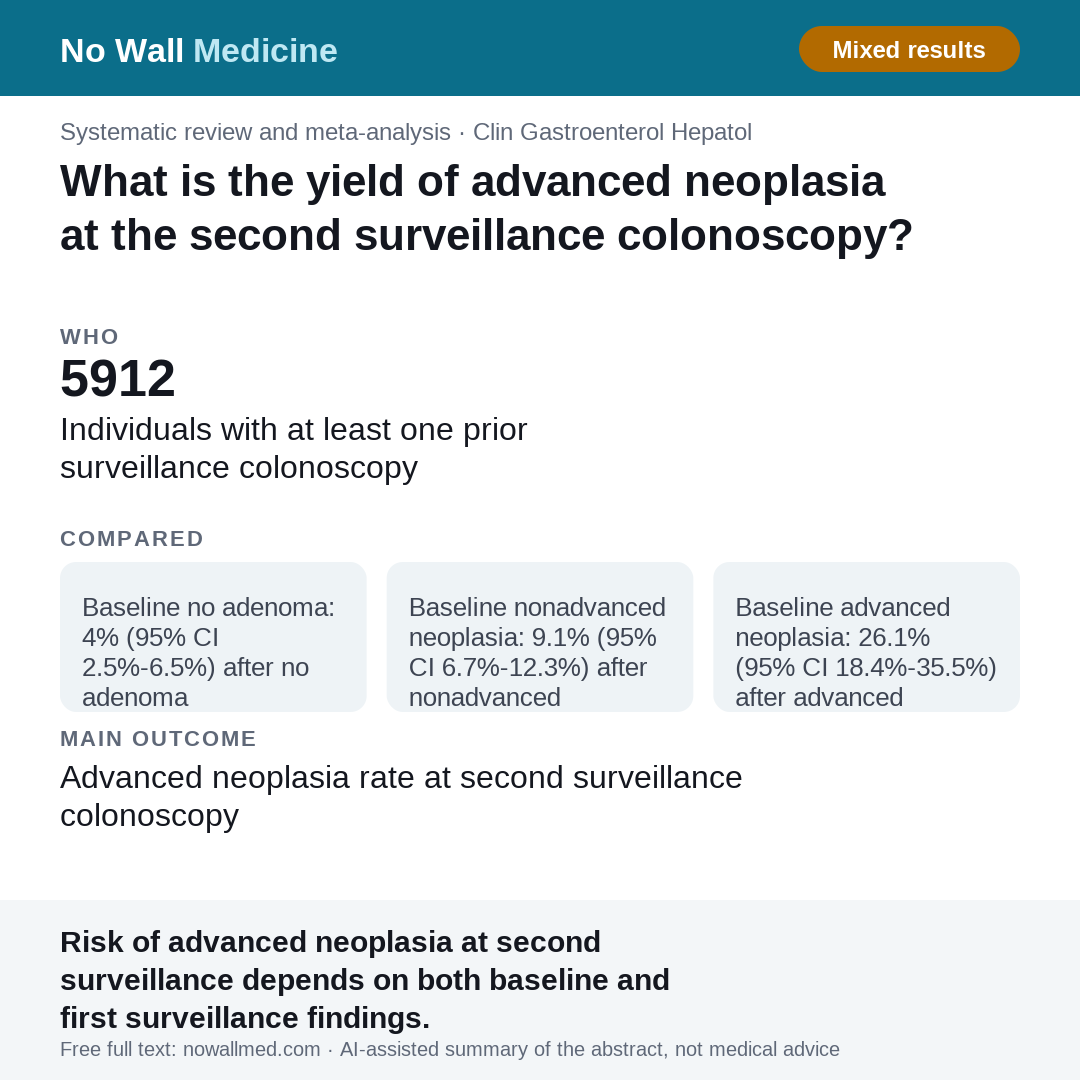
Clinical question: What is the yield of advanced neoplasia at the second surveillance colonoscopy?
Why it matters: Evidence is limited regarding the risk for subsequent neoplasia and the appropriate timing for surveillance colonoscopies in individuals who have already had a polypectomy.
Key points
- Researchers analyzed 5912 individuals from 11 observational studies to measure the rate of advanced neoplasia, which refers to precancerous or cancerous growths, at a second surveillance colonoscopy.
- Among those with baseline advanced neoplasia, the proportion with advanced neoplasia at second surveillance was 9.1% after no adenoma, 12.8% after nonadvanced neoplasia, and 26.1% after advanced neoplasia.
- For individuals with no adenoma at baseline, the proportion with advanced neoplasia at second surveillance was 4% after no adenoma, 7.2% after nonadvanced neoplasia, and 11.4% after advanced neoplasia.
Headline and key points written with AI from the paper’s abstract, with every number checked against it. Read the paper before relying on them.
Was this summary helpful?
Subject terms
Cite this article
Pandita P, Le Y, Trivedi M, Heskett K, Demb J, Singh S. Yield of Advanced Neoplasia at Second Post-polypectomy Surveillance Colonoscopy: A Systematic Review and Meta-analysis. Clin Gastroenterol Hepatol. 2025. doi:10.1016/j.cgh.2025.02.038
Spotted a mistake? Suggest a correction
Top studies every Monday
The week’s key trials and guidelines in your specialties, plus any topics you follow. By email, free.
Get the weekly digest