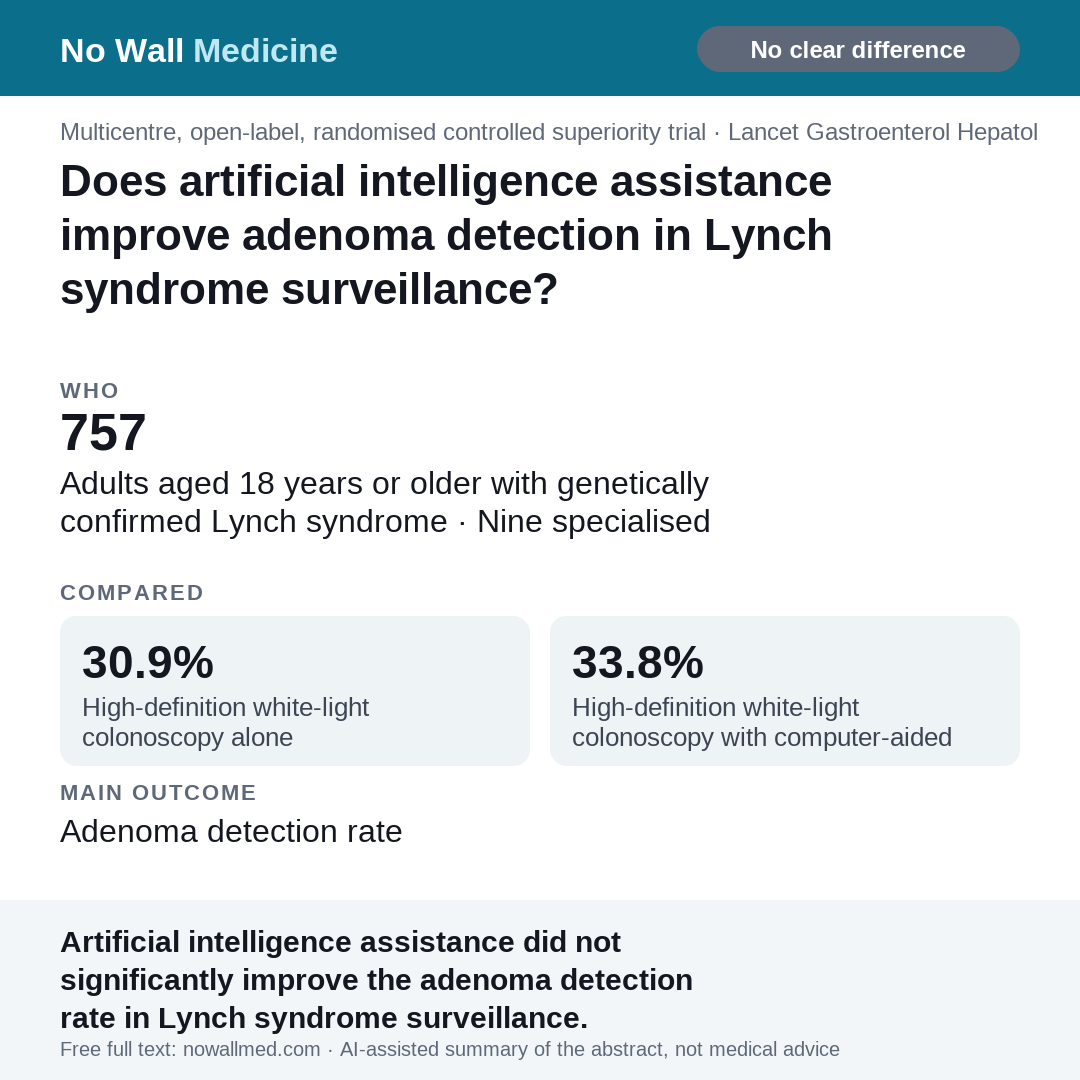
Does artificial intelligence assistance improve adenoma detection in Lynch syndrome surveillance?
Who
757
Adults aged 18 years or older with genetically confirmed Lynch syndrome · Nine specialised hereditary cancer surveillance centres in four European countries
Compared
30.9%High-definition white-light colonoscopy alone (114 of 369 patients)
33.8%High-definition white-light colonoscopy with computer-aided assistance (123 of 364 patients)
Main outcome
Adenoma detection rate
Result: odds ratio 1.14 (95% CI 0.83-1.57)
Bottom line: Artificial intelligence assistance did not significantly improve the adenoma detection rate in Lynch syndrome surveillance.
Funded by: National Center for Hereditary Tumor Syndromes, University Hospital Bonn
Clinical question: Does artificial intelligence assistance improve adenoma detection in Lynch syndrome surveillance?
Why it matters: Evidence regarding the use of computer-aided detection systems for monitoring patients with Lynch syndrome is currently sparse and inconsistent.
Key points
Researchers studied 733 adults with genetically confirmed Lynch syndrome, comparing standard high-definition white-light colonoscopy to colonoscopy with computer-aided detection and diagnosis assistance.
The adenoma detection rate was 30.9% in the standard group versus 33.8% in the artificial intelligence group, which was not a statistically significant difference.
The computer-aided diagnosis system for differentiating lesions had a sensitivity of 85.9% and a specificity of 91.4% when compared to histopathology.
Headline and key points written with AI from the paper’s abstract, with every number checked against it. Read the paper before relying on them.
Background
Artificial intelligence (AI)-based computer-aided detection (CADe) systems improve adenoma detection in average-risk colorectal cancer screening. Meanwhile, evidence in Lynch syndrome surveillance is sparse and inconsistent. We assessed the effect of CADe on adenoma detection during Lynch syndrome surveillance. Computer-aided optical diagnosis (CADx) performance for optical differentiation of colorectal lesions was evaluated as a secondary aim. Methods
CADLY2 was an international, multicentre, open-label, randomised controlled superiority trial at nine specialised hereditary cancer surveillance centres in Belgium, Germany, the Netherlands, and Spain. Adults aged 18 years or older with genetically confirmed Lynch syndrome scheduled for surveillance colonoscopy were randomly assigned (1:1) to high-definition white-light (HD-WL) colonoscopy alone or to HD-WL colonoscopy with computer-aided assistance from CAD EYE (Fujifilm, Tokyo, Japan). CAD EYE was used for CADe during withdrawal and for CADx after lesion detection. Randomisation was done centrally through a secure web-based system using Pocock's minimisation algorithm with a stochastic component and was stratified by centre, sex, previous colorectal cancer, underlying pathogenic variant, and interval since previous colonoscopy. Allocation concealment was ensured through the centralised web-based system. Patients were masked to group allocation until the start of withdrawal in procedures with mild sedation, or until completion of the procedure in procedures with propofol-based sedation. Endoscopists were not masked. The primary outcome was adenoma detection rate, defined as the proportion of patients with at least one histopathologically confirmed adenoma, analysed in the full analysis set (defined as all randomly allocated patients with available data for the primary outcome). The diagnostic performance of the CADx system was evaluated as a secondary outcome. The safety analysis set comprised all randomly allocated patients who underwent a study colonoscopy. This study is registered with the German Clinical Trials Register, DRKS00030695, and is completed. Findings
Between May 9, 2023, and Oct 30, 2025, 757 patients were randomly allocated to HD-WL colonoscopy (377 patients) or to AI-assisted colonoscopy (380 patients); 733 patients were included in the full analysis set (369 HD-WL and 364 AI-assisted). The median age was 49 years (IQR 38-59) in the HD-WL group and 50 years (38-59) in the AI-assisted group; 213 (58%) were female and 156 (42%) male in the HD-WL group, and 207 (57%) were female and 157 (43%) male in the AI-assisted group. The adenoma detection rate was 30·9% (114 of 369 patients) with HD-WL versus 33·8% (123 of 364 patients) with CADe assistance (odds ratio 1·14 [95% CI 0·83-1·57], p=0·41). For CADx differentiation of neoplastic versus non-neoplastic lesions in the paired lesion-level analysis, with histopathology as the reference standard and sessile serrated lesions and traditional serrated adenomas classified as non-neoplastic, CADx sensitivity was 85·9% (95% CI 82·0-89·1) and specificity was 91·4% (89·4-93·0). Three adverse events occurred in the AI-assisted group: two mild post-polypectomy bleedings and one serious pulmonary embolism or deep venous thrombosis unrelated to the procedure. No adverse events occurred in the HD-WL group. Interpretation
CADe-assisted colonoscopy did not show the absolute improvement in adenoma detection rate that was assumed in the prespecified sample-size calculation. CADx did not clearly improve lesion differentiation beyond expert optical diagnosis in expert Lynch syndrome surveillance settings. Funding
Third-party research funding of the National Center for Hereditary Tumor Syndromes, University Hospital Bonn.
Abstract reproduced under the article’s CC BY licence.
Topics
Humans; Female; Male; Middle Aged; Colonoscopy; Colorectal Neoplasms, Hereditary Nonpolyposis; Adult; Adenoma; Artificial Intelligence; Aged; Diagnosis, Computer-Assisted; Early Detection of Cancer
Comparative risk of hepatocellular carcinoma among people with chronic hepatitis B treated with tenofovir or entecavir: A population-based linkage study