Artificial intelligence chatbots showed efficacy in promoting healthy lifestyles and smoking cessation in systematic review
Artificial Intelligence-Based Chatbots for Promoting Health Behavioral Changes: Systematic Review
Systematic reviewMixed results
What is the feasibility and efficacy of artificial intelligence chatbots for promoting health behavior change?
Who
Diverse populations undergoing health behavior change interventions
Compared
6Healthy lifestyles (40%)
4Smoking cessation (27%)
2Treatment or medication adherence (13%)
1Reduction in substance misuse (7%)
Main outcome
Efficacy of artificial intelligence chatbots for behavior change
Bottom line: Artificial intelligence chatbots show efficacy for various health behaviors, but feasibility and usability results remain mixed.
Limitation: Moderate to high risk of internal validity and insufficient description of artificial intelligence techniques.
J Med Internet Res · 2023-02-24Download image
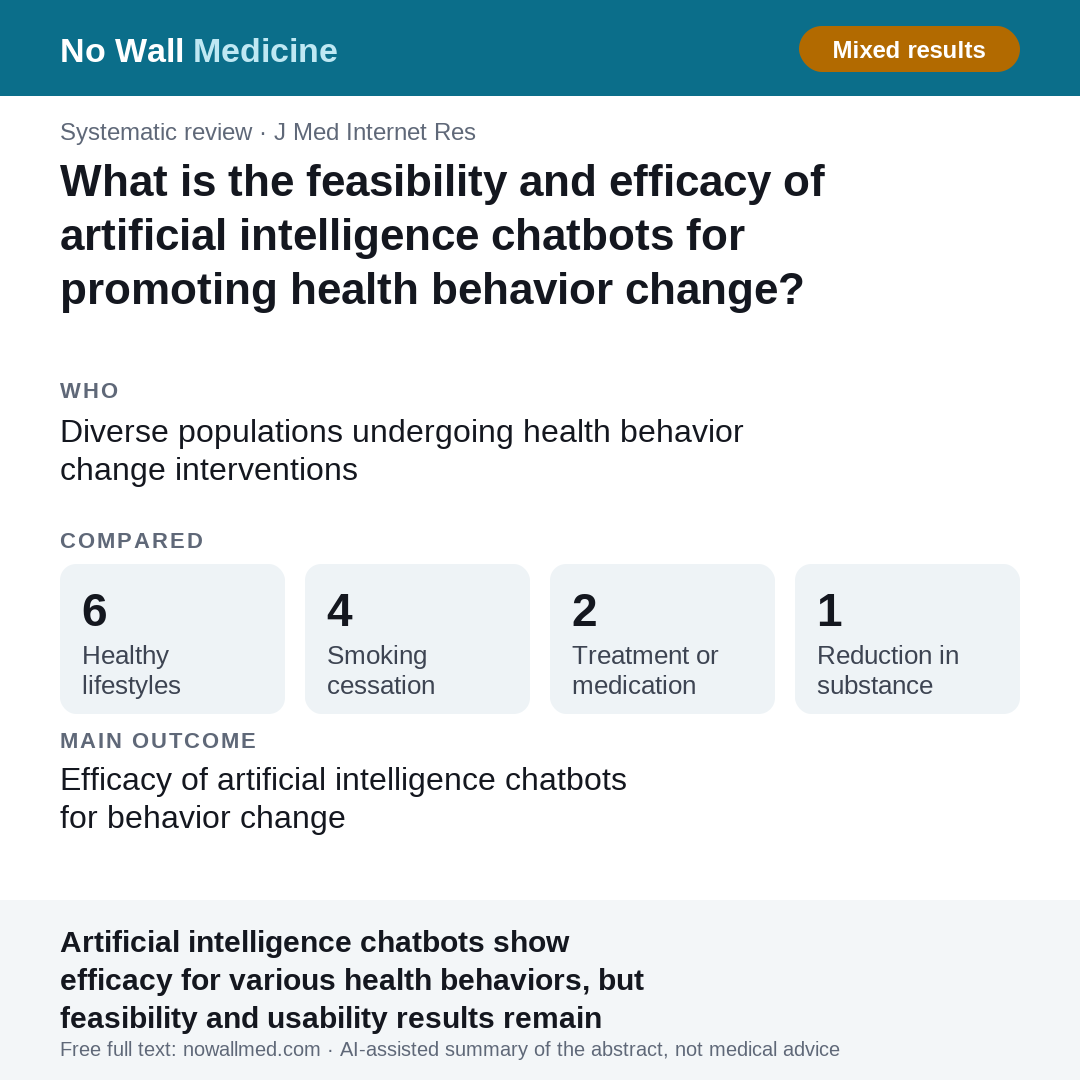
Clinical question: What is the feasibility and efficacy of artificial intelligence chatbots for promoting health behavior change?
Why it matters: It was unknown how effective and feasible artificial intelligence chatbots are for promoting specific health behavior changes.
Key points
- Researchers reviewed 15 studies published between 1980 and 2022 to evaluate how artificial intelligence chatbots promote changes in health behavior.
- Chatbots showed efficacy in promoting healthy lifestyles in 6 studies (40%), smoking cessation in 4 studies (27%), medication adherence in 2 studies (13%), and substance misuse reduction in 1 study (7%).
- The chatbots used strategies like goal setting and real-time feedback, and participants reported they provided a nonjudgmental space for sensitive information.
Limitation the authors note: The results require caution due to moderate to high risk of internal validity, insufficient description of artificial intelligence techniques, and limited generalizability.
Headline and key points written with AI from the paper’s abstract, with every number checked against it. Read the paper before relying on them.
Was this summary helpful?
Subject terms
Cite this article
Aggarwal A, Tam CC, Wu D, Li X, Qiao S. Artificial Intelligence-Based Chatbots for Promoting Health Behavioral Changes: Systematic Review. J Med Internet Res. 2023. doi:10.2196/40789
Spotted a mistake? Suggest a correction
Top studies every Monday
The week’s key trials and guidelines in your specialties, plus any topics you follow. By email, free.
Get the weekly digest