Artificial intelligence chatbots show small-to-moderate effects on mental distress and health behaviors in young people
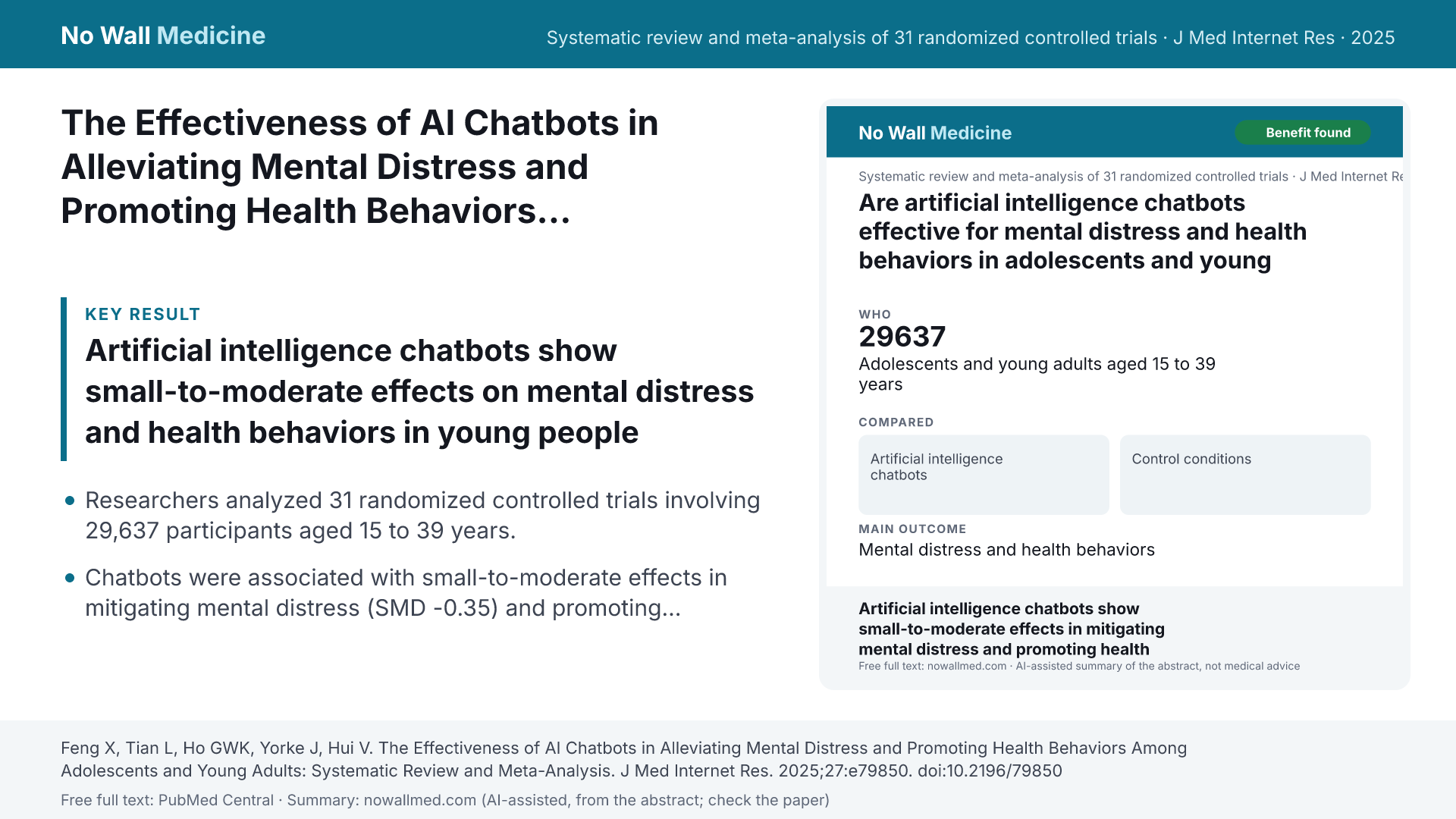
The Effectiveness of AI Chatbots in Alleviating Mental Distress and Promoting Health Behaviors Among Adolescents and Young Adults: Systematic Review and Meta-Analysis
Systematic review and meta-analysis of 31 randomized controlled trialsBenefit found
Are artificial intelligence chatbots effective for mental distress and health behaviors in adolescents and young adults?
Who
29637
Adolescents and young adults aged 15 to 39 years
Compared
Artificial intelligence chatbots
Control conditions
Main outcome
Mental distress and health behaviors
Result: standard mean difference -0.35 (95% CI -0.46 to -0.24) for mental distress; SMD 0.11 (95% CI 0.03 to 0.19) for health behaviors
Bottom line: Artificial intelligence chatbots show small-to-moderate effects in mitigating mental distress and promoting health behaviors among adolescents and young adults.
Limitation: Effectiveness varied by target samples, control conditions, design features, and user engagement barriers.
J Med Internet Res · 2025-11-26 · Save PNG
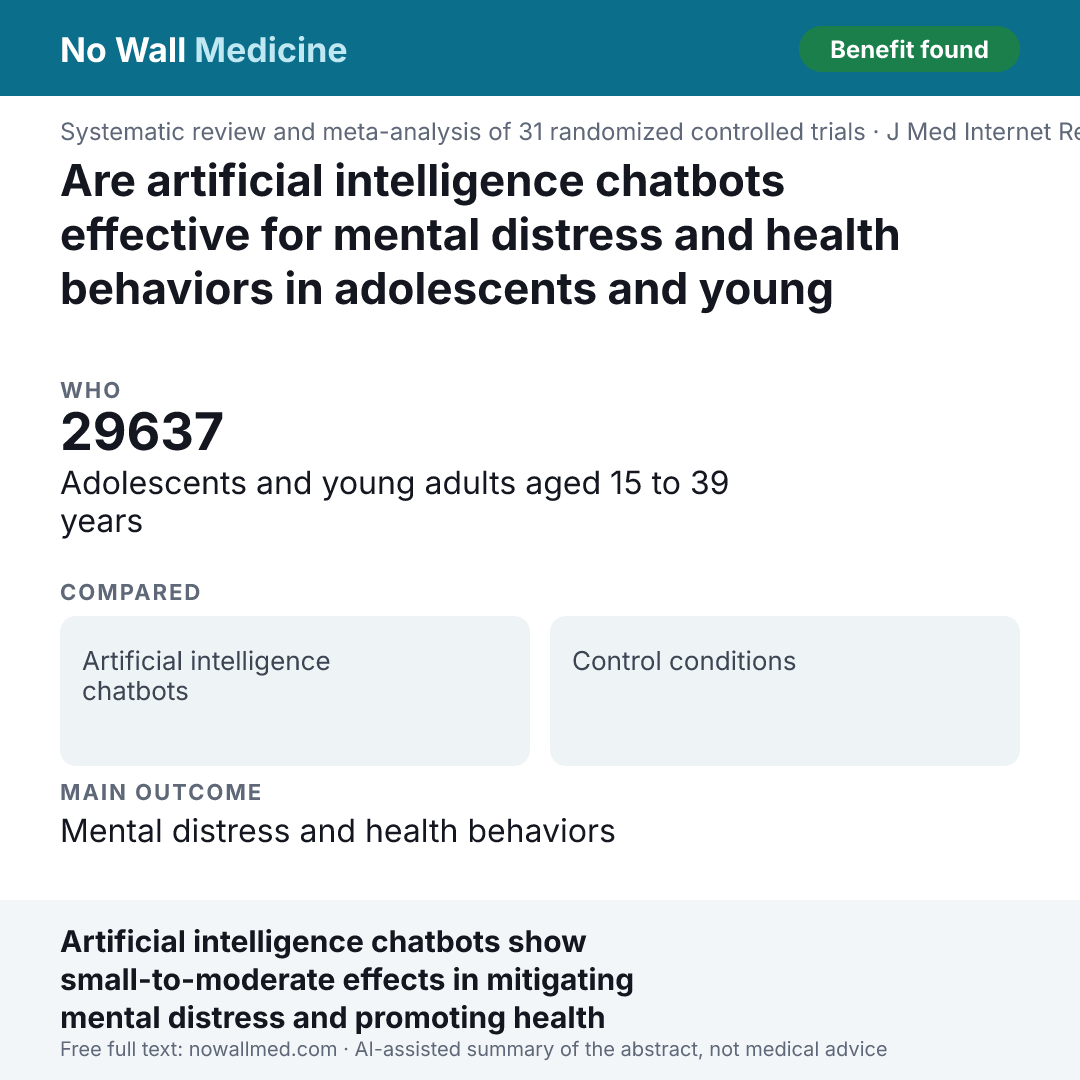
Clinical question: Are artificial intelligence chatbots effective for mental distress and health behaviors in adolescents and young adults?
Why it matters: Questions remain regarding how effective artificial intelligence chatbots are at addressing the unique mental health and health behavior challenges faced by adolescents and young adults.
Key points
- Researchers analyzed 31 randomized controlled trials involving 29,637 participants aged 15 to 39 years.
- Chatbots were associated with small-to-moderate effects in mitigating mental distress (SMD -0.35) and promoting health behaviors (SMD 0.11).
- Significant improvements were seen for depression (SMD -0.43), anxiety (SMD -0.37), stress (SMD -0.41), and psychosomatic symptoms (SMD -0.48).
Headline and key points written with AI from the paper’s abstract, with every number checked against it. Read the paper before relying on them.
Was this summary helpful?
Subject terms
Headline, design, result, key points, caveat and citation as plain text.
Cite this article
Feng X, Tian L, Ho GWK, Yorke J, Hui V. The Effectiveness of AI Chatbots in Alleviating Mental Distress and Promoting Health Behaviors Among Adolescents and Young Adults: Systematic Review and Meta-Analysis. J Med Internet Res. 2025;27:e79850. doi:10.2196/79850
Spotted a mistake? Suggest a correction