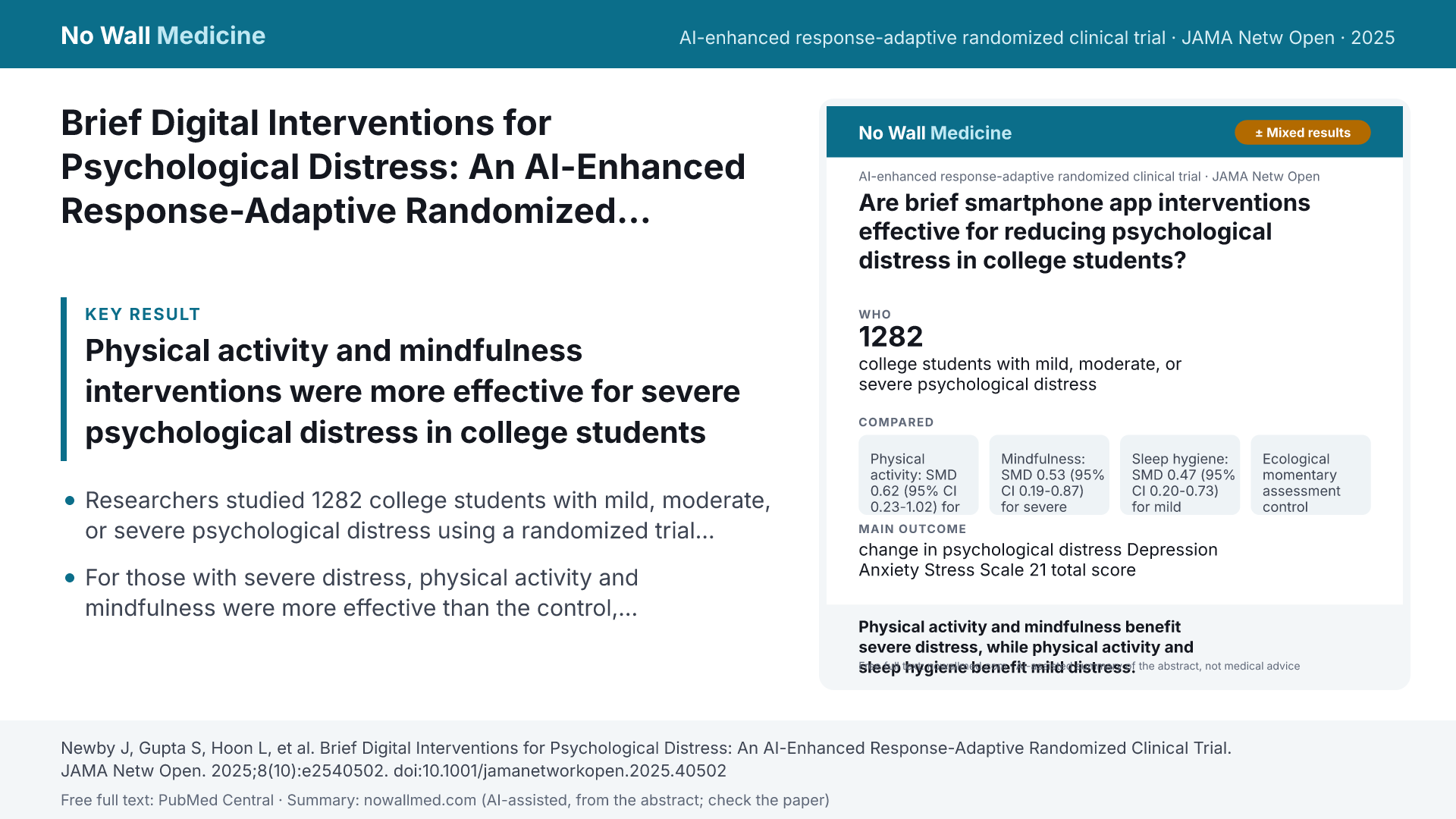
Physical activity and mindfulness interventions were more effective for severe psychological distress in college students
Brief Digital Interventions for Psychological Distress: An AI-Enhanced Response-Adaptive Randomized Clinical Trial
AI-enhanced response-adaptive randomized clinical trialMixed results
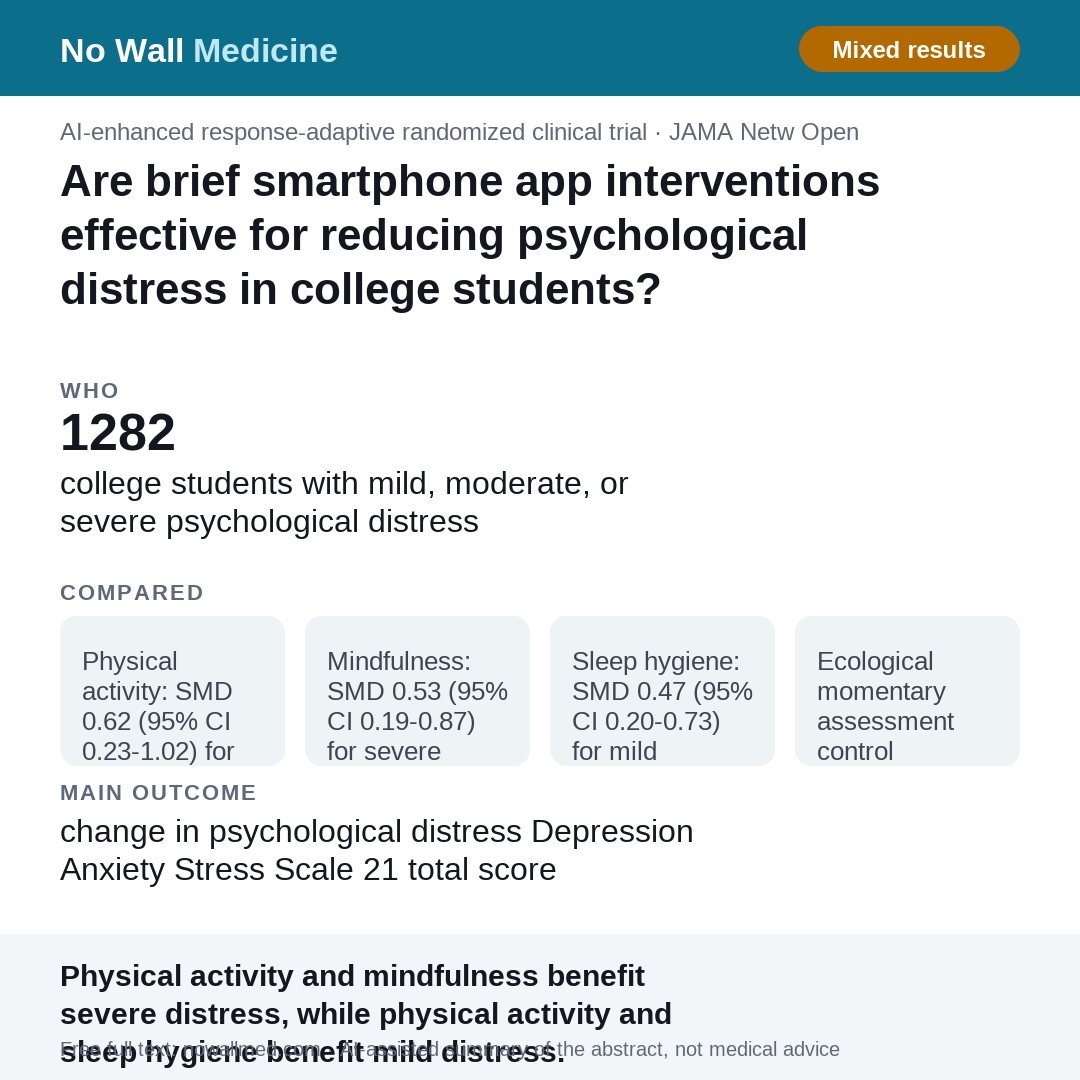
Are brief smartphone app interventions effective for reducing psychological distress in college students?
Who
1282
college students with mild, moderate, or severe psychological distress
Compared
Physical activity: SMD 0.62 (95% CI 0.23-1.02) for severe distress
Mindfulness: SMD 0.53 (95% CI 0.19-0.87) for severe distress
Sleep hygiene: SMD 0.47 (95% CI 0.20-0.73) for mild distress
Ecological momentary assessment control
Main outcome
change in psychological distress Depression Anxiety Stress Scale 21 total score
Bottom line: Physical activity and mindfulness benefit severe distress, while physical activity and sleep hygiene benefit mild distress.
JAMA Netw Open · 2025-10-01Download image
Clinical question: Are brief smartphone app interventions effective for reducing psychological distress in college students?
Why it matters: It is unclear how effective different smartphone app-based interventions are for varying levels of psychological distress severity.
Key points
- Researchers studied 1282 college students with mild, moderate, or severe psychological distress using a randomized trial of smartphone app interventions.
- For those with severe distress, physical activity and mindfulness were more effective than the control, while physical activity and sleep hygiene were more effective for mild distress.
- No significant differences were observed among the 439 participants who experienced moderate levels of distress.
Limitation the authors note: The trial design had reduced power to detect significant group differences.
Headline and key points written with AI from the paper’s abstract, with every number checked against it. Read the paper before relying on them.
Was this summary helpful?
Subject terms
Cite this article
Newby J, Gupta S, Hoon L, Zheng W, Whitton AE, Huckvale K. Brief Digital Interventions for Psychological Distress: An AI-Enhanced Response-Adaptive Randomized Clinical Trial. JAMA Netw Open. 2025. doi:10.1001/jamanetworkopen.2025.40502
Spotted a mistake? Suggest a correction
Top studies every Monday
The week’s key trials and guidelines in your specialties, plus any topics you follow. By email, free.
Get the weekly digest