Artificial intelligence shows promise for predicting immunotherapy response but lacks evidence for clinical practice
Artificial intelligence for predictive biomarker discovery in immuno-oncology: a systematic review
Systematic literature reviewMixed results
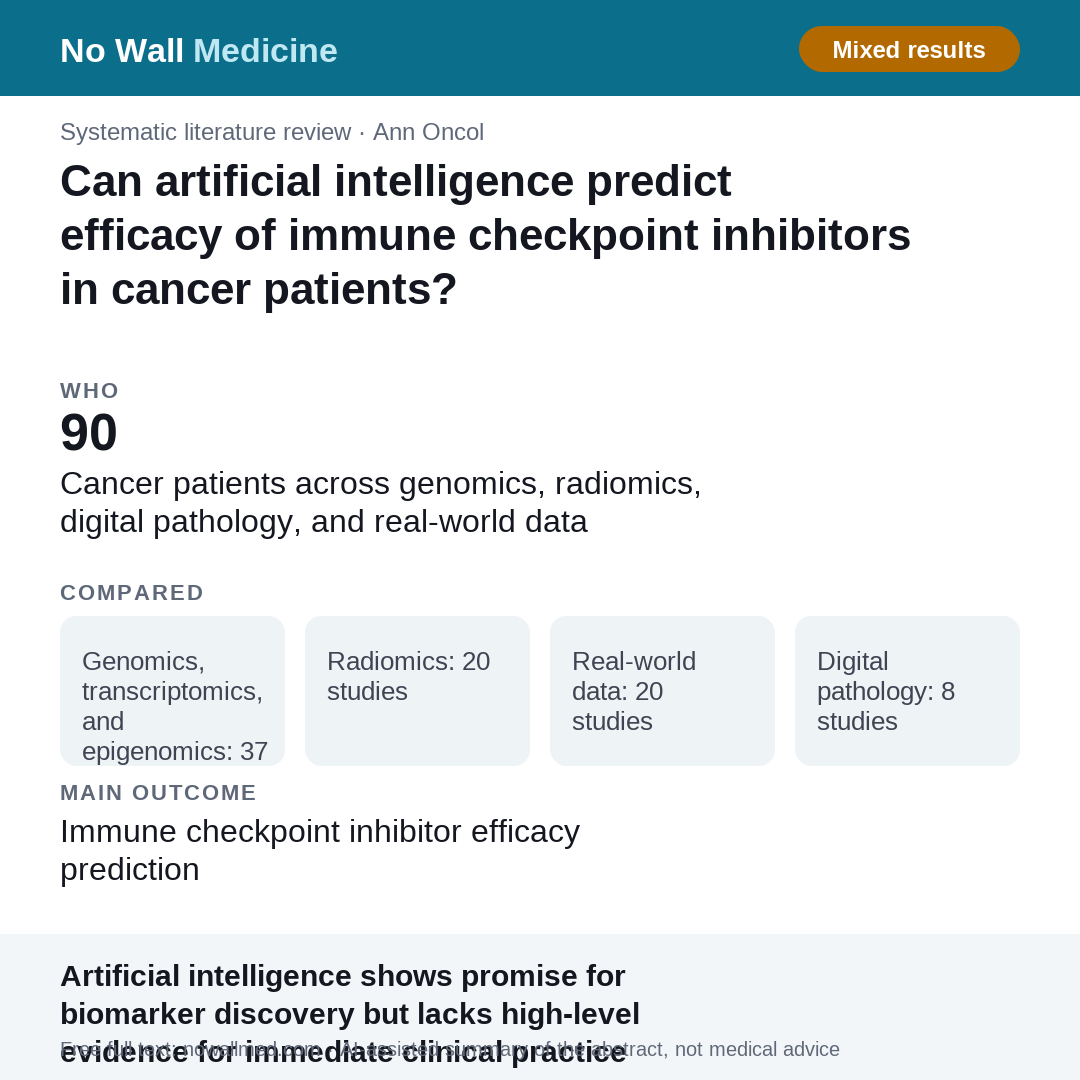
Can artificial intelligence predict efficacy of immune checkpoint inhibitors in cancer patients?
Who
90
Cancer patients across genomics, radiomics, digital pathology, and real-world data
Compared
Genomics, transcriptomics, and epigenomics: 37 studies
Radiomics: 20 studies
Real-world data: 20 studies
Digital pathology: 8 studies
Main outcome
Immune checkpoint inhibitor efficacy prediction
Bottom line: Artificial intelligence shows promise for biomarker discovery but lacks high-level evidence for immediate clinical practice change.
Limitation: No prospective study design incorporated artificial intelligence methodologies from the outset.
Ann Oncol · 2023-10-23Download image
Clinical question: Can artificial intelligence predict efficacy of immune checkpoint inhibitors in cancer patients?
Why it matters: It is currently challenging to select which patients will benefit from immune checkpoint inhibitor treatments.
Key points
- Researchers reviewed 90 studies using artificial intelligence to predict how cancer patients respond to immune checkpoint inhibitors, which are drugs that help the immune system fight cancer.
- The review found that 72% of studies used standard machine learning and 22% used deep learning, with non-small-cell lung cancer being the most studied type at 36%.
- While new biomarkers were identified through various data types, none of the included studies provided high-level evidence to change immediate clinical practice.
Limitation the authors note: No prospective study design incorporated artificial intelligence methodologies from the outset, as all implemented it as a post hoc analysis.
Headline and key points written with AI from the paper’s abstract, with every number checked against it. Read the paper before relying on them.
Topics
Cite this article
Prelaj A, Miskovic V, Zanitti M, Trovo F, Genova C, Viscardi G. Artificial intelligence for predictive biomarker discovery in immuno-oncology: a systematic review. Ann Oncol. 2023. doi:10.1016/j.annonc.2023.10.125
Spotted a mistake? Suggest a correction
Top studies every Monday
The week’s key trials and guidelines in your specialties, plus any topics you follow. By email, free.
Get the weekly digest