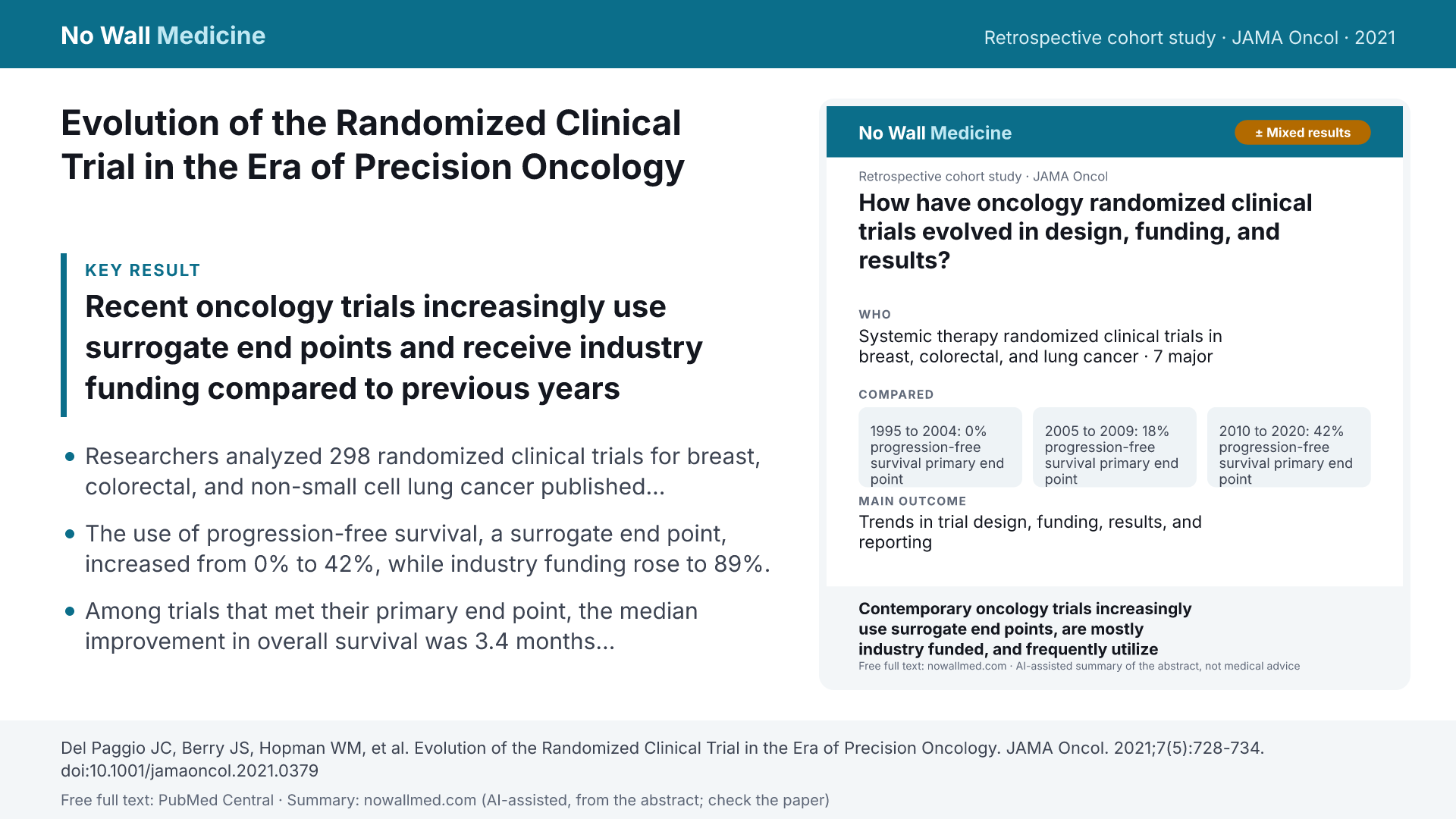
Recent oncology trials increasingly use surrogate end points and receive industry funding compared to previous years
Evolution of the Randomized Clinical Trial in the Era of Precision Oncology
Retrospective cohort studyMixed results
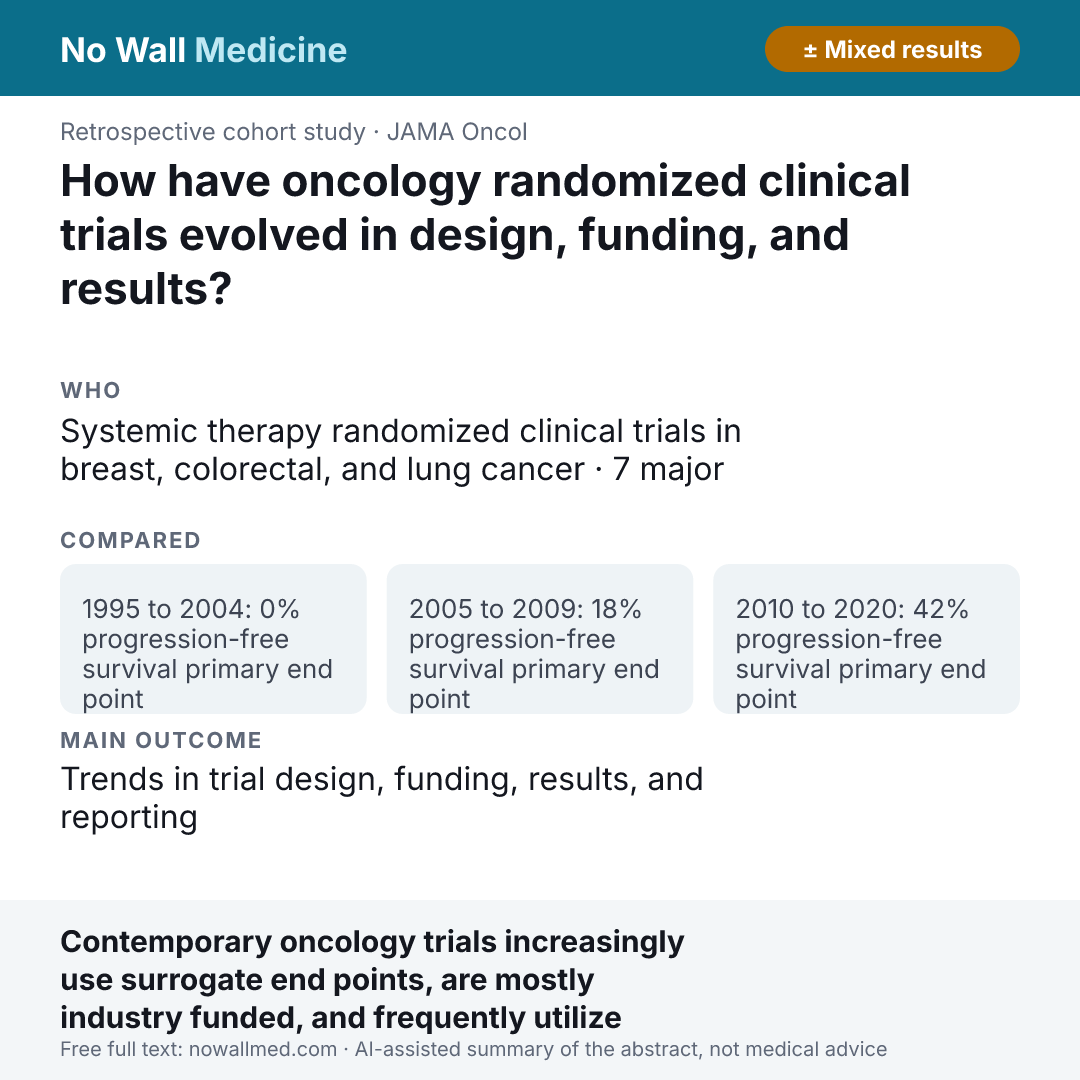
How have oncology randomized clinical trials evolved in design, funding, and results?
Who
Systemic therapy randomized clinical trials in breast, colorectal, and lung cancer · 7 major journals
Compared
1995 to 2004: 0% progression-free survival primary end point
2005 to 2009: 18% progression-free survival primary end point
2010 to 2020: 42% progression-free survival primary end point
Main outcome
Trends in trial design, funding, results, and reporting
Bottom line: Contemporary oncology trials increasingly use surrogate end points, are mostly industry funded, and frequently utilize professional medical writers.
JAMA Oncol · 2021-03-26 · Save PNG
Clinical question: How have oncology randomized clinical trials evolved in design, funding, and results?
Key points
- Researchers analyzed 298 randomized clinical trials for breast, colorectal, and non-small cell lung cancer published between 2010 and 2020.
- The use of progression-free survival, a surrogate end point, increased from 0% to 42%, while industry funding rose to 89%.
- Among trials that met their primary end point, the median improvement in overall survival was 3.4 months and progression-free survival was 2.9 months.
Headline and key points written with AI from the paper’s abstract, with every number checked against it. Read the paper before relying on them.
Was this summary helpful?
Subject terms
Headline, design, result, key points, caveat and citation as plain text.
Cite this article
Del Paggio JC, Berry JS, Hopman WM, et al. Evolution of the Randomized Clinical Trial in the Era of Precision Oncology. JAMA Oncol. 2021;7(5):728-734. doi:10.1001/jamaoncol.2021.0379
Spotted a mistake? Suggest a correction