Artificial intelligence accuracy for pediatric fracture detection ranges from 88.8% to 97.9% in reviewed studies
Artificial intelligence for radiological paediatric fracture assessment: a systematic review
Systematic reviewUnclear result
What is the diagnostic performance of artificial intelligence for paediatric fracture assessment?
Who
Children with fractures on imaging · Not specified
Compared
Artificial intelligence: 88.8 to 97.9%
Human readers
Main outcome
Diagnostic accuracy for paediatric fracture assessment
Bottom line: Artificial intelligence shows high accuracy, but limited external validation makes generalisability to wider paediatric populations difficult to understand.
Limitation: Wide heterogeneity and limited information on algorithm performance on external datasets.
Insights Imaging · 2022-06-03Download image
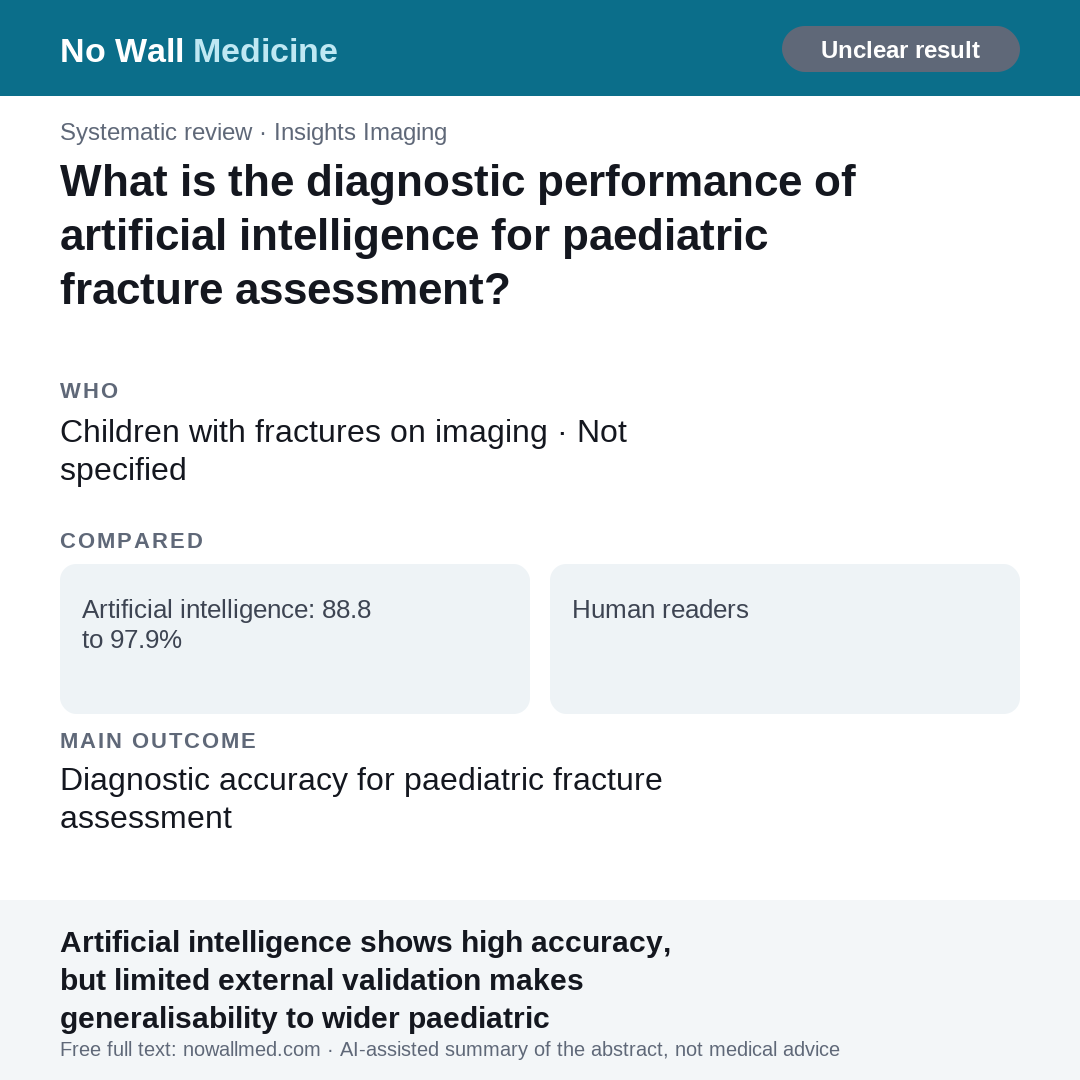
Clinical question: What is the diagnostic performance of artificial intelligence for paediatric fracture assessment?
Why it matters: It is unknown how well artificial intelligence tools for pediatric fracture detection generalize to wider populations due to limited external validation.
Key points
- Researchers reviewed nine studies involving pediatric fracture assessment using artificial intelligence tools on medical imaging.
- The accuracy rates for artificial intelligence tools ranged from 88.8% to 97.9%, with most studies focusing on elbow radiographs.
- In two of three studies comparing artificial intelligence to human readers, artificial intelligence sensitivity was marginally higher but not statistically significant.
Limitation the authors note: Most studies used data from a single institution and only 2/9 performed external validation.
Headline and key points written with AI from the paper’s abstract, with every number checked against it. Read the paper before relying on them.
Was this summary helpful?
Cite this article
Shelmerdine SC, White RD, Liu H, Arthurs OJ, Sebire NJ. Artificial intelligence for radiological paediatric fracture assessment: a systematic review. Insights Imaging. 2022. doi:10.1186/s13244-022-01234-3
Spotted a mistake? Suggest a correction
Top studies every Monday
The week’s key trials and guidelines in your specialties, plus any topics you follow. By email, free.
Get the weekly digest