Artificial intelligence algorithms showed higher sensitivity and specificity than clinicians for detecting osteoarthritis
Artificial intelligence in osteoarthritis detection: A systematic review and meta-analysis
Systematic review and meta-analysisBenefit found
How does artificial intelligence diagnostic performance compare to clinicians for osteoarthritis detection?
Who
61
Studies evaluating artificial intelligence algorithms for osteoarthritis detection or classification
Compared
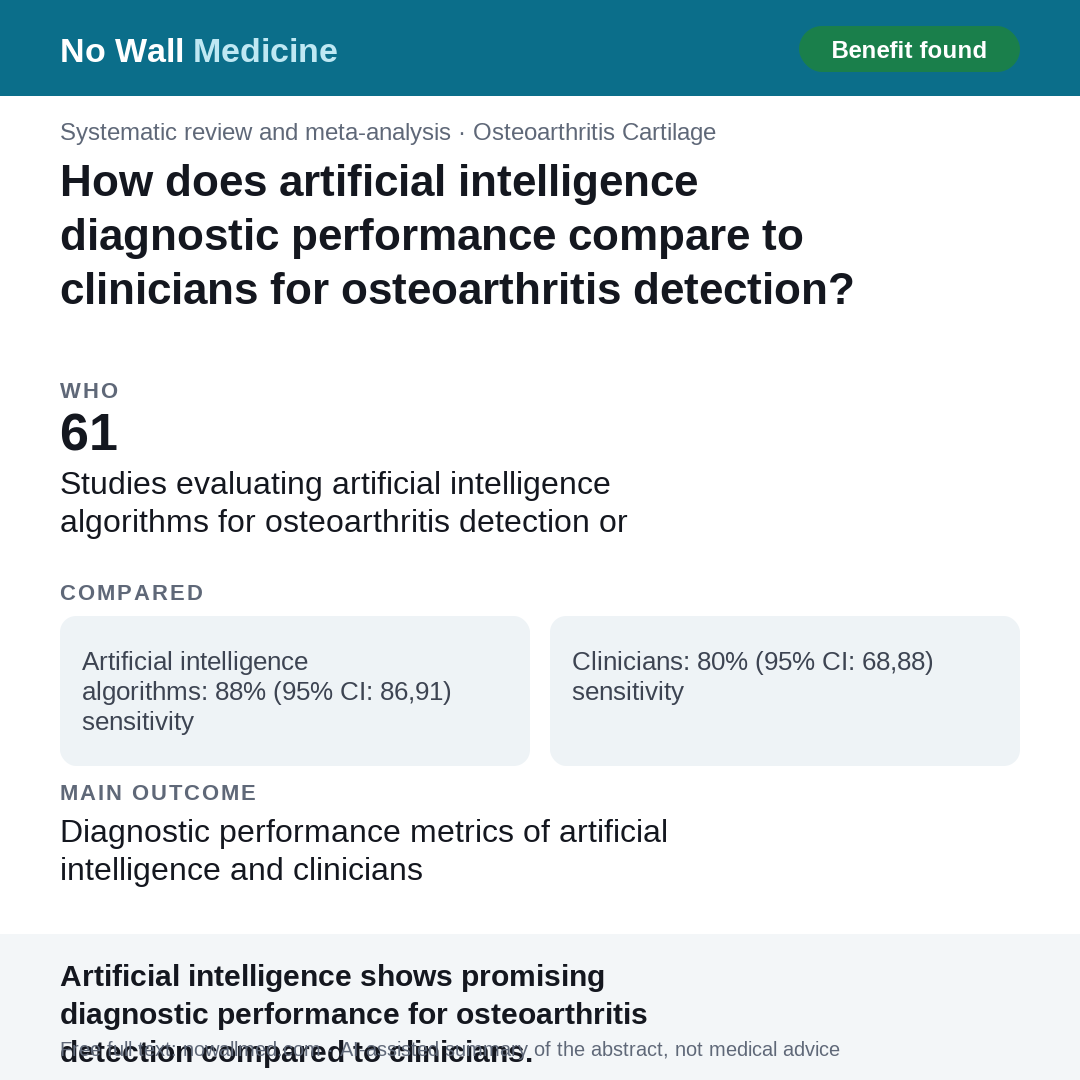
Artificial intelligence algorithms: 88% (95% CI: 86,91) sensitivity
Clinicians: 80% (95% CI: 68,88) sensitivity
Main outcome
Diagnostic performance metrics of artificial intelligence and clinicians
Bottom line: Artificial intelligence shows promising diagnostic performance for osteoarthritis detection compared to clinicians.
Limitation: Results should be interpreted with caution due to potential pitfalls in included studies.
Osteoarthritis Cartilage · 2023-10-18Download image
Clinical question: How does artificial intelligence diagnostic performance compare to clinicians for osteoarthritis detection?
Why it matters: It was unknown how the diagnostic performance of artificial intelligence algorithms compares to that of clinicians for detecting osteoarthritis.
Key points
- Researchers analyzed 61 studies to compare the diagnostic performance of artificial intelligence algorithms against clinicians for detecting or classifying osteoarthritis.
- On internal validation tests, artificial intelligence had a pooled sensitivity of 88% and specificity of 81%, compared to 80% sensitivity and 79% specificity for clinicians.
- During external validation, the pooled sensitivity for artificial intelligence algorithms was 94% and the pooled specificity was 91%.
Limitation the authors note: The authors state that results should be interpreted with caution due to the potential pitfalls in the included studies.
Headline and key points written with AI from the paper’s abstract, with every number checked against it. Read the paper before relying on them.
Topics
Cite this article
Mohammadi S, Salehi MA, Jahanshahi A, Shahrabi Farahani M, Zakavi SS, Behrouzieh S. Artificial intelligence in osteoarthritis detection: A systematic review and meta-analysis. Osteoarthritis Cartilage. 2023. doi:10.1016/j.joca.2023.09.011
Spotted a mistake? Suggest a correction
Top studies every Monday
The week’s key trials and guidelines in your specialties, plus any topics you follow. By email, free.
Get the weekly digest