Deep learning using speech samples shows 0.87 accuracy for detecting depression in meta-analysis
Diagnostic accuracy of deep learning using speech samples in depression: a systematic review and meta-analysis
Systematic review and meta-analysisBenefit found
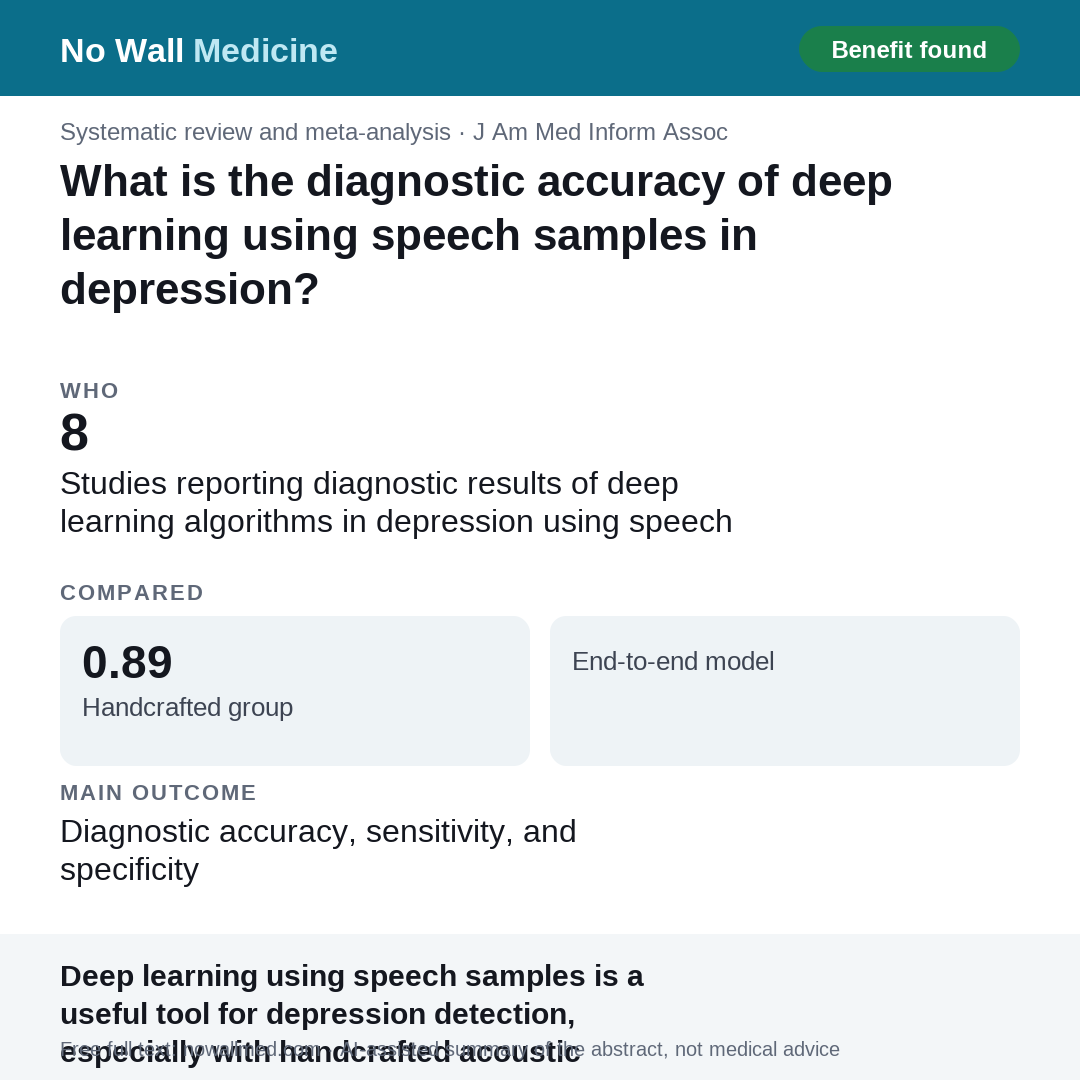
What is the diagnostic accuracy of deep learning using speech samples in depression?
Who
8
Studies reporting diagnostic results of deep learning algorithms in depression using speech data
Compared
0.89Handcrafted group (95% CI, 0.81-0.97)
End-to-end model
Main outcome
Diagnostic accuracy, sensitivity, and specificity
Result: accuracy 0.87 (95% CI, 0.81-0.93)
Bottom line: Deep learning using speech samples is a useful tool for depression detection, especially with handcrafted acoustic features.
Limitation: All studies used convolutional neural network models, making it hard to decipher other deep learning algorithms.
J Am Med Inform Assoc · 2024-07-16Download image
Clinical question: What is the diagnostic accuracy of deep learning using speech samples in depression?
Why it matters: The diagnostic accuracy of deep learning algorithms using speech data to identify depression was not previously synthesized in a meta-analysis.
Key points
- Researchers analyzed 25 studies, including 8 used for a meta-analysis, to evaluate how well deep learning—a type of artificial intelligence—identifies depression through speech.
- The pooled diagnostic accuracy was 0.87, with a sensitivity of 0.82 and a specificity of 0.85.
- Handcrafted models, which use specifically selected sound features, showed a higher pooled accuracy of 0.89 compared to end-to-end models.
Limitation the authors note: All studies included in the meta-analysis used convolutional neural network models, which makes it difficult to understand the performance of other deep learning algorithms.
Headline and key points written with AI from the paper’s abstract, with every number checked against it. Read the paper before relying on them.
Topics
Cite this article
Liu L, Liu L, Wafa HA, Tydeman F, Xie W, Wang Y. Diagnostic accuracy of deep learning using speech samples in depression: a systematic review and meta-analysis. J Am Med Inform Assoc. 2024. doi:10.1093/jamia/ocae189
Spotted a mistake? Suggest a correction
Top studies every Monday
The week’s key trials and guidelines in your specialties, plus any topics you follow. By email, free.
Get the weekly digest