Aspirin did not reduce death or myocardial infarction after noncardiac surgery
Aspirin in patients undergoing noncardiac surgery
Why it matters: Starting or continuing aspirin around noncardiac surgery did not reduce death or heart attack and increased major bleeding.
Related landmark trials: BRIDGE
Context written by the No Wall Medicine team.
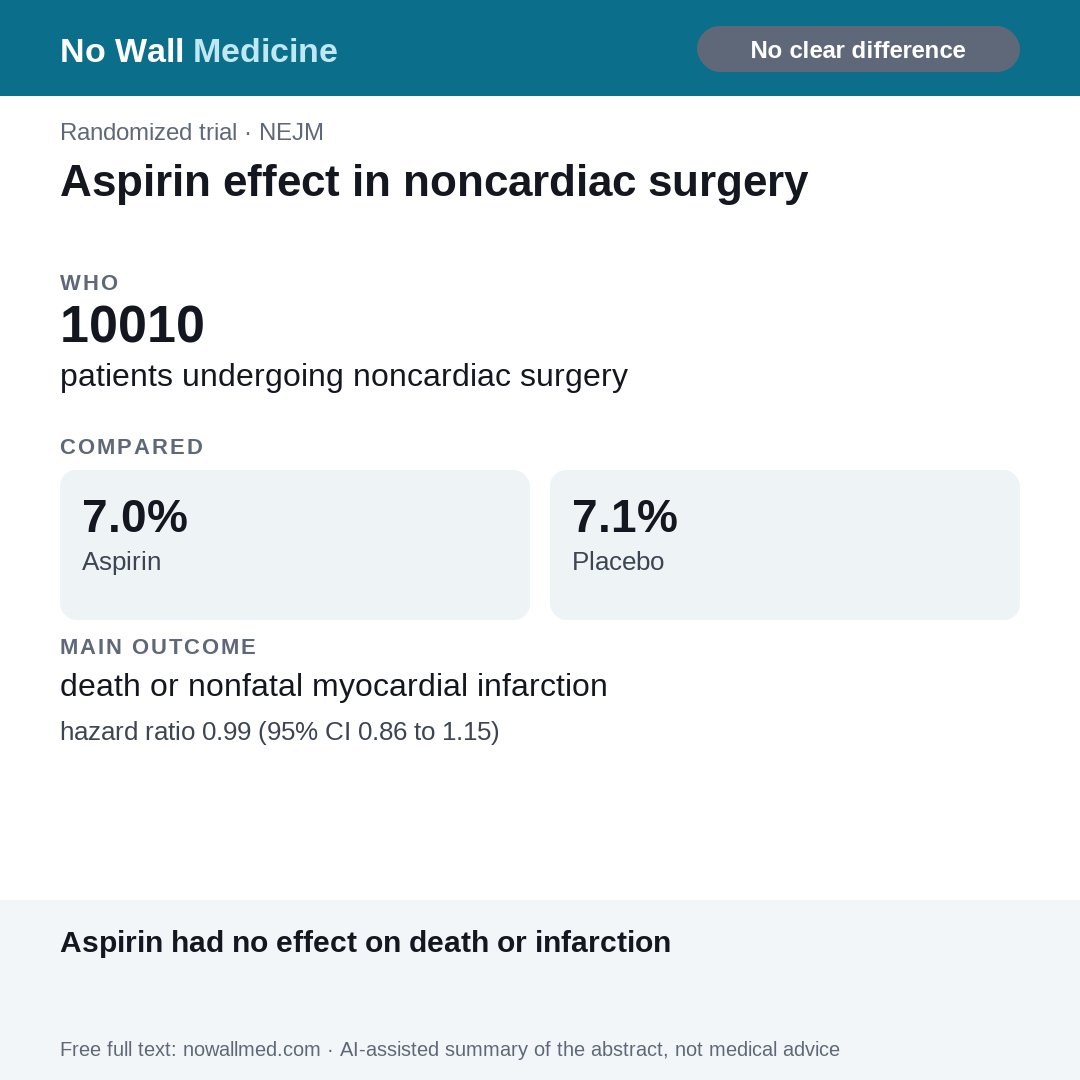
Randomized trialNo clear difference
Aspirin effect in noncardiac surgery
Who
10010
patients undergoing noncardiac surgery
Compared
7.0%Aspirin (351/4998)
7.1%Placebo (355/5012)
Main outcome
death or nonfatal myocardial infarction
Result: hazard ratio 0.99 (95% CI 0.86 to 1.15)
Bottom line: Aspirin had no effect on death or infarction
Funded by: Canadian Institutes of Health Research
NEJM · 2014-03-31Download image
Trial at a glance
Bottom line: Aspirin had no effect on death or myocardial infarction, but increased major bleeding risk
Clinical question
Aspirin in noncardiac surgery patients
Design
2-by-2 factorial trial
Who was studied
10,010 patients undergoing noncardiac surgery
Key inclusion criteria
- at risk for vascular complications
Interventions
- aspirin group: aspirin 200 mg before surgery, 100 mg daily
- placebo group: placebo
Primary outcome
composite of death or nonfatal myocardial infarction. 7.0% in aspirin group, 7.1% in placebo group, hazard ratio 0.99
Secondary outcomes
- major bleeding: 4.6% in aspirin group, 3.8% in placebo group, hazard ratio 1.23
Harms
major bleeding more common in aspirin group
Funding
Canadian Institutes of Health Research and others
Written with AI from the abstract; every number was checked against it. Details such as eligibility criteria may be missing because the abstract does not give them. Read the paper before relying on it.
Key points
- 10,010 patients undergoing noncardiac surgery were randomly assigned to aspirin or placebo.
- Aspirin had no significant effect on death or nonfatal myocardial infarction, with 7.0% and 7.1% rates.
- Major bleeding was more common in the aspirin group, with 4.6% vs 3.8% rates.
Headline and key points written with AI from the paper’s abstract, with every number checked against it. Read the paper before relying on them.
Topics
Cite this article
Devereaux PJ, Mrkobrada M, Sessler DI, Leslie K, Alonso-Coello P, Kurz A. Aspirin in patients undergoing noncardiac surgery. NEJM. 2014. doi:10.1056/NEJMoa1401105
Spotted a mistake? Suggest a correction