No bridging anticoagulation was noninferior to low-molecular-weight heparin for arterial thromboembolism
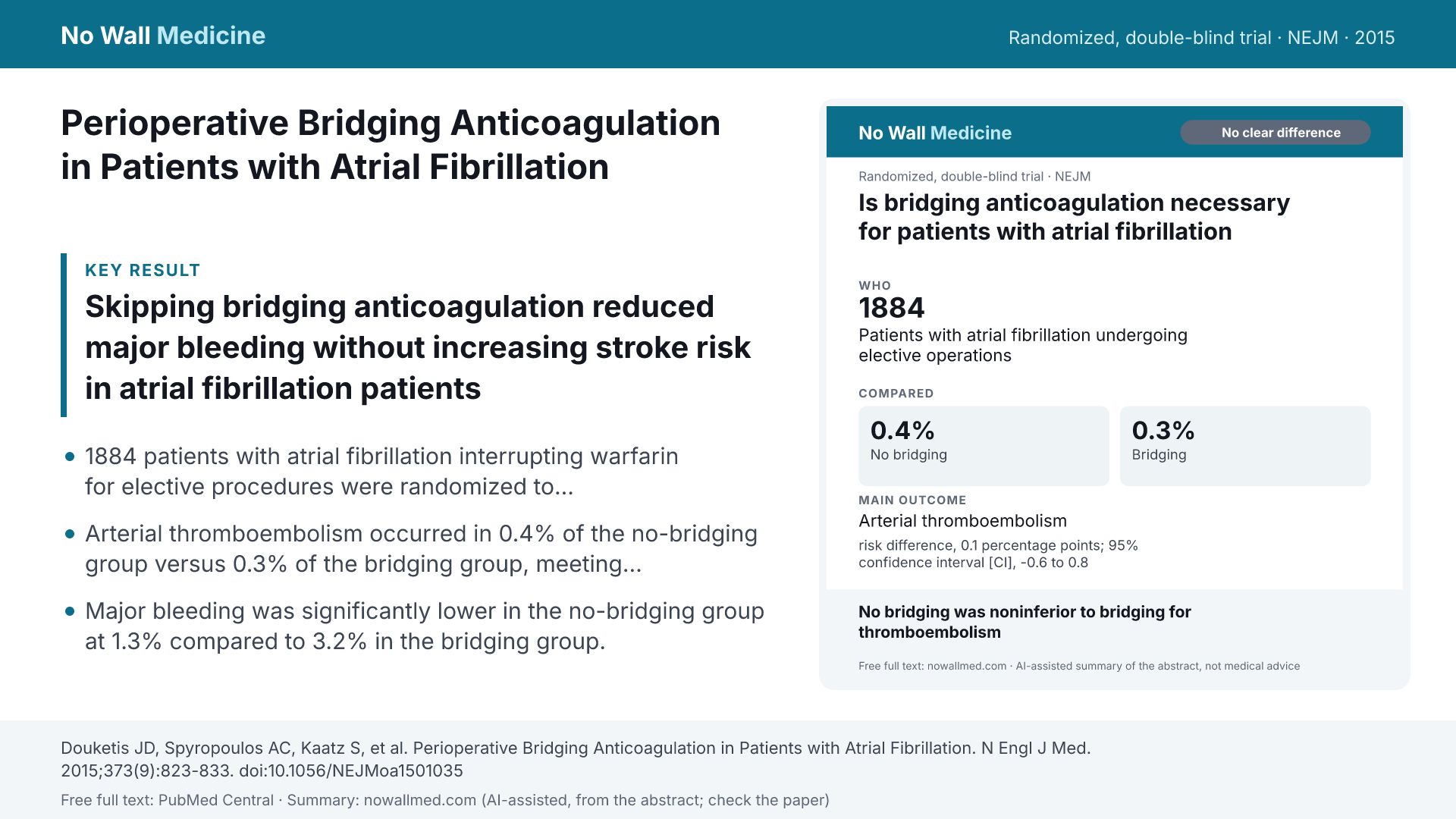
Perioperative Bridging Anticoagulation in Patients with Atrial Fibrillation
Why it matters: For patients with atrial fibrillation who stopped warfarin for surgery, skipping heparin bridging was noninferior for blood clots and halved major bleeding.
Related landmark trials: POISE-2 (aspirin)
Context written by the No Wall Medicine team.
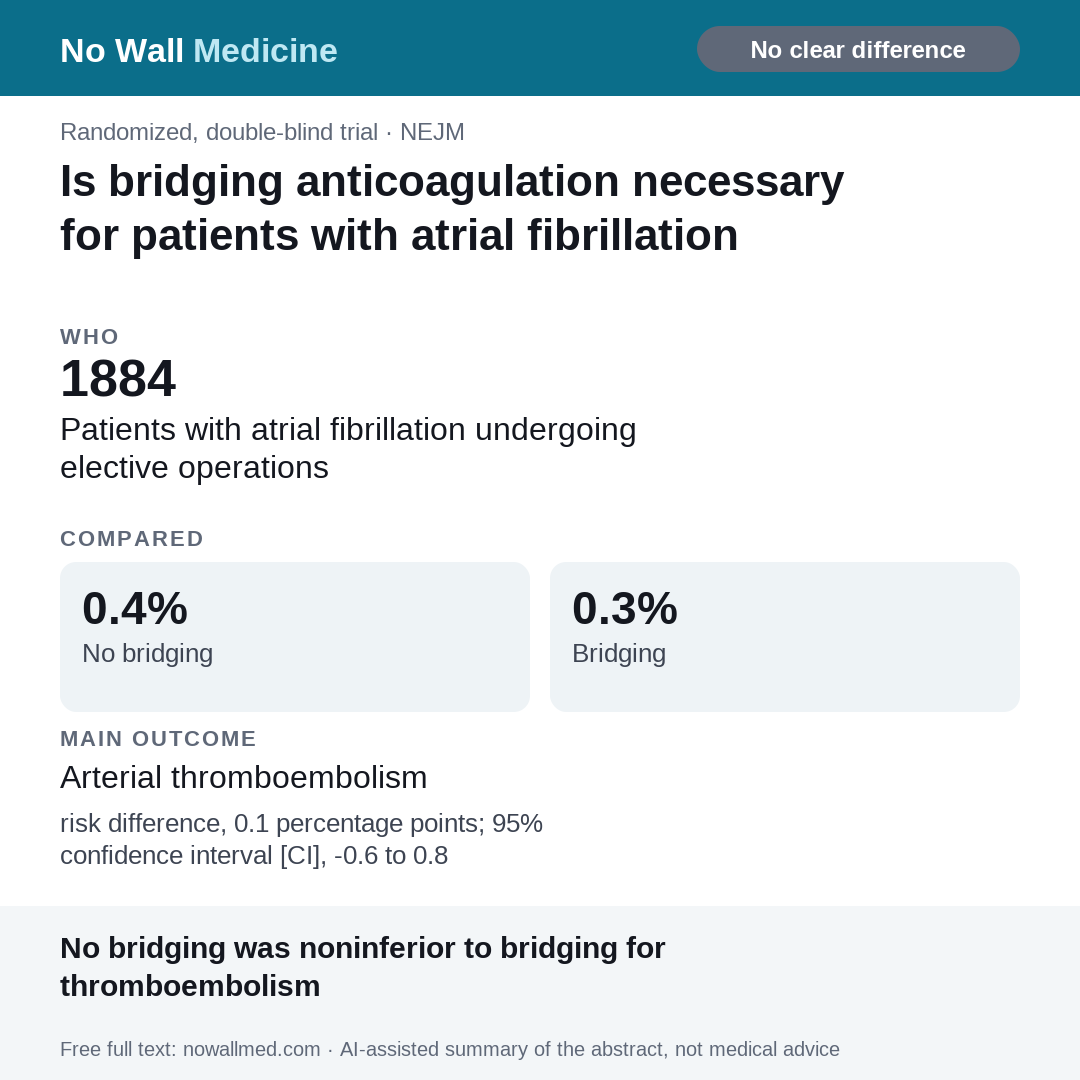
Randomized, double-blind trialNo clear difference
Is bridging anticoagulation necessary for patients with atrial fibrillation
Who
1884
Patients with atrial fibrillation undergoing elective operations
Compared
0.4%No bridging
0.3%Bridging
Main outcome
Arterial thromboembolism
Result: risk difference, 0.1 percentage points; 95% confidence interval [CI], -0.6 to 0.8
Bottom line: No bridging was noninferior to bridging for thromboembolism
Funded by: National Heart, Lung, and Blood Institute
NEJM · 2015-06-22Download image
Trial at a glance
Bottom line: Forgoing bridging anticoagulation was noninferior to bridging with low-molecular-weight heparin for preventing arterial thromboembolism and decreased major bleeding risk.
Clinical question
Is bridging anticoagulation necessary for patients with atrial fibrillation undergoing elective operations?
Design
Randomized, double-blind, placebo-controlled trial. United States and Canada, 108 sites, 2009-2014
Who was studied
1884 patients with atrial fibrillation undergoing elective operations
Key inclusion criteria
- 18 years or older
- chronic atrial fibrillation or flutter
- warfarin therapy for 3 months or longer
- elective operation or procedure requiring warfarin interruption
Key exclusion criteria
- mechanical heart valve
- stroke, systemic embolism, or transient ischemic attack within 12 weeks
- major bleeding within 6 weeks
- creatinine clearance less than 30 ml per minute
Interventions
- no-bridging group: matching subcutaneous placebo
- bridging group: low-molecular-weight heparin (100 IU of dalteparin per kilogram of body weight)
Primary outcome
arterial thromboembolism at 30 days. 0.4% in no-bridging group and 0.3% in bridging group
Secondary outcomes
- major bleeding: 1.3% in no-bridging group and 3.2% in bridging group
- acute myocardial infarction: no significant difference
- death: no significant difference
Harms
major bleeding occurred in 1.3% of no-bridging group and 3.2% of bridging group
Limitations reported by the authors
- potential limitations of the BRIDGE trial
Funding
National Heart, Lung, and Blood Institute
Written with AI from the full paper; every number was checked against it. Read the paper before relying on it.
Key points
- 1884 patients with atrial fibrillation were studied, comparing no bridging therapy to bridging therapy.
- Arterial thromboembolism incidence was 0.4% in the no-bridging group and 0.3% in the bridging group.
- Major bleeding incidence was 1.3% in the no-bridging group and 3.2% in the bridging group.
Headline and key points written with AI from the paper’s abstract, with every number checked against it. Read the paper before relying on them.
Was this summary helpful?
Subject terms
Cite this article
Douketis JD, Spyropoulos AC, Kaatz S, Becker RC, Caprini JA, Dunn AS. Perioperative Bridging Anticoagulation in Patients with Atrial Fibrillation. NEJM. 2015. doi:10.1056/NEJMoa1501035
Spotted a mistake? Suggest a correction
Top studies every Monday
The week’s key trials and guidelines in your specialties, plus any topics you follow. By email, free.
Get the weekly digest