Perioperative Bridging Anticoagulation in Patients with Atrial Fibrillation
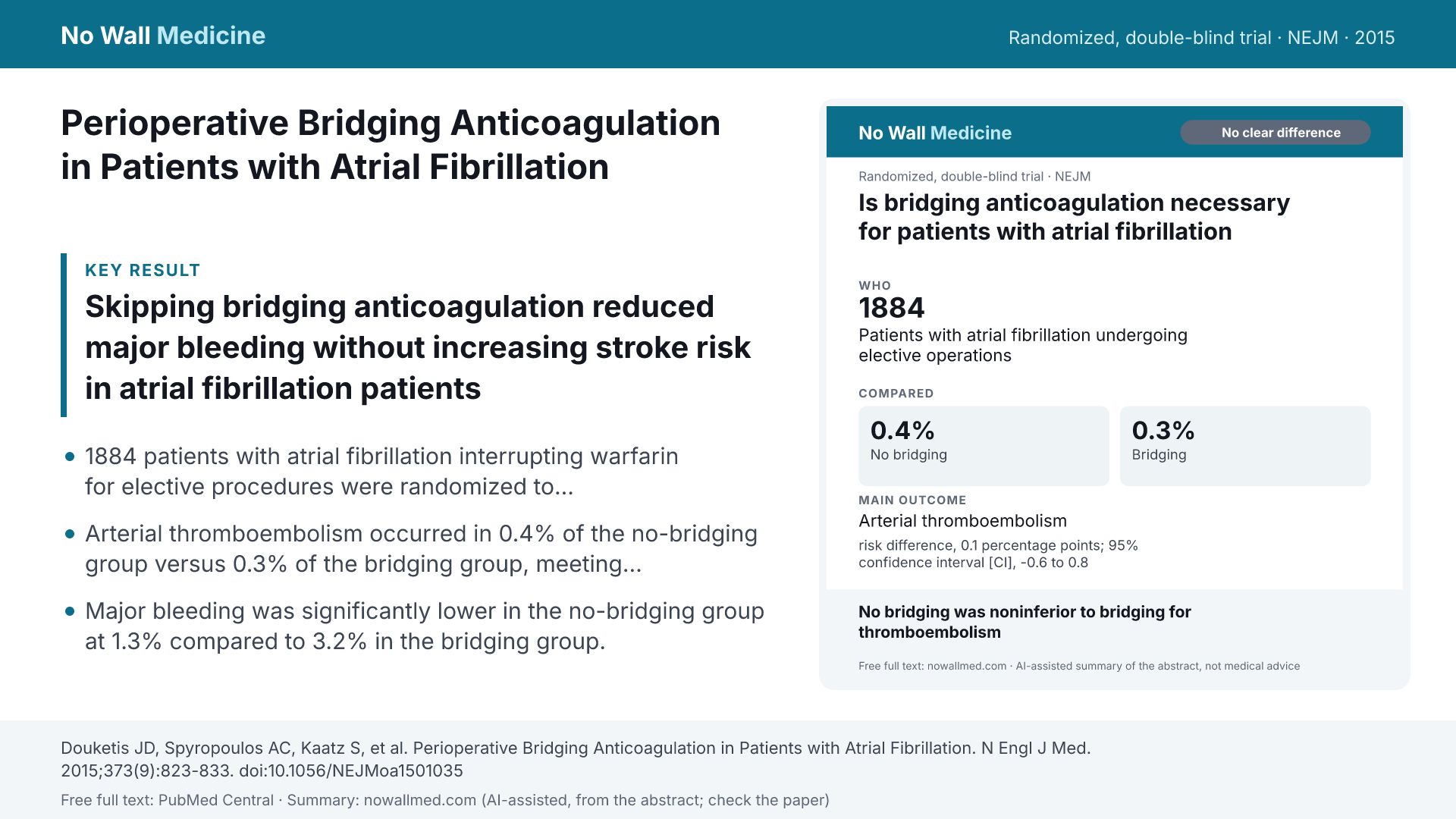
Key result: Skipping bridging anticoagulation reduced major bleeding without increasing stroke risk in atrial fibrillation patients
Randomized, double-blind trialNo clear difference
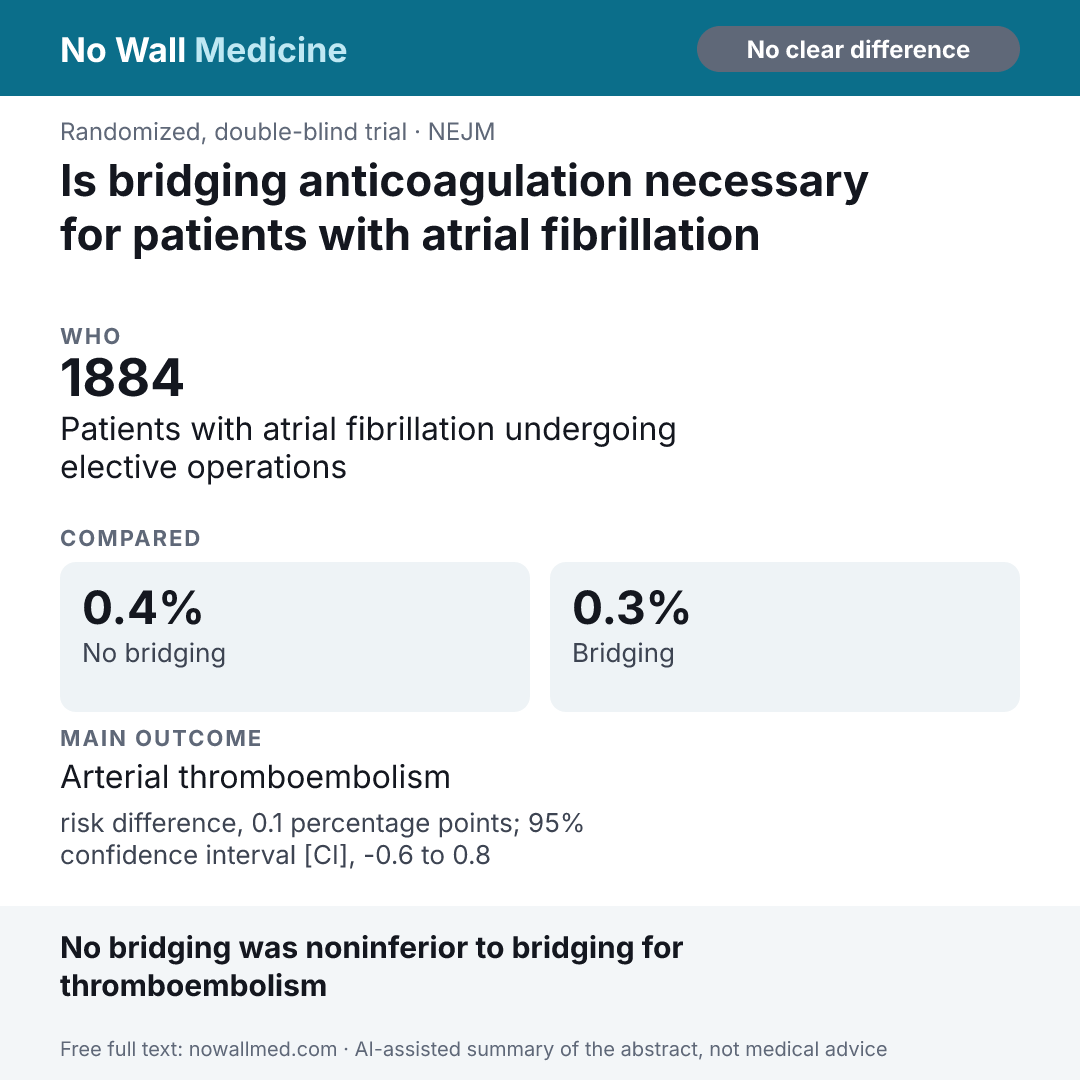
Is bridging anticoagulation necessary for patients with atrial fibrillation
Who
1884
Patients with atrial fibrillation undergoing elective operations
Compared
0.4%No bridging
0.3%Bridging
Main outcome
Arterial thromboembolism
Result: risk difference, 0.1 percentage points; 95% confidence interval [CI], -0.6 to 0.8
Bottom line: No bridging was noninferior to bridging for thromboembolism
Funded by: National Heart, Lung, and Blood Institute
NEJM · 2015-06-22 · Save PNG
Key points
- 1884 patients with atrial fibrillation interrupting warfarin for elective procedures were randomized to receive low-molecular-weight heparin or placebo.
- Arterial thromboembolism occurred in 0.4% of the no-bridging group versus 0.3% of the bridging group, meeting noninferiority criteria.
- Major bleeding was significantly lower in the no-bridging group at 1.3% compared to 3.2% in the bridging group.
Discussion prompts
- Would these patients look like yours? Who was left out?
- Is the main outcome one that matters to patients?
- Is the difference large enough to change what you do?
Cite: Douketis JD, Spyropoulos AC, Kaatz S, et al. Perioperative Bridging Anticoagulation in Patients with Atrial Fibrillation. N Engl J Med. 2015;373(9):823-833. doi:10.1056/NEJMoa1501035
Free full text: PubMed Central · Summary and visual abstract: nowallmed.com/a/perioperative-bridging-anticoagulation-in-patients-with-atrial-1ut2skc/ (AI-assisted from the abstract; check the paper before relying on it).