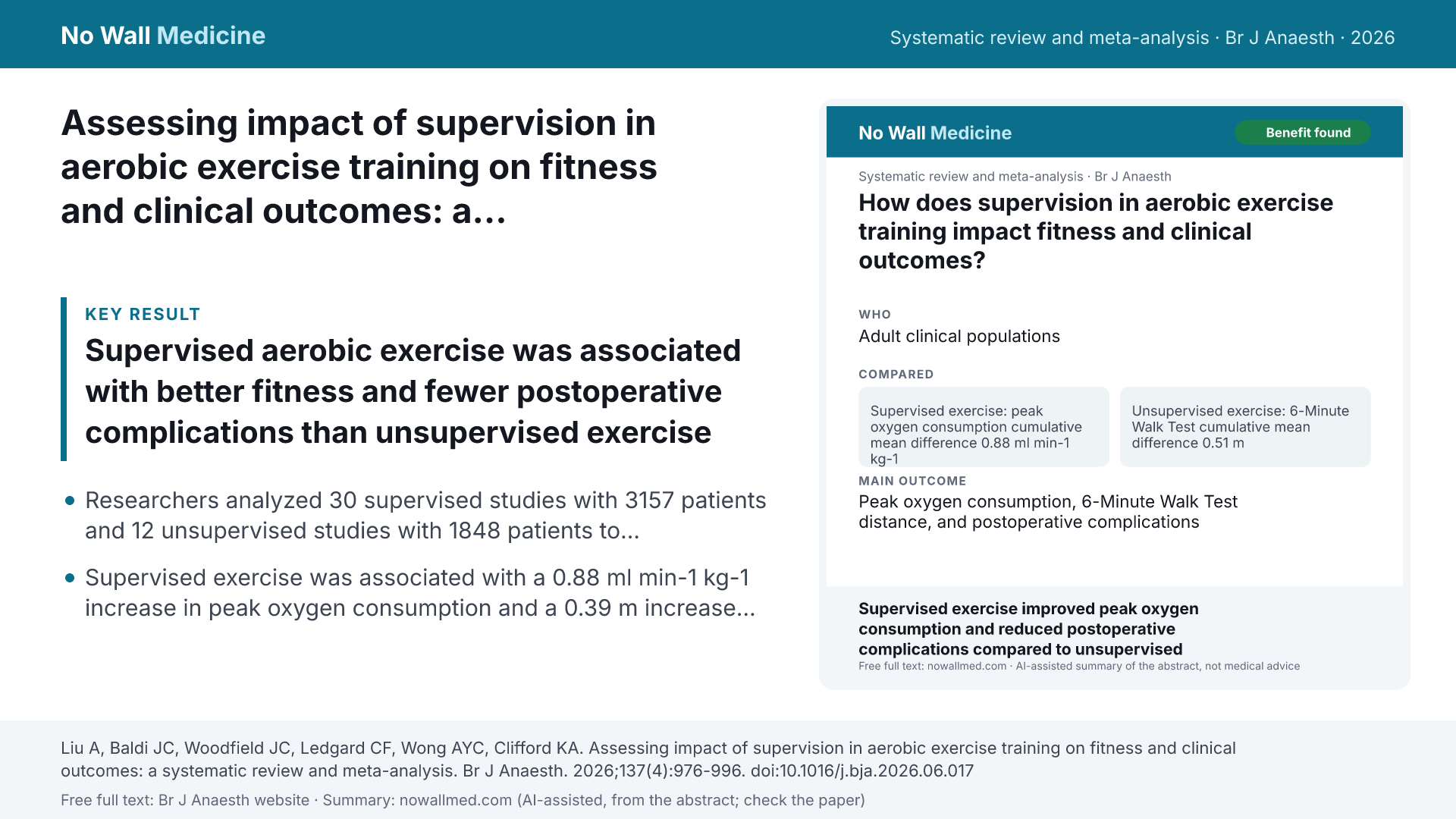
Assessing impact of supervision in aerobic exercise training on fitness and clinical outcomes: a systematic review and meta-analysis
Key result: Supervised aerobic exercise was associated with better fitness and fewer postoperative complications than unsupervised exercise
Key points
- Researchers analyzed 30 supervised studies with 3157 patients and 12 unsupervised studies with 1848 patients to compare fitness and clinical outcomes.
- Supervised exercise was associated with a 0.88 ml min-1 kg-1 increase in peak oxygen consumption and a 0.39 m increase in 6-Minute Walk Test distance.
- Supervised exercise was associated with an odds ratio of 0.60 for postoperative complications, which was 0.53 for high-intensity exercise.
Why it matters: The impact of different types of supervision on patient outcomes during aerobic exercise training has yet to be elucidated.
Limitation the authors note: Findings were limited by a lack of direct comparisons between supervised and unsupervised exercise groups.
Discussion prompts
- Would these patients look like yours? Who was left out?
- Is the main outcome one that matters to patients?
- Is the difference large enough to change what you do?
Cite: Liu A, Baldi JC, Woodfield JC, Ledgard CF, Wong AYC, Clifford KA. Assessing impact of supervision in aerobic exercise training on fitness and clinical outcomes: a systematic review and meta-analysis. Br J Anaesth. 2026;137(4):976-996. doi:10.1016/j.bja.2026.06.017
Free full text: Br J Anaesth website · Summary and visual abstract: nowallmed.com/a/assessing-impact-of-supervision-in-aerobic-exercise-training-on-1u7h84y/ (AI-assisted from the abstract; check the paper before relying on it).