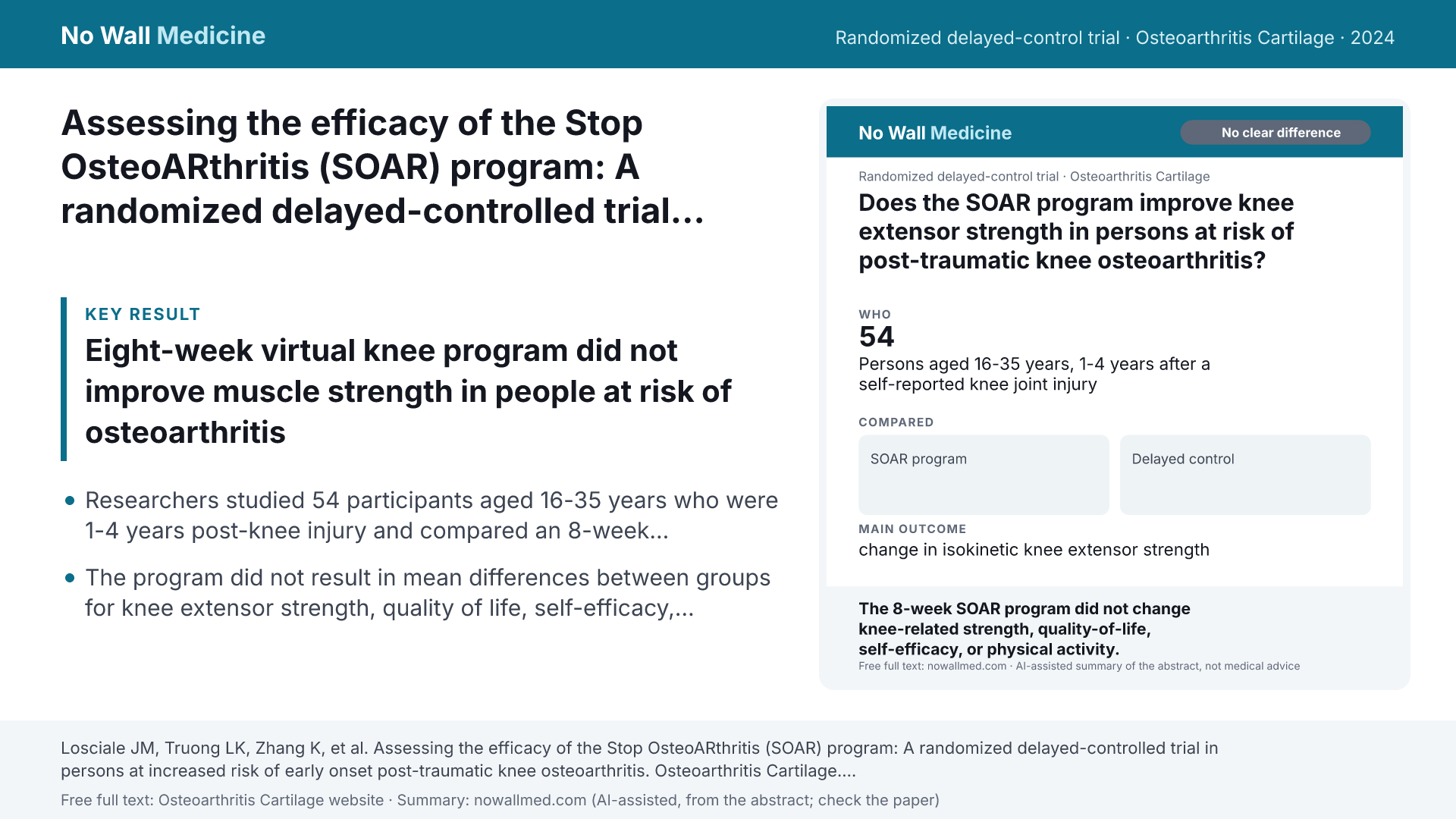
Eight-week virtual knee program did not improve muscle strength in people at risk of osteoarthritis
Assessing the efficacy of the Stop OsteoARthritis (SOAR) program: A randomized delayed-controlled trial in persons at increased risk of early onset post-traumatic knee osteoarthritis
Randomized delayed-control trialNo clear difference
Does the SOAR program improve knee extensor strength in persons at risk of post-traumatic knee osteoarthritis?
Who
54
Persons aged 16-35 years, 1-4 years after a self-reported knee joint injury
Compared
SOAR program
Delayed control
Main outcome
change in isokinetic knee extensor strength
Result: 0.05 (95% confidence interval: -0.10, 0.19)
Bottom line: The 8-week SOAR program did not change knee-related strength, quality-of-life, self-efficacy, or physical activity.
Osteoarthritis Cartilage · 2024-04-12Download image
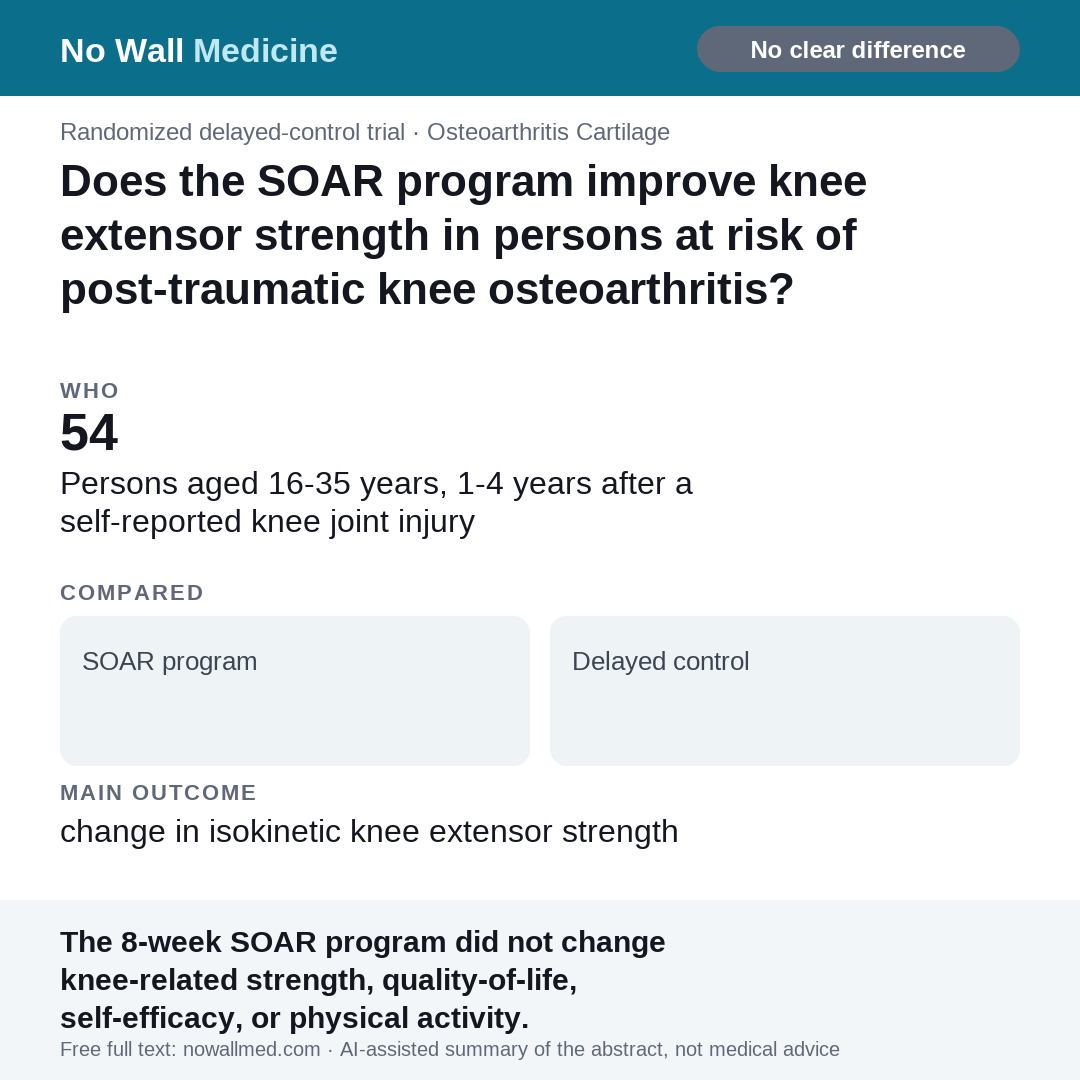
Clinical question: Does the SOAR program improve knee extensor strength in persons at risk of post-traumatic knee osteoarthritis?
Why it matters: It is unknown if a virtual, physiotherapist-guided program can improve knee health outcomes for individuals at risk of post-traumatic knee osteoarthritis.
Key points
- Researchers studied 54 participants aged 16-35 years who were 1-4 years post-knee injury and compared an 8-week virtual physiotherapist-guided program to a delayed control group.
- The program did not result in mean differences between groups for knee extensor strength, quality of life, self-efficacy, or physical activity at 9 weeks.
- The intervention was associated with greater improvements in perceived self-management and kinesiophobia, which is the fear of movement or re-injury.
Headline and key points written with AI from the paper’s abstract, with every number checked against it. Read the paper before relying on them.
Was this summary helpful?
Subject terms
Cite this article
Losciale JM, Truong LK, Zhang K, Silvester-Lee T, Miciak M, Pajkic A. Assessing the efficacy of the Stop OsteoARthritis (SOAR) program: A randomized delayed-controlled trial in persons at increased risk of early onset post-traumatic knee osteoarthritis. Osteoarthritis Cartilage. 2024. doi:10.1016/j.joca.2024.04.003
Spotted a mistake? Suggest a correction
Top studies every Monday
The week’s key trials and guidelines in your specialties, plus any topics you follow. By email, free.
Get the weekly digest