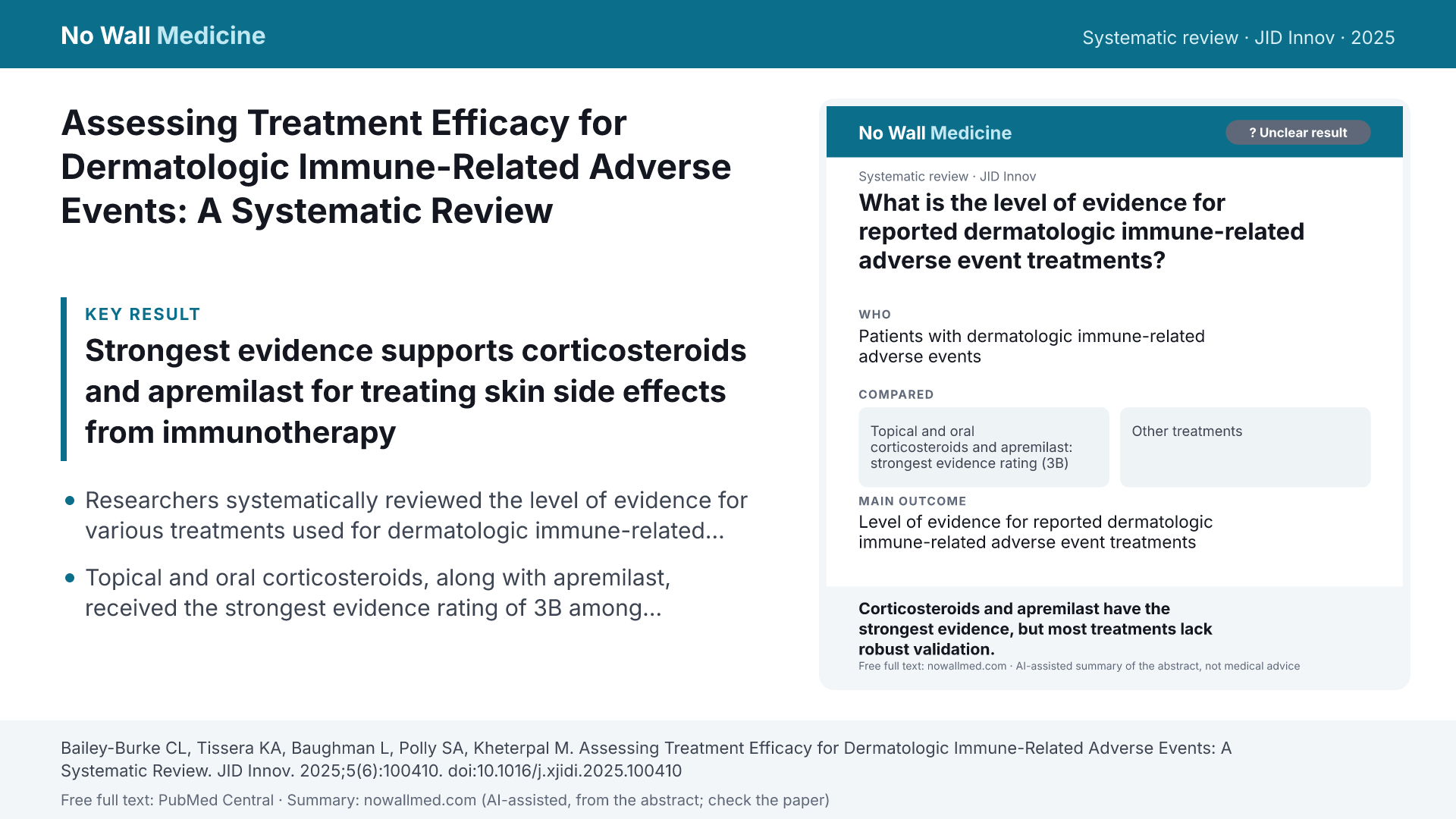
Strongest evidence supports corticosteroids and apremilast for treating skin side effects from immunotherapy
Assessing Treatment Efficacy for Dermatologic Immune-Related Adverse Events: A Systematic Review
Systematic reviewUnclear result
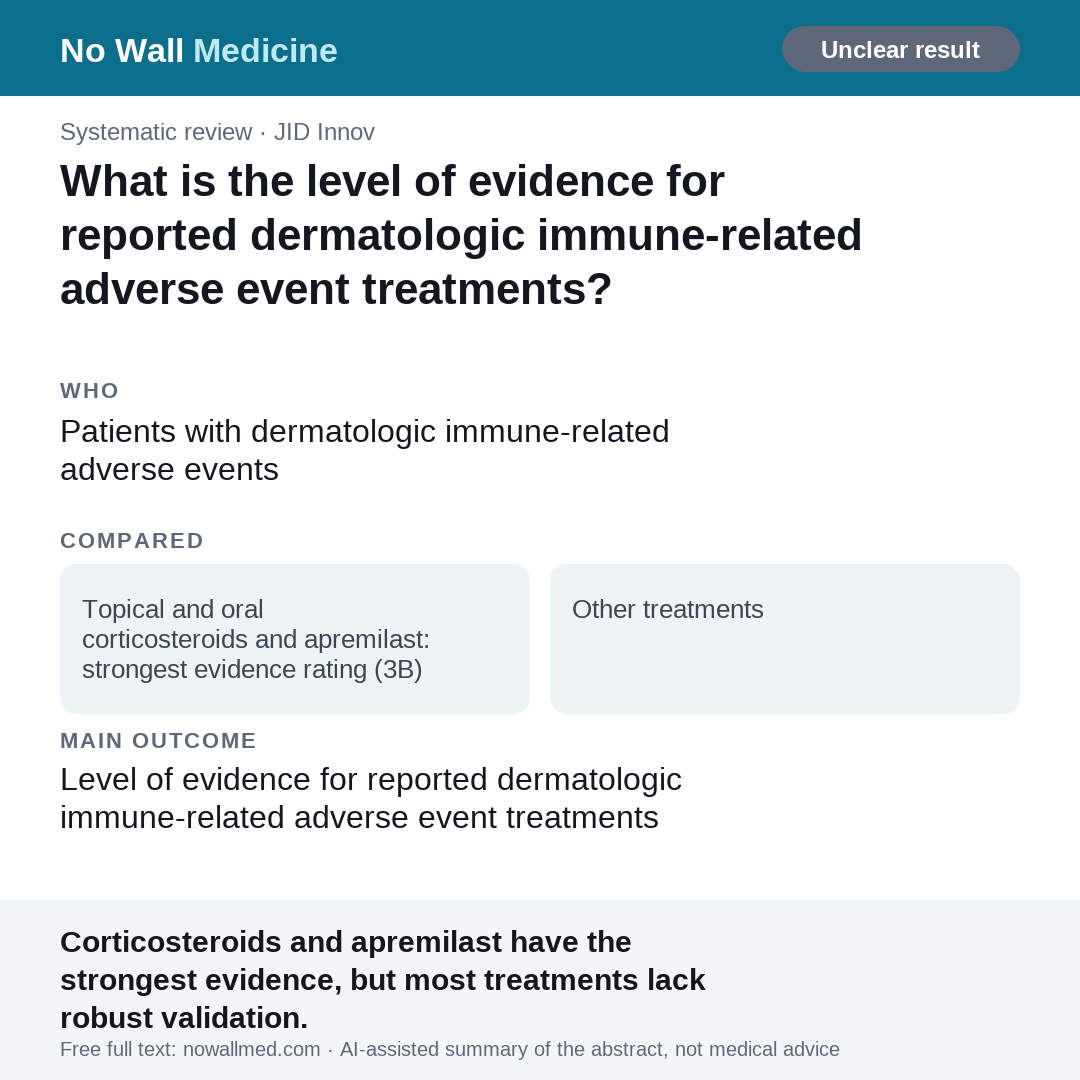
What is the level of evidence for reported dermatologic immune-related adverse event treatments?
Who
Patients with dermatologic immune-related adverse events
Compared
Topical and oral corticosteroids and apremilast: strongest evidence rating (3B)
Other treatments
Main outcome
Level of evidence for reported dermatologic immune-related adverse event treatments
Bottom line: Corticosteroids and apremilast have the strongest evidence, but most treatments lack robust validation.
Limitation: Lack of randomized control trials and prospective cohort studies
JID Innov · 2025-09-02Download image
Clinical question: What is the level of evidence for reported dermatologic immune-related adverse event treatments?
Why it matters: Management of skin side effects from immunotherapy is inconsistent because treatment responses vary and there are no standardized guidelines.
Key points
- Researchers systematically reviewed the level of evidence for various treatments used for dermatologic immune-related adverse events, which are skin side effects from immune checkpoint inhibitor therapy.
- Topical and oral corticosteroids, along with apremilast, received the strongest evidence rating of 3B among the treatments evaluated.
- Most treatments for these skin conditions lack robust validation because of a lack of randomized controlled trials and prospective cohort studies.
Headline and key points written with AI from the paper’s abstract, with every number checked against it. Read the paper before relying on them.
Was this summary helpful?
Cite this article
Bailey-Burke CL, Tissera KA, Baughman L, Polly SA, Kheterpal M. Assessing Treatment Efficacy for Dermatologic Immune-Related Adverse Events: A Systematic Review. JID Innov. 2025. doi:10.1016/j.xjidi.2025.100410
Spotted a mistake? Suggest a correction