Assessing Treatment Efficacy for Dermatologic Immune-Related Adverse Events: A Systematic Review
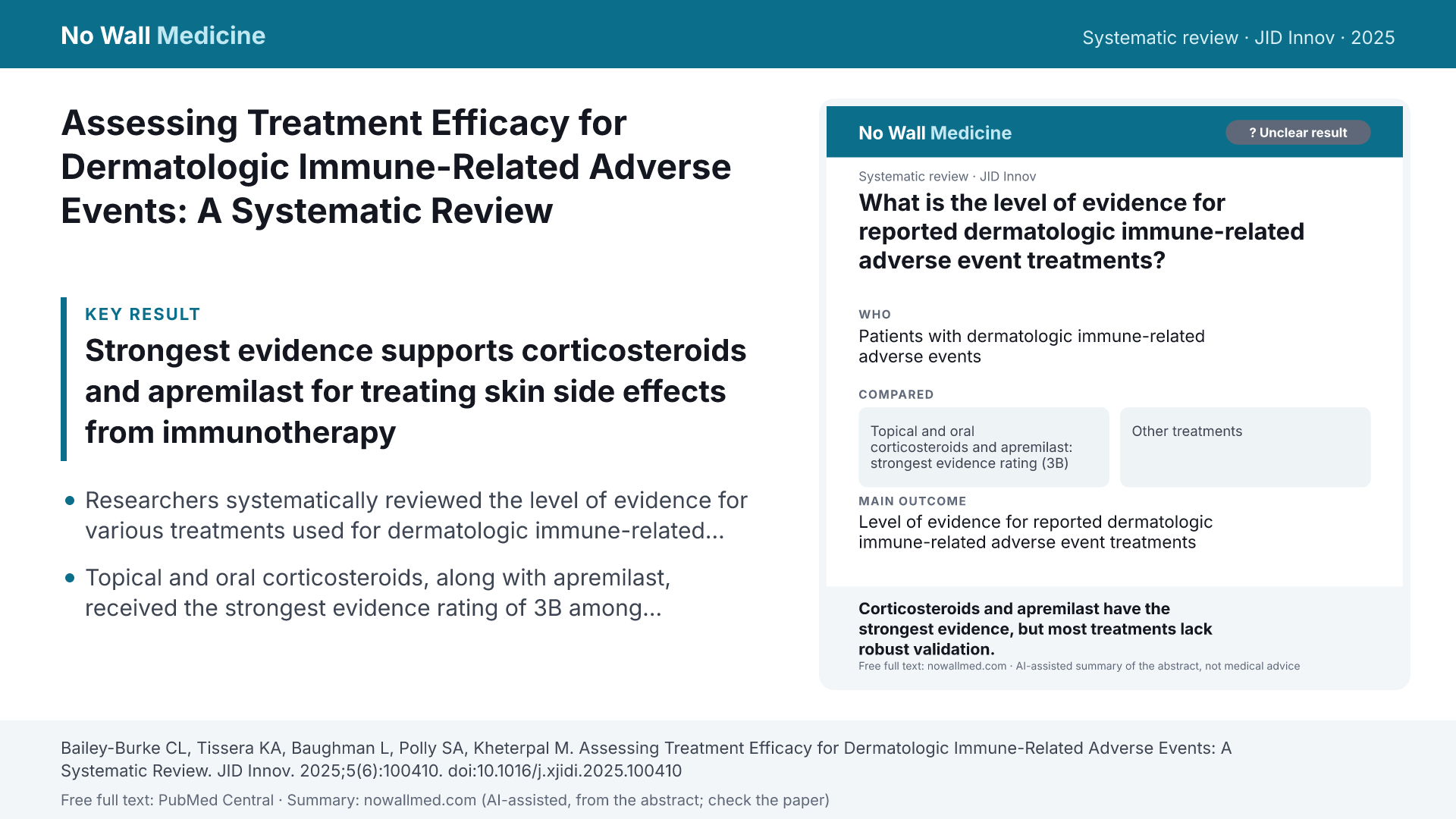
Key result: Strongest evidence supports corticosteroids and apremilast for treating skin side effects from immunotherapy
Systematic reviewUnclear result
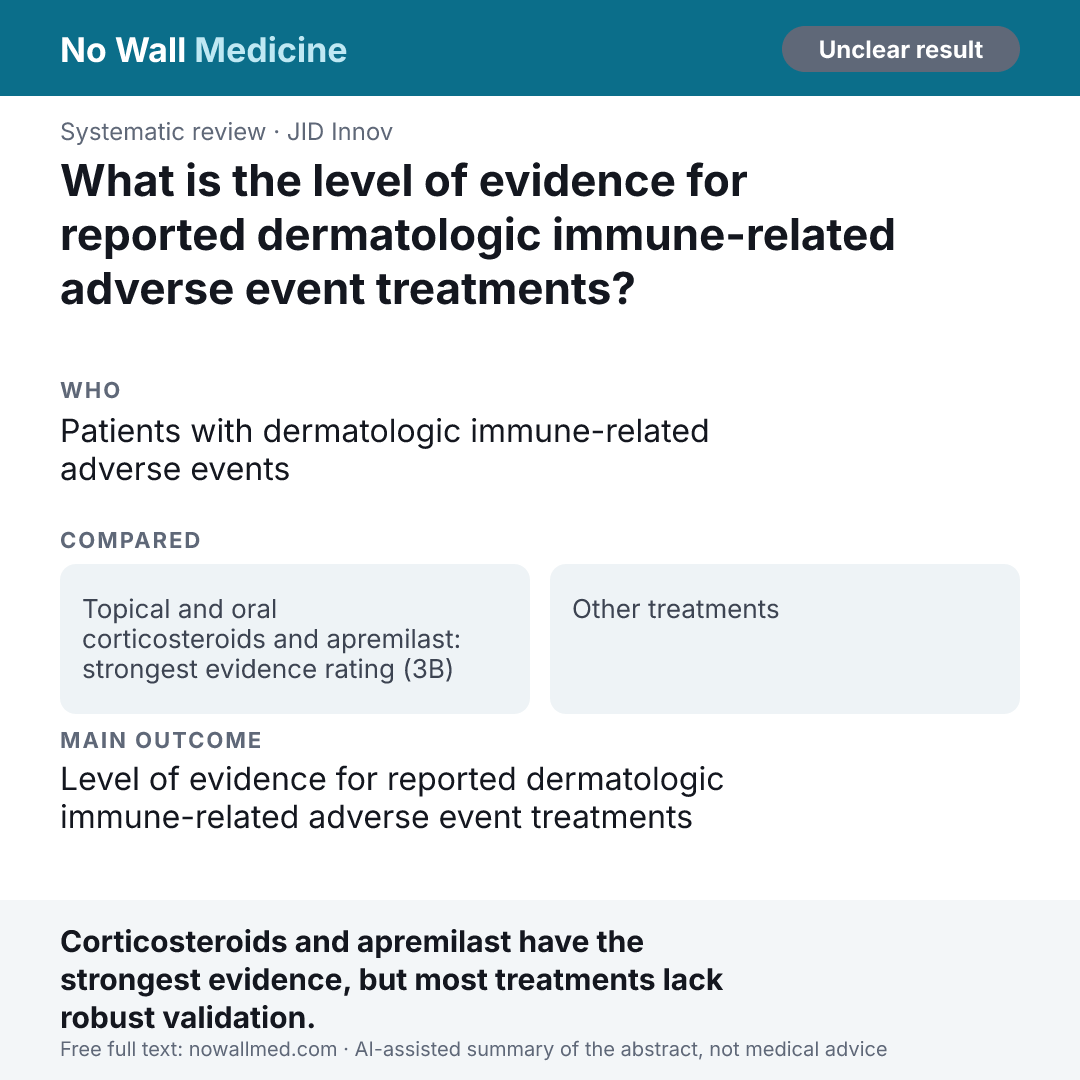
What is the level of evidence for reported dermatologic immune-related adverse event treatments?
Who
Patients with dermatologic immune-related adverse events
Compared
Topical and oral corticosteroids and apremilast: strongest evidence rating (3B)
Other treatments
Main outcome
Level of evidence for reported dermatologic immune-related adverse event treatments
Bottom line: Corticosteroids and apremilast have the strongest evidence, but most treatments lack robust validation.
Limitation: Lack of randomized control trials and prospective cohort studies
JID Innov · 2025-09-02 · Save PNG
Key points
- Researchers systematically reviewed the level of evidence for various treatments used for dermatologic immune-related adverse events, which are skin side effects from immune checkpoint inhibitor therapy.
- Topical and oral corticosteroids, along with apremilast, received the strongest evidence rating of 3B among the treatments evaluated.
- Most treatments for these skin conditions lack robust validation because of a lack of randomized controlled trials and prospective cohort studies.
Why it matters: Management of skin side effects from immunotherapy is inconsistent because treatment responses vary and there are no standardized guidelines.
Discussion prompts
- Would these patients look like yours? Who was left out?
- Is the main outcome one that matters to patients?
- Is the difference large enough to change what you do?
Cite: Bailey-Burke CL, Tissera KA, Baughman L, Polly SA, Kheterpal M. Assessing Treatment Efficacy for Dermatologic Immune-Related Adverse Events: A Systematic Review. JID Innov. 2025;5(6):100410. doi:10.1016/j.xjidi.2025.100410
Free full text: PubMed Central · Summary and visual abstract: nowallmed.com/a/assessing-treatment-efficacy-for-dermatologic-immune-related-adverse-oqk61g/ (AI-assisted from the abstract; check the paper before relying on it).