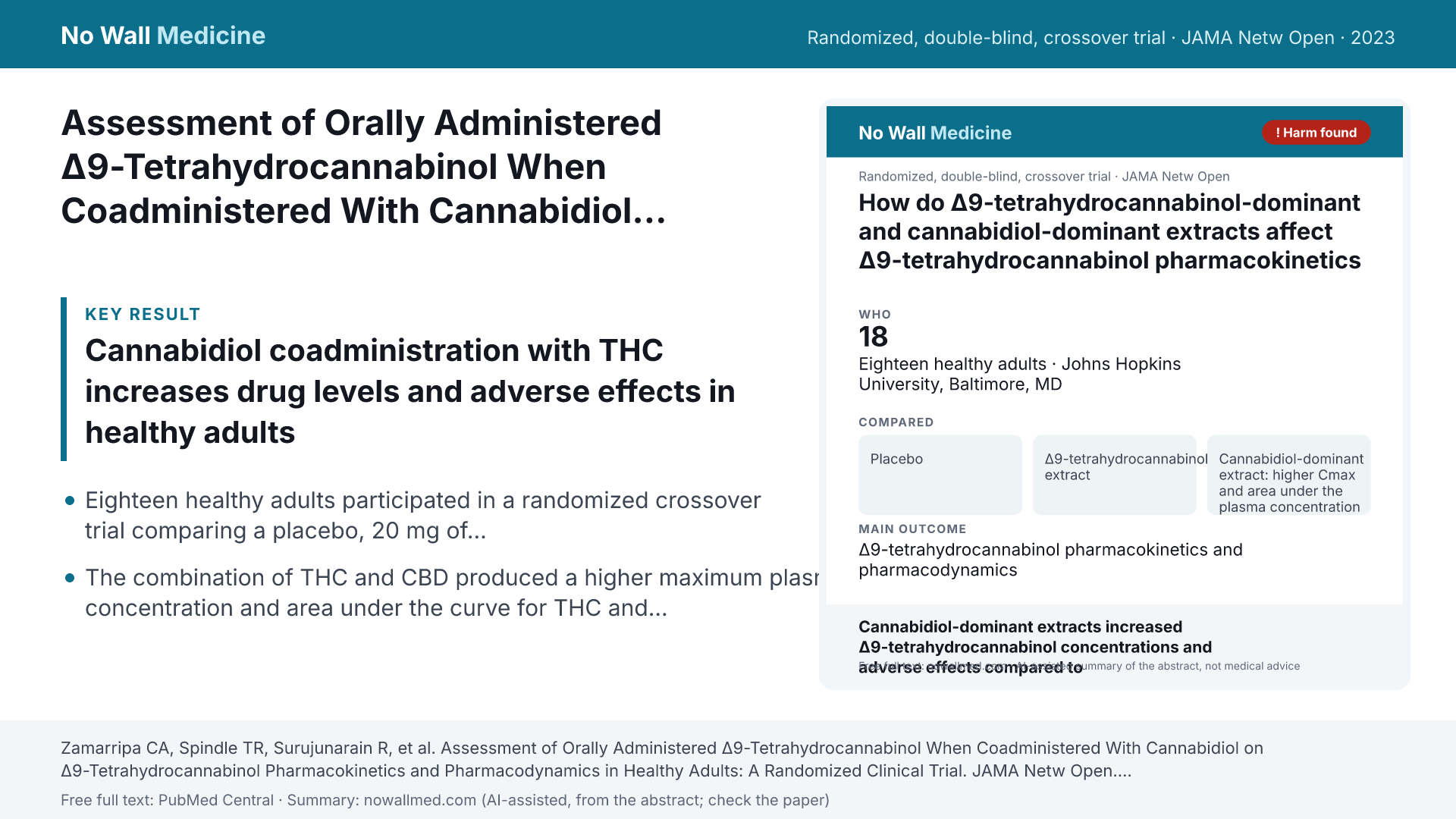
Cannabidiol coadministration with THC increases drug levels and adverse effects in healthy adults
Assessment of Orally Administered Δ9-Tetrahydrocannabinol When Coadministered With Cannabidiol on Δ9-Tetrahydrocannabinol Pharmacokinetics and Pharmacodynamics in Healthy Adults: A Randomized Clinical Trial
Randomized, double-blind, crossover trialHarm found
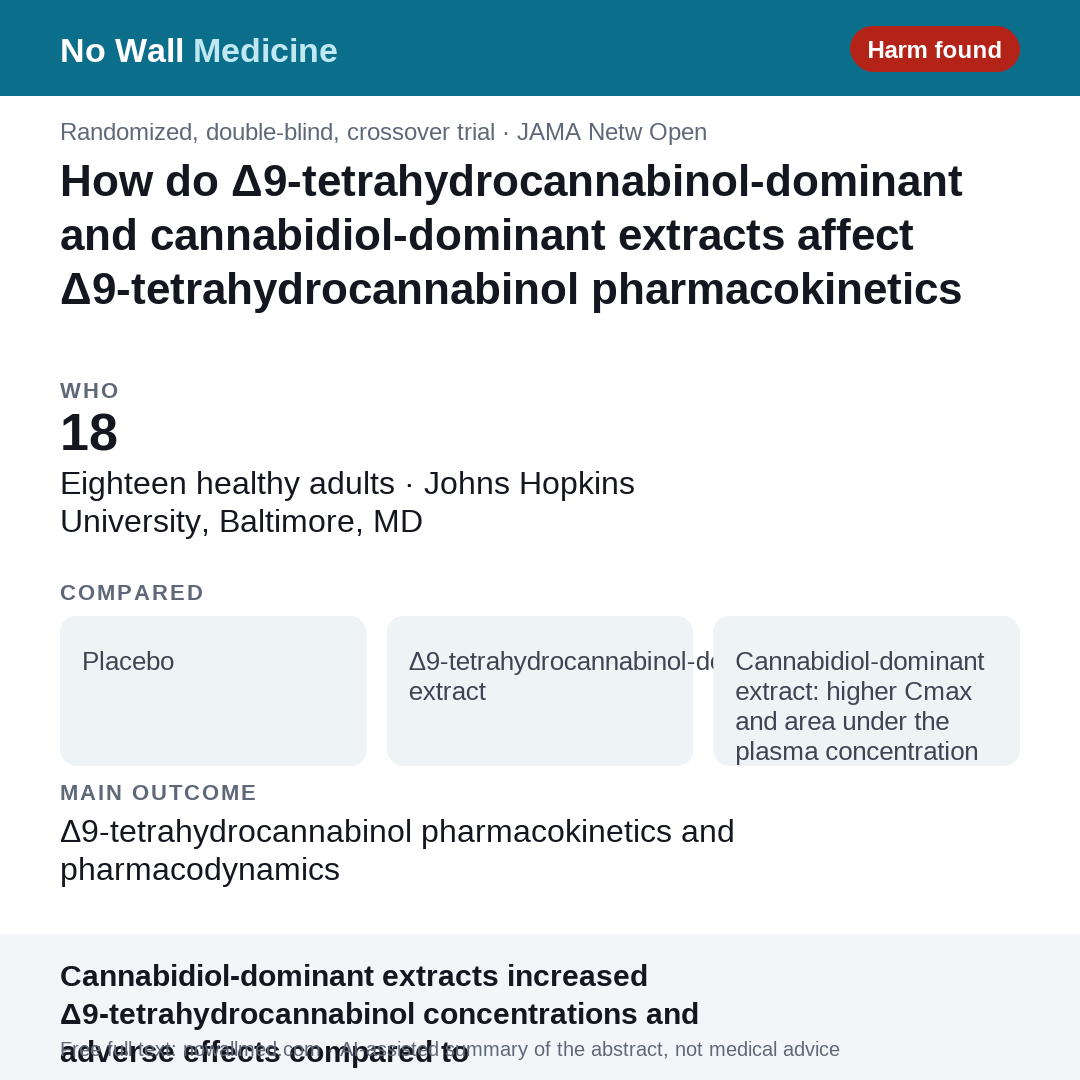
How do Δ9-tetrahydrocannabinol-dominant and cannabidiol-dominant extracts affect Δ9-tetrahydrocannabinol pharmacokinetics and pharmacodynamics?
Who
18
Eighteen healthy adults · Johns Hopkins University, Baltimore, MD
Compared
Placebo
Δ9-tetrahydrocannabinol-dominant extract
Cannabidiol-dominant extract: higher Cmax and area under the plasma concentration vs time curve
Main outcome
Δ9-tetrahydrocannabinol pharmacokinetics and pharmacodynamics
Bottom line: Cannabidiol-dominant extracts increased Δ9-tetrahydrocannabinol concentrations and adverse effects compared to Δ9-tetrahydrocannabinol-dominant extracts at the same dose.
JAMA Netw Open · 2023-02-01Download image
Clinical question: How do Δ9-tetrahydrocannabinol-dominant and cannabidiol-dominant extracts affect Δ9-tetrahydrocannabinol pharmacokinetics and pharmacodynamics?
Why it matters: It is unknown how different concentrations of THC and CBD in oral cannabis extracts affect the way the body processes THC and its subsequent effects.
Key points
- Eighteen healthy adults participated in a randomized crossover trial comparing a placebo, 20 mg of Δ9-tetrahydrocannabinol (THC) alone, and 20 mg of THC with 640 mg of cannabidiol (CBD).
- The combination of THC and CBD produced a higher maximum plasma concentration and area under the curve for THC and its metabolites compared to THC alone.
- The CBD-dominant extract was associated with increased self-reported anxiety, sedation, and memory difficulty, as well as increased heart rate and impaired cognitive and psychomotor performance.
Headline and key points written with AI from the paper’s abstract, with every number checked against it. Read the paper before relying on them.
Was this summary helpful?
Subject terms
Cite this article
Zamarripa CA, Spindle TR, Surujunarain R, et al. Assessment of Orally Administered Δ9-Tetrahydrocannabinol When Coadministered With Cannabidiol on Δ9-Tetrahydrocannabinol Pharmacokinetics and Pharmacodynamics in Healthy Adults: A Randomized Clinical Trial. JAMA Netw Open. 2023. doi:10.1001/jamanetworkopen.2022.54752
Spotted a mistake? Suggest a correction