Assisted fluid management increased sublingual microvascular flow during high-risk abdominal surgery
Assisted Fluid Management and Sublingual Microvascular Flow During High-Risk Abdominal Surgery: A Randomized Controlled Trial
Randomized, patient and assessor-blinded, superiority studyBenefit found
Does assisted fluid management improve sublingual microvascular flow during high-risk abdominal surgery?
Who
86
Patients undergoing high-risk abdominal surgery requiring arterial catheter and uncalibrated stroke volume monitoring · Bicenter
Compared
Assisted fluid management guided goal-directed fluid therapy: 2.89 [2.84-2.94]
Standard goal-directed fluid therapy: 2.59 [2.38-2.78]
Main outcome
Average intraoperative microvascular flow index
Result: median difference 0.30; 95% confidence interval [CI], 0.19-0.49
Bottom line: Assisted fluid management guided goal-directed fluid therapy resulted in higher sublingual microvascular flow during surgery.
Anesth Analg · 2024-08-08Download image
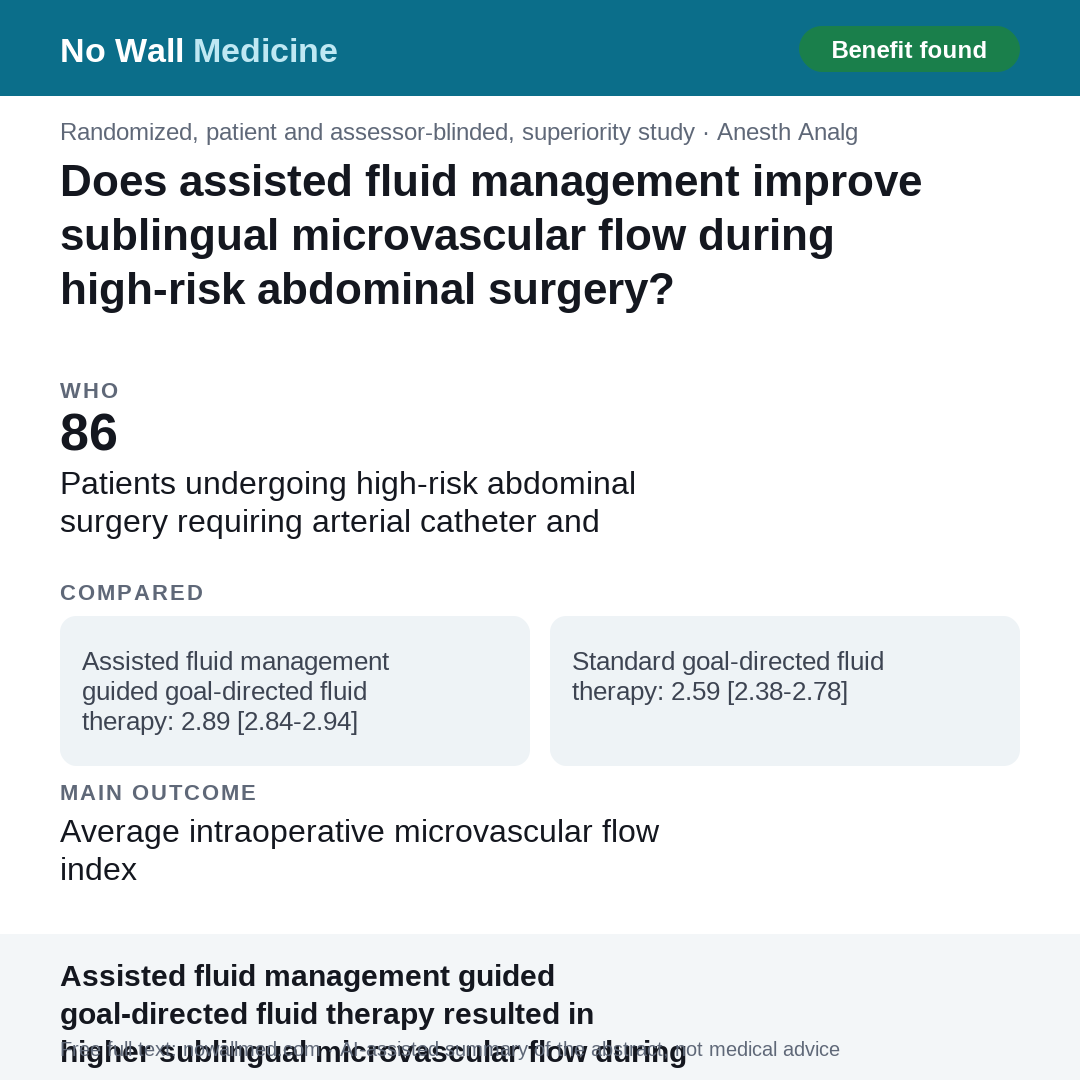
Clinical question: Does assisted fluid management improve sublingual microvascular flow during high-risk abdominal surgery?
Why it matters: It is unknown if using a decision support tool to guide fluid therapy improves sublingual microvascular flow, which is the blood flow in the tiny vessels under the tongue.
Key points
- Researchers randomized 86 patients undergoing high-risk abdominal surgery to receive either standard goal-directed fluid therapy or assisted fluid management using a decision support tool.
- The assisted management group had a higher median microvascular flow index of 2.89 compared to 2.59 in the standard group.
- Patients using the assisted system had higher cardiac index values and lower end-of-surgery arterial lactate concentrations than those receiving standard therapy.
Headline and key points written with AI from the paper’s abstract, with every number checked against it. Read the paper before relying on them.
Topics
Cite this article
Coeckelenbergh S, Entzeroth M, Van der Linden P, Flick M, Soucy-Proulx M, Alexander B. Assisted Fluid Management and Sublingual Microvascular Flow During High-Risk Abdominal Surgery: A Randomized Controlled Trial. Anesth Analg. 2024. doi:10.1213/ANE.0000000000007097
Spotted a mistake? Suggest a correction
Top studies every Monday
The week’s key trials and guidelines in your specialties, plus any topics you follow. By email, free.
Get the weekly digest