Maintaining optimized cardiac index was associated with more complications after major open abdominal surgery
Cardiac index-guided therapy to maintain optimised postinduction cardiac index in high-risk patients having major open abdominal surgery: the multicentre randomised iPEGASUS trial
Multicentre randomised trialHarm found
Does maintaining optimised postinduction cardiac index reduce postoperative complications in high-risk abdominal surgery patients?
Who
318
High-risk patients having elective major open abdominal surgery · Three German and two Spanish centres
Compared
cardiac index-guided therapy: 84 of 152 subjects (55%)
routine care: 77 of 166 subjects (46%)
Main outcome
incidence of moderate or severe complications within 28 days
Result: odds ratio 1.87 (95% confidence interval 1.03-3.39)
Bottom line: Maintaining optimised postinduction cardiac index may increase the incidence of complications compared to routine care.
Br J Anaesth · 2024-05-26Download image
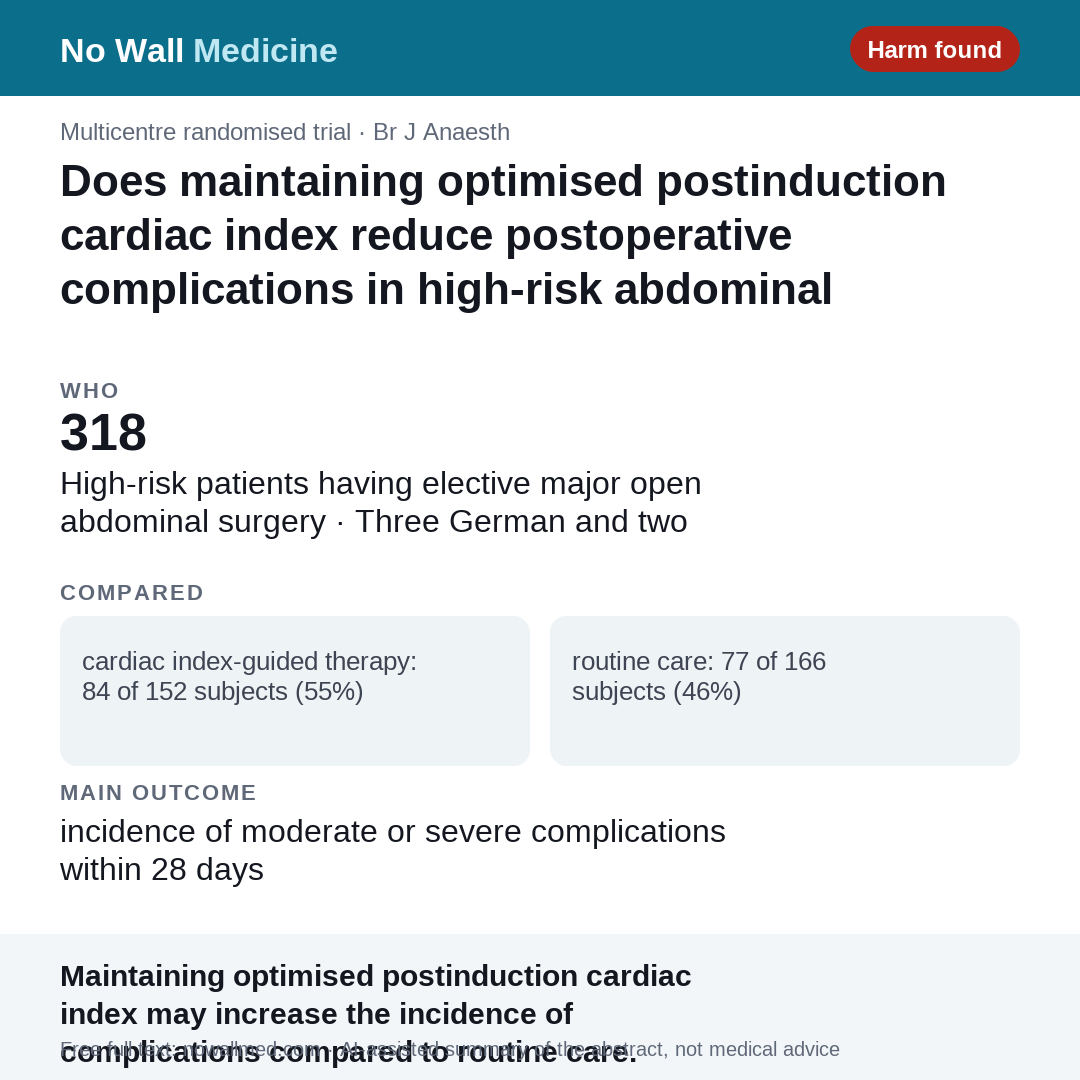
Clinical question: Does maintaining optimised postinduction cardiac index reduce postoperative complications in high-risk abdominal surgery patients?
Why it matters: It is unclear whether optimizing the cardiac index, which is the amount of blood the heart pumps per minute relative to body size, reduces postoperative complications.
Key points
- Researchers studied 318 high-risk patients undergoing elective major open abdominal surgery across five centers in Germany and Spain.
- The composite outcome of moderate or severe complications within 28 days occurred in 55% of patients receiving cardiac index-guided therapy compared to 46% in routine care.
- The primary outcome showed an odds ratio of 1.87 with a 95% confidence interval of 1.03-3.39 and a P value of 0.038.
Headline and key points written with AI from the paper’s abstract, with every number checked against it. Read the paper before relying on them.
Topics
Cite this article
Funcke S, Schmidt G, Bergholz A, Argente Navarro P, Azparren Cabezón G, Barbero-Espinosa S. Cardiac index-guided therapy to maintain optimised postinduction cardiac index in high-risk patients having major open abdominal surgery: the multicentre randomised iPEGASUS trial. Br J Anaesth. 2024. doi:10.1016/j.bja.2024.03.040
Spotted a mistake? Suggest a correction
Top studies every Monday
The week’s key trials and guidelines in your specialties, plus any topics you follow. By email, free.
Get the weekly digest