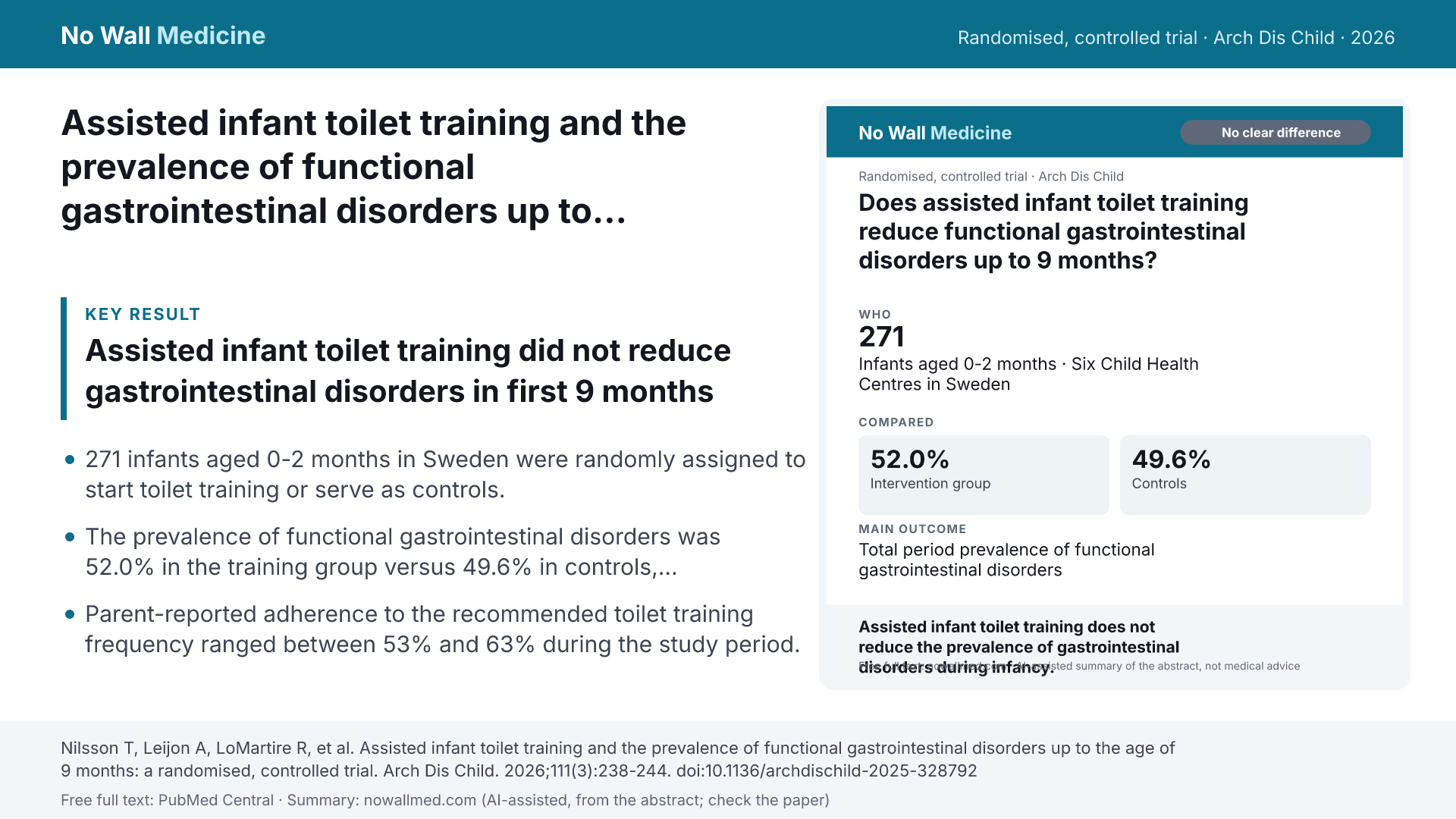
Assisted infant toilet training did not reduce gastrointestinal disorders in first 9 months
Assisted infant toilet training and the prevalence of functional gastrointestinal disorders up to the age of 9 months: a randomised, controlled trial
Randomised, controlled trialNo clear difference
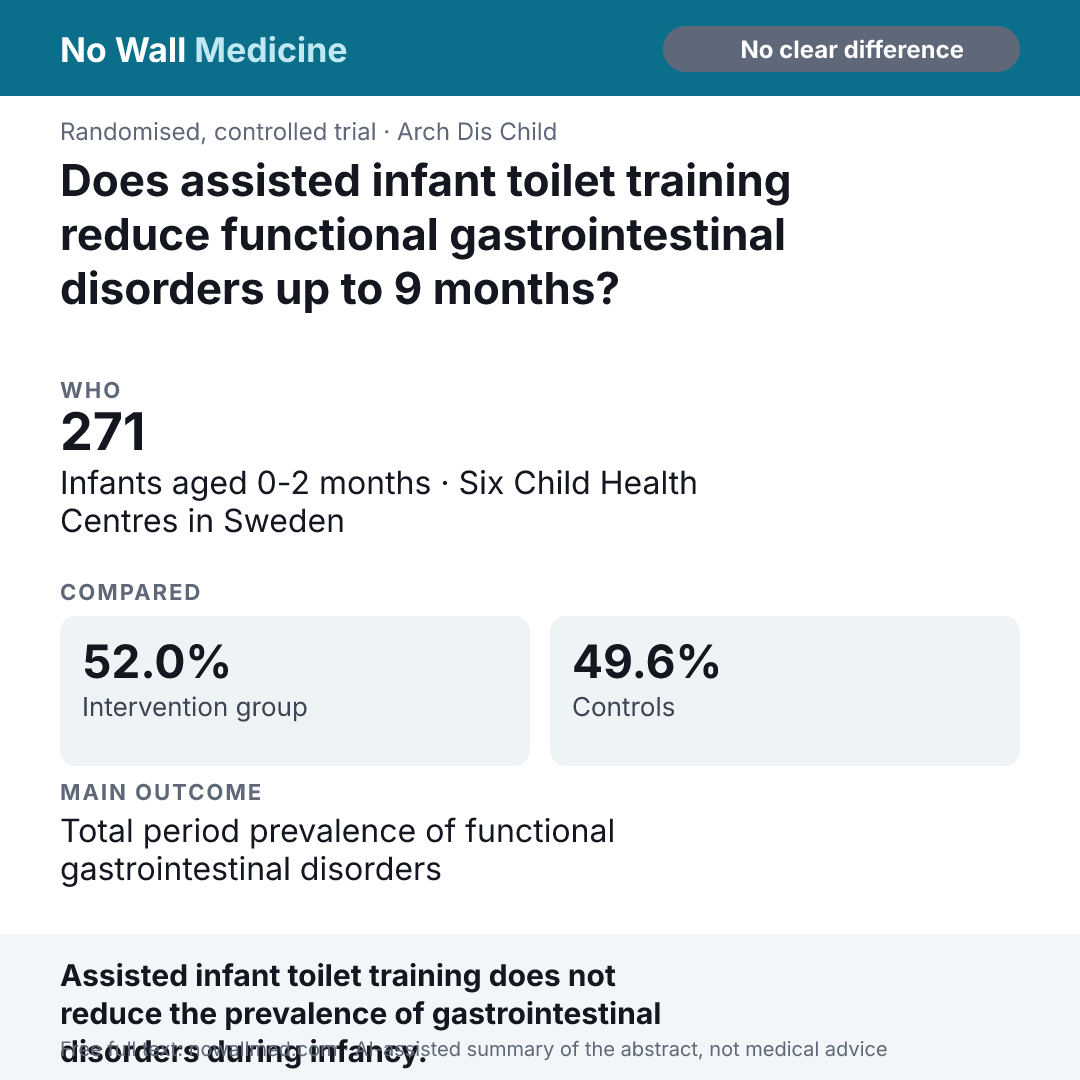
Does assisted infant toilet training reduce functional gastrointestinal disorders up to 9 months?
Who
271
Infants aged 0-2 months · Six Child Health Centres in Sweden
Compared
52.0%Intervention group
49.6%Controls
Main outcome
Total period prevalence of functional gastrointestinal disorders
Result: difference 2.4% (95% CI -9.8 to 14.7)
Bottom line: Assisted infant toilet training does not reduce the prevalence of gastrointestinal disorders during infancy.
Arch Dis Child · 2026-02-19 · NCT04082689
Why it matters: It is suggested that late initiation of toilet training contributes to functional gastrointestinal disorders in children.
Headline and visual abstract written with AI from the paper’s abstract, with every number checked against it. Read the paper before relying on them.
Was this summary helpful?
Abstract
Background
It is suggested that late initiation of toilet training contributes to functional gastrointestinal disorders in children. This study aims to evaluate if assisted infant toilet training can reduce the prevalence of functional gastrointestinal disorders during the first 9 months of life. Methods
The ongoing Bowel And Bladder function in Infant Toilet Training (BABITT) study is a randomised, controlled trial that recruited infants aged 0-2 months at six Child Health Centres in Sweden. Infants were randomly assigned (1:1) to either start parent-assisted infant toilet training at the age of 0-2 months (intervention) or as controls. The intervention group was encouraged to practise at a moderate frequency of 1-3 times/day, 5-7 days/week. A validated web questionnaire was answered at ages 2, 3, 6 and 9 months. Results
271 infants (145 males, 54%) were randomly assigned at median age of 34 days (136 intervention; 135 controls). The intention-to-treat analysis with complete cases (127 intervention; 132 controls) showed no difference in the total period prevalence of functional gastrointestinal disorders (infant colic, infant dyschezia and/or functional constipation, defined by Rome IV criteria) between the intervention group and controls (52.0% vs 49.6%, difference 2.4% (95% CI -9.8 to 14.7); p=0.6956) up to the age of 9 months. Parent-reported intervention adherence ranged between 53% and 63%. Conclusions
This study does not support that assisted infant toilet training, practised at a moderate frequency, reduces the prevalence of gastrointestinal disorders during infancy. Long-term effects are being evaluated in the ongoing BABITT study up to the age of 4 years. Trial registration number
NCT04082689.
Abstract reproduced under the article’s CC BY NC licence.
Subject terms
Cite this article
Nilsson T, Leijon A, LoMartire R, et al. Assisted infant toilet training and the prevalence of functional gastrointestinal disorders up to the age of 9 months: a randomised, controlled trial. Arch Dis Child. 2026;111(3):238-244. doi:10.1136/archdischild-2025-328792
Spotted a mistake? Suggest a correction