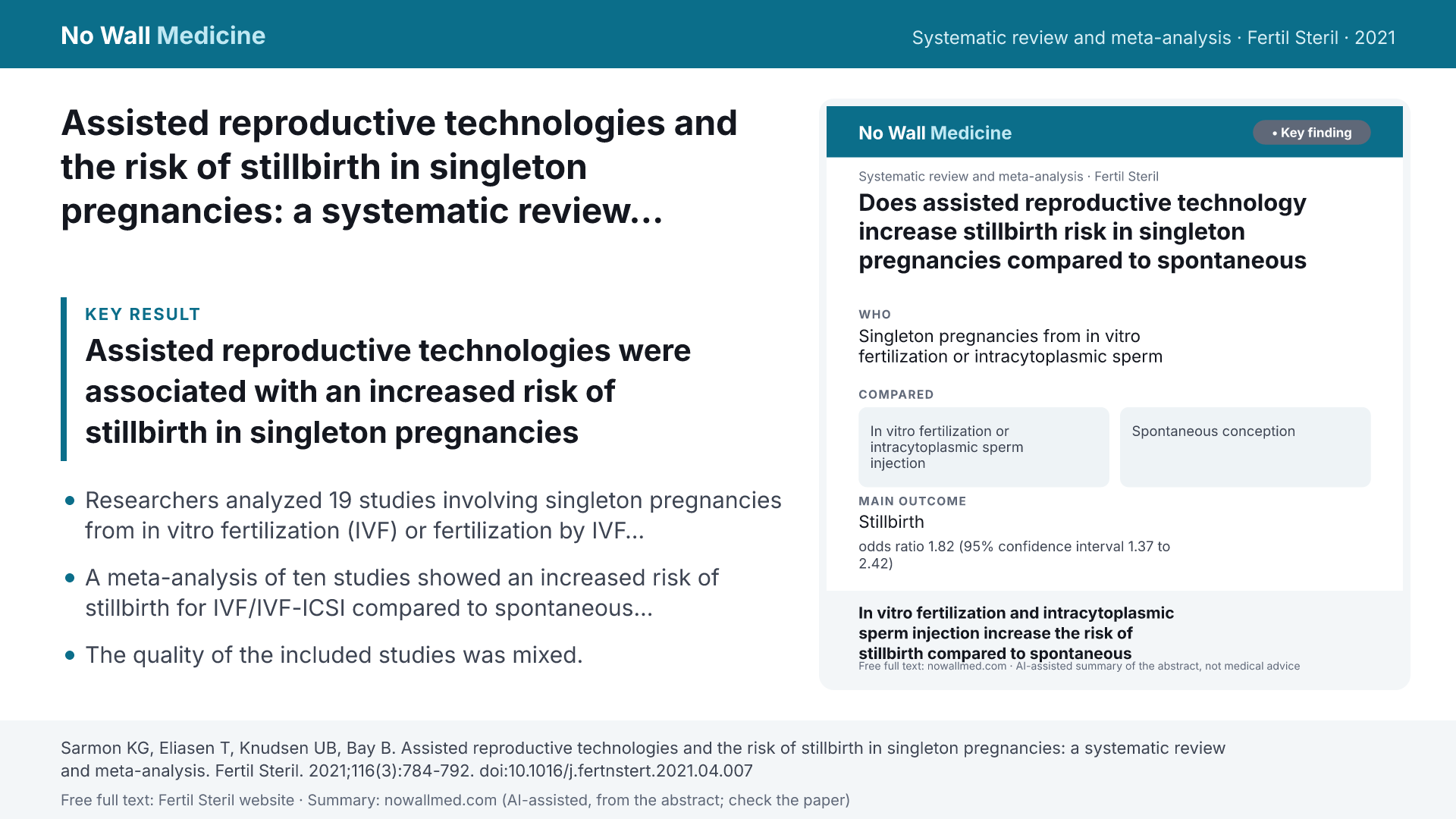
Assisted reproductive technologies were associated with an increased risk of stillbirth in singleton pregnancies
Assisted reproductive technologies and the risk of stillbirth in singleton pregnancies: a systematic review and meta-analysis
Systematic review and meta-analysisKey finding
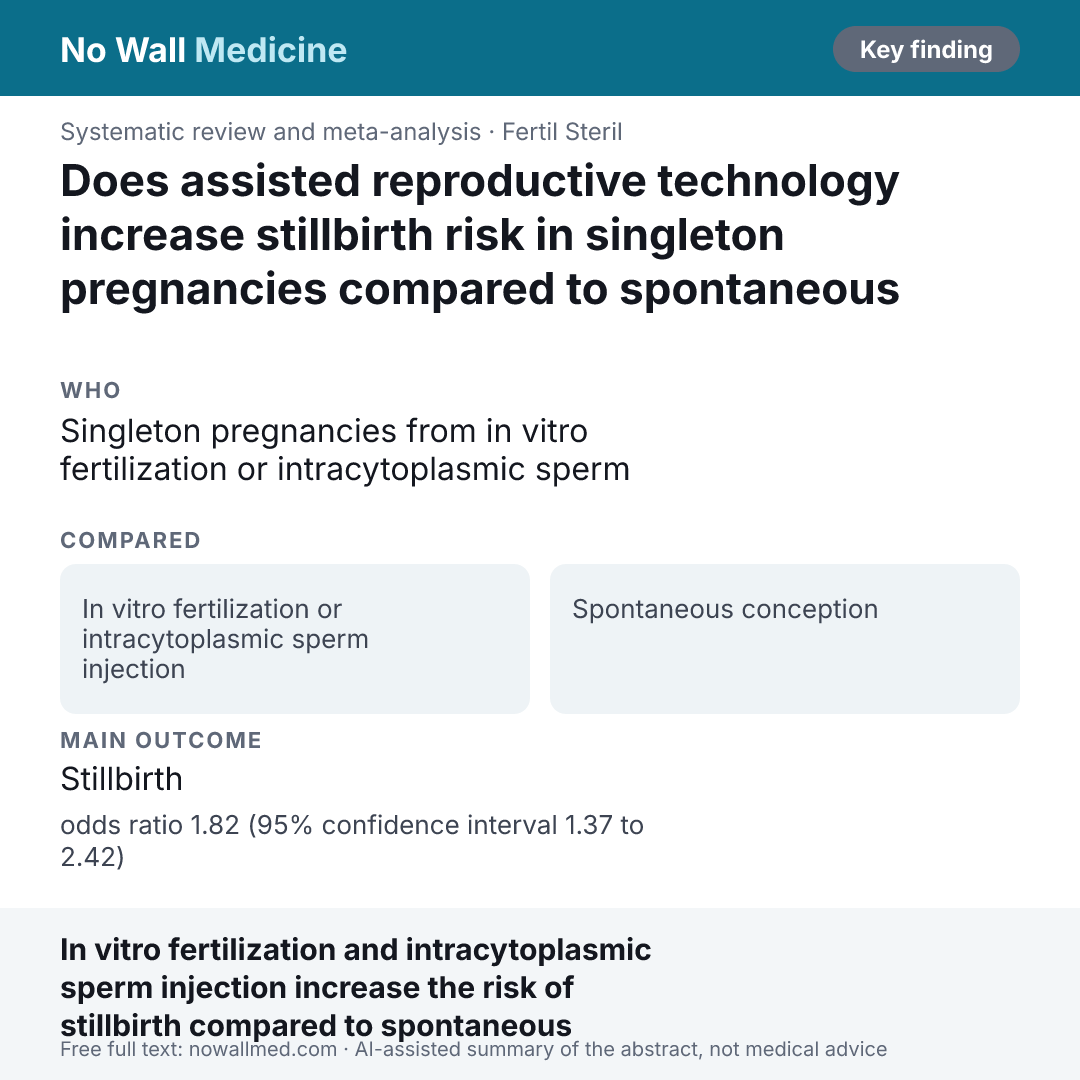
Does assisted reproductive technology increase stillbirth risk in singleton pregnancies compared to spontaneous conception?
Who
Singleton pregnancies from in vitro fertilization or intracytoplasmic sperm injection
Compared
In vitro fertilization or intracytoplasmic sperm injection
Spontaneous conception
Main outcome
Stillbirth
Result: odds ratio 1.82 (95% confidence interval 1.37 to 2.42)
Bottom line: In vitro fertilization and intracytoplasmic sperm injection increase the risk of stillbirth compared to spontaneous conception.
Limitation: Study quality was mixed.
Fertil Steril · 2021-05-20 · Save PNG
Clinical question: Does assisted reproductive technology increase stillbirth risk in singleton pregnancies compared to spontaneous conception?
Why it matters: The risk of stillbirth in singleton pregnancies resulting from in vitro fertilization or intracytoplasmic sperm injection compared to natural conception was not clearly established.
Key points
- Researchers analyzed 19 studies involving singleton pregnancies from in vitro fertilization (IVF) or fertilization by IVF and intracytoplasmic sperm injection (ICSI) compared to spontaneous conception.
- A meta-analysis of ten studies showed an increased risk of stillbirth for IVF/IVF-ICSI compared to spontaneous conception with an odds ratio of 1.82 (95% confidence interval: 1.37-2.42).
- The quality of the included studies was mixed.
Limitation the authors note: The study quality was mixed.
Headline and key points written with AI from the paper’s abstract, with every number checked against it. Read the paper before relying on them.
Was this summary helpful?
Subject terms
Headline, design, result, key points, caveat and citation as plain text.
Cite this article
Sarmon KG, Eliasen T, Knudsen UB, Bay B. Assisted reproductive technologies and the risk of stillbirth in singleton pregnancies: a systematic review and meta-analysis. Fertil Steril. 2021;116(3):784-792. doi:10.1016/j.fertnstert.2021.04.007
Spotted a mistake? Suggest a correction