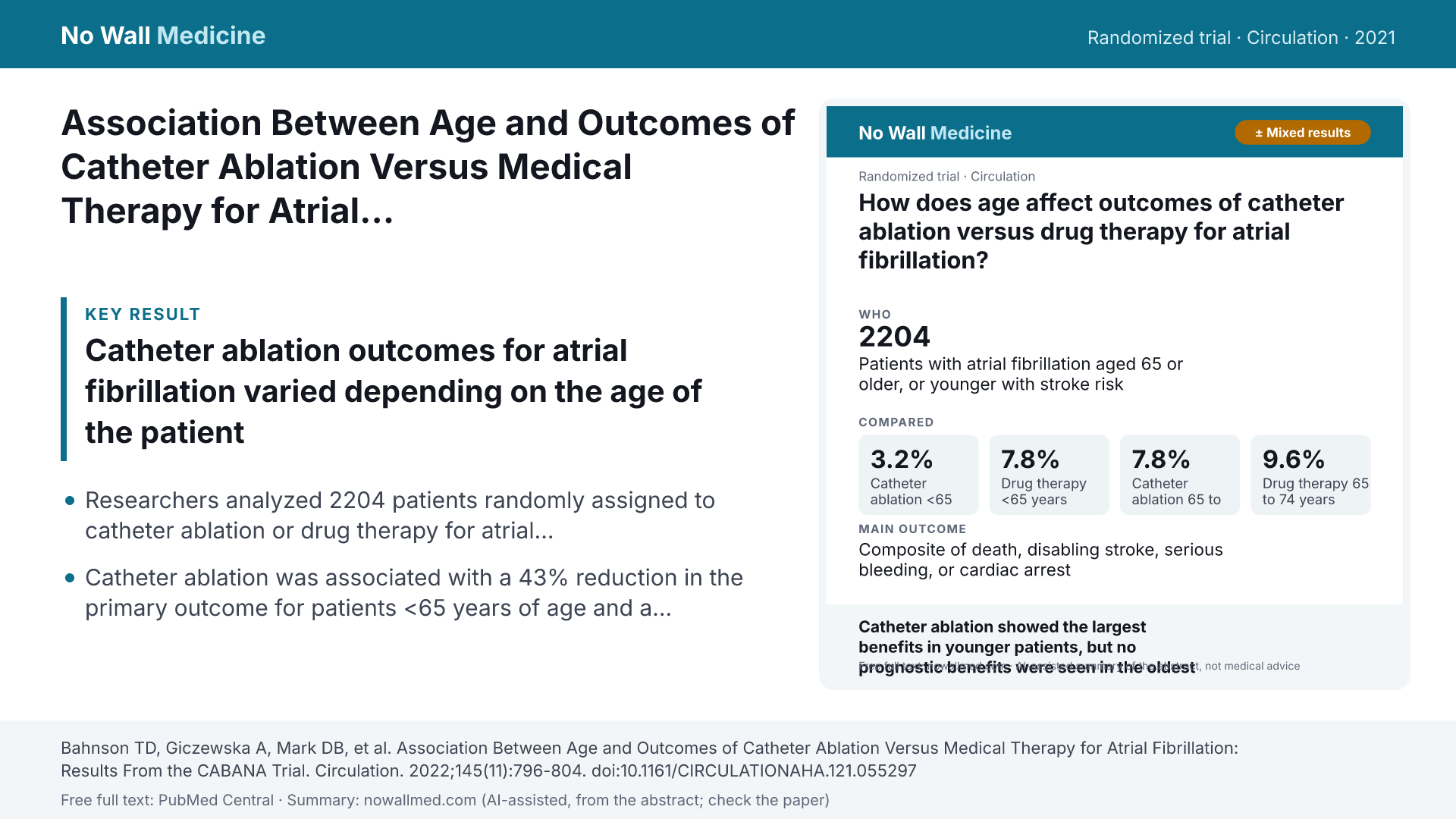
Catheter ablation outcomes for atrial fibrillation varied depending on the age of the patient
Association Between Age and Outcomes of Catheter Ablation Versus Medical Therapy for Atrial Fibrillation: Results From the CABANA Trial
Randomized trialMixed results
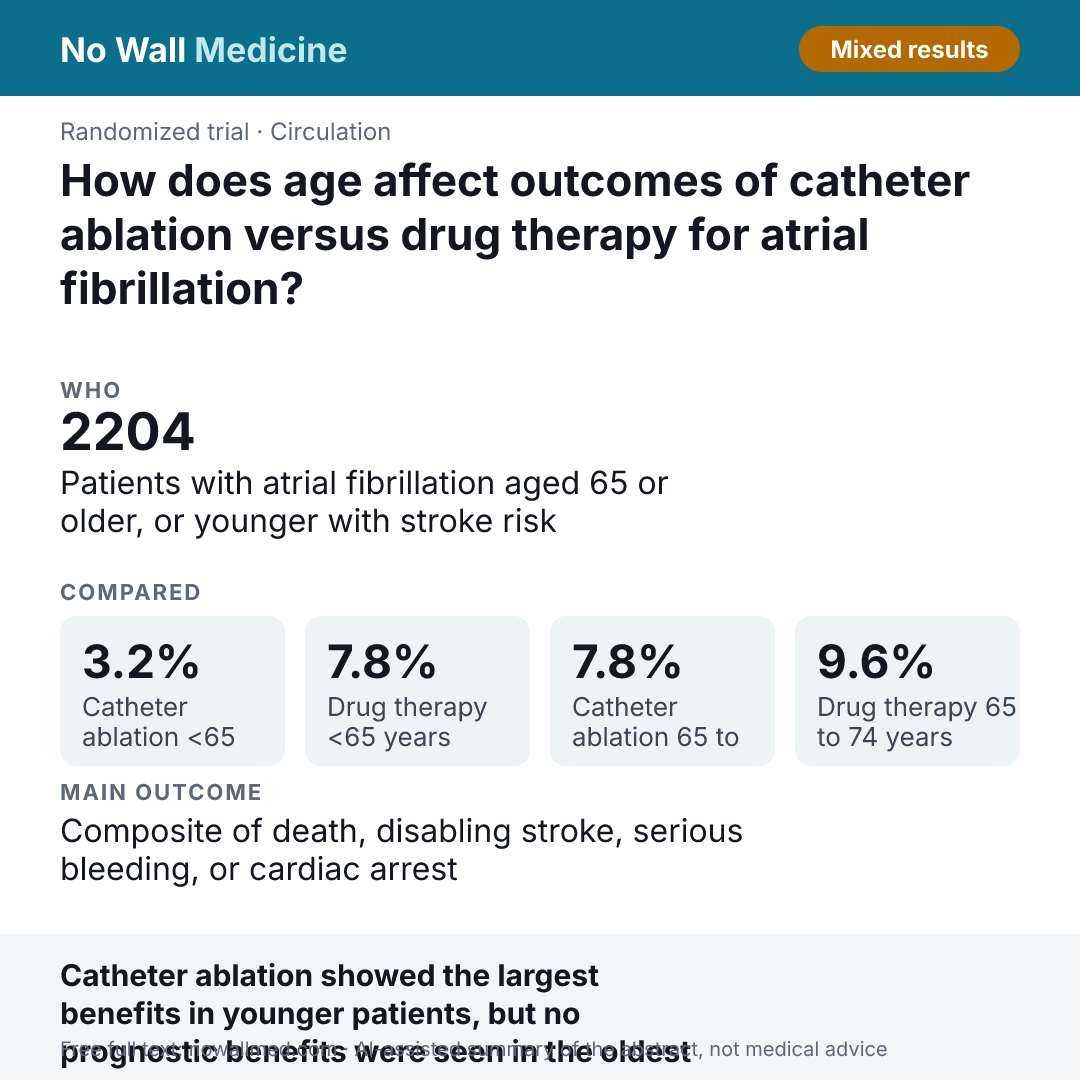
How does age affect outcomes of catheter ablation versus drug therapy for atrial fibrillation?
Who
2204
Patients with atrial fibrillation aged 65 or older, or younger with stroke risk
Compared
3.2%Catheter ablation <65 years
7.8%Drug therapy <65 years
7.8%Catheter ablation 65 to 74 years
9.6%Drug therapy 65 to 74 years
Main outcome
Composite of death, disabling stroke, serious bleeding, or cardiac arrest
Result: aHR 0.57 (95% CI 0.30-1.09) for <65, aHR 0.79 (95% CI 0.54-1.16) for 65-74, aHR 1.39 (95% CI 0.75-2.58) for ≥75
Bottom line: Catheter ablation showed the largest benefits in younger patients, but no prognostic benefits were seen in the oldest patients.
Circulation · 2021-12-22 · Save PNG
Same trial (NCT00911508)
Papers we list that report this registered trial, oldest first. Read a secondary analysis alongside the main results.
- Secondary analysis Key finding
Catheter ablation was associated with better outcomes than drug therapy for racial and ethnic minorities JACC 2021-07 - Main results Mixed results
This paper Circulation 2021-12 - Related analysis Benefit found
Catheter ablation improved quality of life more than drug therapy in men and women J Am Heart Assoc 2023-01 - Secondary analysis Key finding
Atrial fibrillation ablation was associated with better outcomes in patients likely to have heart failure with preserved ejection fraction JACC Heart Fail 2025-04 - Secondary analysis Mixed results
Catheter ablation benefits patients with fewer than three nonmodifiable risk factors for atrial fibrillation recurrence JAMA Netw Open 2025-08 - Secondary analysis Mixed results
Time from atrial fibrillation diagnosis to ablation procedure showed complex links to clinical outcomes BMC Med 2026-01
Clinical question: How does age affect outcomes of catheter ablation versus drug therapy for atrial fibrillation?
Key points
- Researchers analyzed 2204 patients randomly assigned to catheter ablation or drug therapy for atrial fibrillation, categorized into three age groups.
- Catheter ablation was associated with a 43% reduction in the primary outcome for patients <65 years of age and a 21% reduction for those 65 to 74 years of age.
- For patients ≥75 years of age, the effect of catheter ablation on the primary outcome was indeterminate, with four-year event rates of 14.8% versus 9.0%.
Headline and key points written with AI from the paper’s abstract, with every number checked against it. Read the paper before relying on them.
Was this summary helpful?
Subject terms
Headline, design, result, key points, caveat and citation as plain text.
Cite this article
Bahnson TD, Giczewska A, Mark DB, et al. Association Between Age and Outcomes of Catheter Ablation Versus Medical Therapy for Atrial Fibrillation: Results From the CABANA Trial. Circulation. 2021. doi:10.1161/CIRCULATIONAHA.121.055297
Spotted a mistake? Suggest a correction